


Azerbaijan advances just transition in national climate plan
Tripartite constituents and the ILO held a national workshop to align Azerbaijan’s NDC 3.0 with just transition and decent work principles. It continues a series of ILO interventions conducted in 2024 in preparation for COP29 and in 2025 under the South-South and Triangular Cooperation ILO-supported project.
7 August 2025
BAKU (ILO News) — The International Labour Organization (ILO) in collaboration with national partners conducted a National Technical Meeting in Baku to support the integration of just transition principles into Azerbaijan’s third Nationally Determined Contribution (NDC 3.0). A continuation of the conversations initiated under COP29 in collaboration with the Partnership of Action on Green Economy (PAGE) and the Europe and Central Asia issue Based Coalition on Environment and Climate Change (IBC), the event brought together representatives from the Government, employers’ and workers’ organizations, and ILO experts to discuss policy coordination, social dialogue and inclusive climate action.
Shaping Azerbaijan’s green future
The workshop was opened by Fuad Heydarov, Head of the Labour Policy Department at the Ministry of Labour and Social Protection of Population, who outlined Azerbaijan’s efforts to align labour and climate policies under NDC 3.0. He emphasized the importance of collective bargaining, legal reforms and social dialogue in supporting a just transition, including through state programmes on just transition, skills development and the digitization of labour services.
Social partners also shared their perspectives. The National Confederation of Entrepreneurs (Employers) (ASK) highlighted the role of micro, small and medium enterprises (MSMEs) and the importance of enabling environments for green enterprise development. Vuqar Zeynalov, Vice-President of the ASK, also mentioned the role of ASK to support members of the Confederation to improve their skills and capacity-building on just transition.
The Trade Unions Confederation (AHIK) stressed the need to safeguard workers’ rights in the process of just transition. Fuad Alekberov, Advisor to the Chairman of AHIK, outlined a need in effective social dialogue and coordination of all relevant agencies in ensuring just transition and sustainable enterprises’ development.
Mikhail Pouchkin, Director of the ILO Office for Eastern Europe and Central Asia, highlighted the ILO’s longstanding partnership with Azerbaijan and its support for integrating climate and labour policies. “This workshop marks a key milestone as Azerbaijan finalizes its NDC 3.0 ahead of COP30,” said Pouchkin. “It will help ensure that NDC 3.0 reflects the principles of just transition – one that leaves no one behind.”

The sessions featured updates on the formulation of NDC 3.0, highlighting national priorities in water management, sustainable agriculture and climate adaptation. The Ministry of Ecology and Natural Resources underlined Azerbaijan’s greenhouse gas reduction commitments and the need for cross-ministerial cooperation to advance just transition, while the Ministry of Energy pointed to ongoing efforts to expand renewable energy and develop green energy zones in regions undergoing recovery and reconstruction.
Turning plans into action
A lively exchange focused on how to anticipate future skills needs and forecasting methods. Discussions also touched on the challenges of financing just transition, with national participants examining how to advance reforms when resources are limited.
Camilla Roman, Senior Technical Specialist (ILO Priority Action Programme Just transitions towards environmentally sustainable economies and societies) and Rishabh Kumar Dhir, Technical Officer (ILO Department of Sustainable Enterprises, Productivity and Just Transition) presented guidance on including just transition and sustainable enterprise development into climate policy frameworks. Their interventions emphasized the importance of employment-centred climate action, inclusive constituent engagement and coherence across policy instruments.
The participants also discussed the ILO’s Guidance Note Unlocking more and better jobs: Integrating sustainable enterprises for a just transition in Nationally Determined Contributions. It offers practical guidance on what to keep in mind when integrating sustainable enterprises into NDCs for a resilient low-carbon future, including key elements such as social dialogue, enabling environment, responsible business conduct, among other aspects. These insights will spur reflections and serve to inform Azerbaijan’s approach to NDC 3.0 and its broader climate and development agenda.
The workshop concluded with updates on upcoming ILO-supported events. Cristina Martinez (Senior Specialist Enterprise Development and Green Jobs), on behalf of the ILO Regional Office EUROPE introduced the objectives of the Regional Knowledge Sharing Meeting on “Integrating Just Transition Policies in Nationally Determined Contributions through Social Dialogue”, 1-3 October, Budapest, Hungary. Camilla Roman introduced the International Workshop, “Addressing just transition in NDCs: Learning, leading and looking ahead” to be held in Johannesburg, South Africa, 1-2 October. Closing remarks were delivered by representatives of the ILO constituents and participating Ministries, reaffirming Azerbaijan’s commitment to inclusive climate action that advances a just transition for all.
This initiative aligns with the ILO’s regional and global efforts to support countries in integrating the social and employment dimensions into climate policies. Nationally Determined Contributions are central to the Paris Agreement, and including just transition principles ensures that NDCs are a key enabler of climate ambition and a vehicle of sustainable development.

Related content
UN Climate Change Conference, Baku, 11-22 November 2024
ILO at COP29
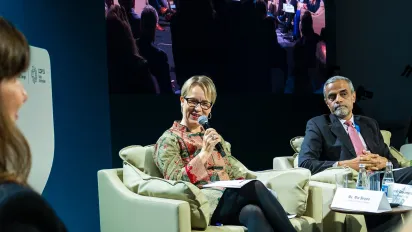
COP29
ILO facilitates COP29 talks highlighting role of skills development in a just transition to environmental sustainability

ILO Guidance Note
Unlocking more and better jobs: Integrating sustainable enterprises for a just transition in Nationally Determined Contributions