

Armenia strengthens employment services through nationwide training
Employment specialists across Armenia build skills in supporting jobseekers, engaging employers and improving job placement with ILO support.
8 May 2026
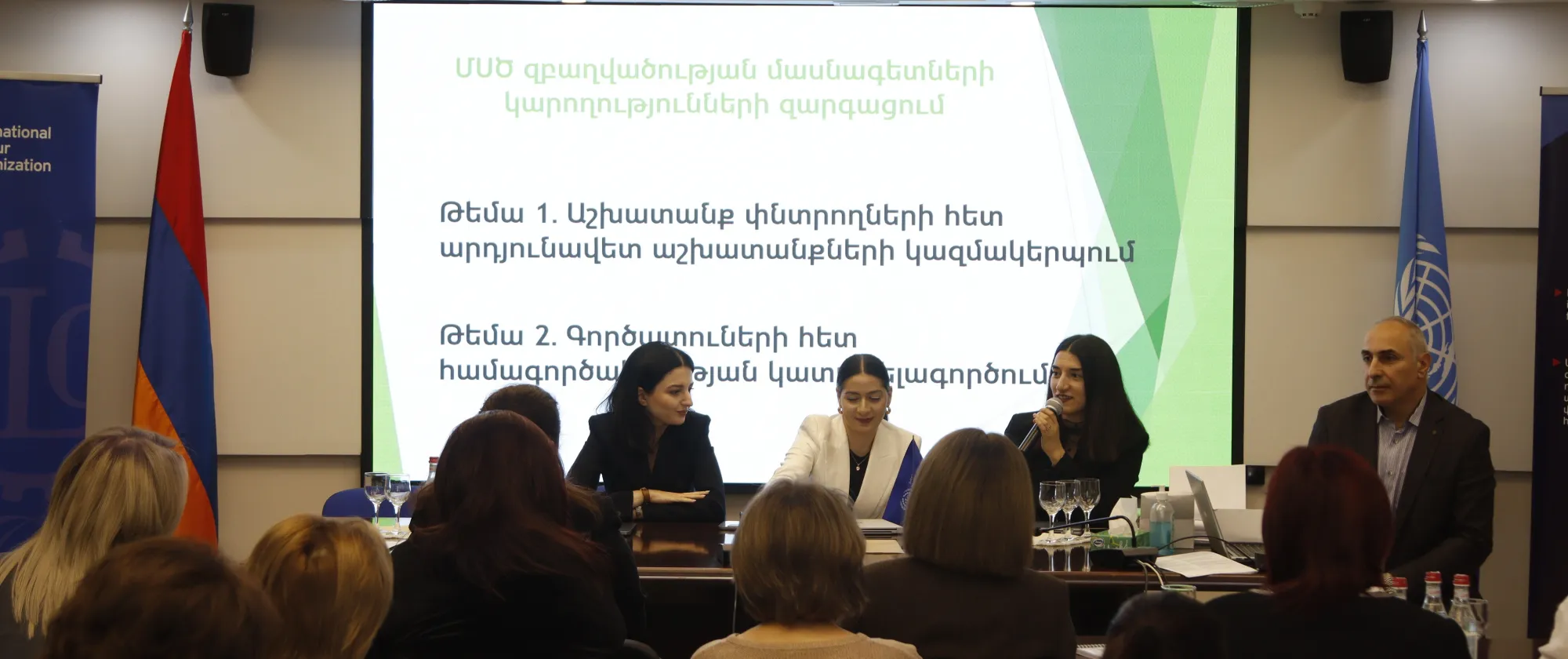
YEREVAN (ILO News) – Employment specialists from all 49 territorial centres of Armenia’s Unified Social Service are participating in a nationwide training programme organized by the International Labour Organization (ILO) to strengthen employment services and improve support for jobseekers and employers.
The one-day trainings, taking place across Armenia throughout May, focus on strengthening employment service delivery. Participants are developing skills in conducting in-depth assessments of jobseekers’ needs, working with employers and supporting more effective job placement.
Opening the first training in Yerevan, Deputy Head of the Unified Social Service Liana Tovmasyan emphasized the strategic importance of continuous professional development for frontline employment specialists.
“Today, employment services face new challenges. The labour market is becoming increasingly dynamic, employers’ expectations are growing, and beneficiaries’ needs are becoming more diverse and individualized. In these conditions, our primary task is to ensure the provision of flexible, targeted and results-oriented services,” she noted.
She also highlighted the role of employment specialists in expanding access to decent employment opportunities, stressing that continuous professional development remains a priority for the Unified Social Service.
Head of the Employment and Labour Potential Development Department of the Unified Social Service Diana Lalazaryan noted that several new and modernized employment programmes are being launched in the sector.
ILO National Project Coordinator Varduhi Avanesyan underscored the critical role of effective and inclusive public employment services in supporting people’s access to the labour market, particularly in rapidly changing economic contexts. She noted that employment counsellors need modern tools, methodologies and practical skills to provide tailored support to jobseekers and strengthen engagement with employers.

The trainings combine interactive exercises and group discussions, allowing participants to exchange experiences and discuss challenges in identifying and responding to the expectations and needs of jobseekers, unemployed persons and employers.
The trainings are organized within the framework of the ILO RBSA-funded intervention on Building the capacity of constituents of pre-empting informalisation of work and promote transition to formality in the context of a refugee crisis in Armenia.
Related content

Country portal
Armenia
Building the capacity of constituents of pre-empting informalisation of work and promote transition to formality in the context of a...

Topic portal
Employment services

Manual
How to support a job seeker? Handbook for employment and career development counsellors
Relevant projects
Building the capacity of constituents of pre-empting informalisation of work and promote transition to formality in the context of a...