

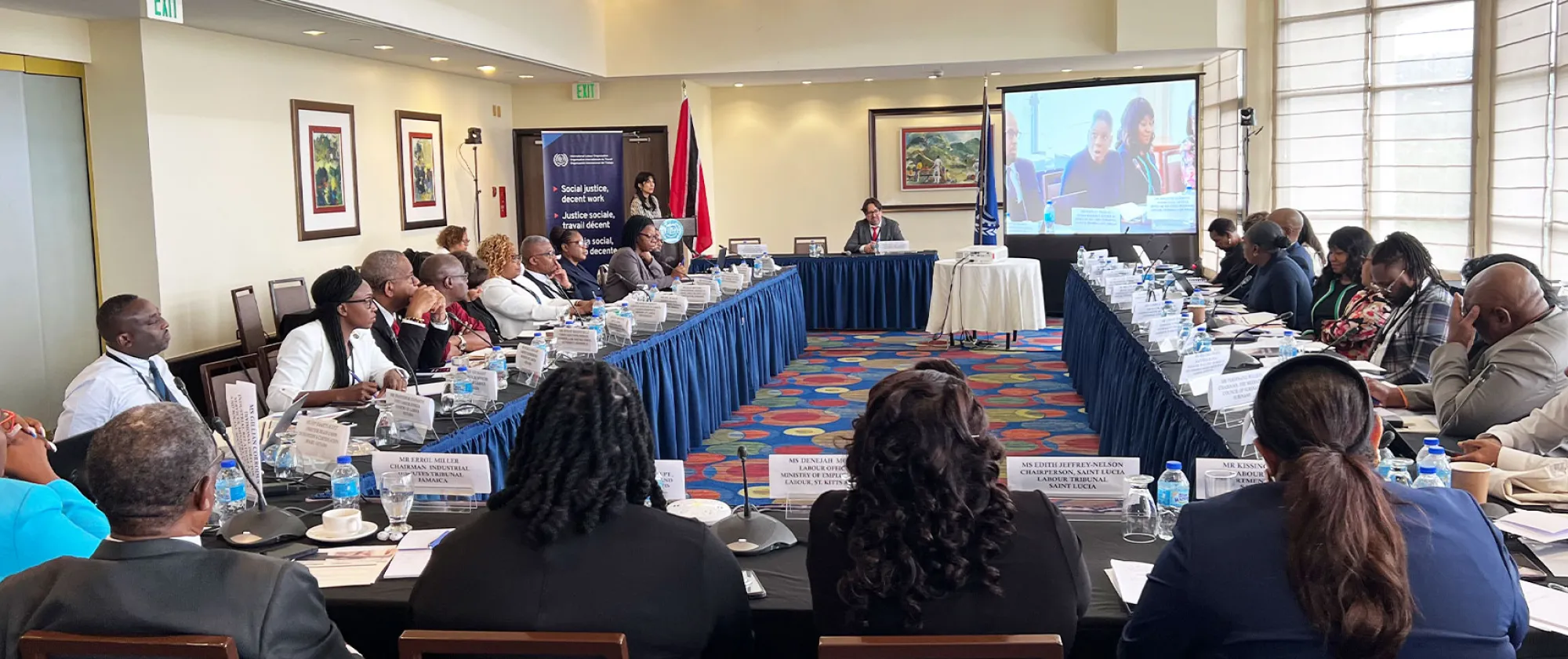
30 labour officials gather for ILO Symposium on Labour Dispute Resolution and Prevention in the Caribbean
Event closed with the adoption of conclusions to serve as a roadmap for reducing barriers to labour justice.
11 October 2024
PORT OF SPAIN, TRINIDAD AND TOBAGO (ILO News) - Like many regions around the world, Caribbean labour dispute prevention and resolution systems face limited accessibility, independence and accountability, as well as scarce resources, complex procedural requirements, and inadequate remedies. Such challenges diminish industrial harmony and lead to ineffective labour market governance.
In an effort to find solutions to these barriers, the ILO Caribbean Office recently hosted a Subregional Symposium on Labour Dispute Prevention and Resolution in the Caribbean on October 9 and 10, 2024, in Port of Spain.
The two-day event brought together 30 senior officials and heads of dispute resolution institutions from 13 Caribbean nations, including Antigua and Barbuda, The Bahamas, Barbados, Belize, Dominica, Grenada, Guyana, Jamaica, Saint Lucia, Saint Kitts and Nevis, Saint Vincent and the Grenadines, Suriname, and Trinidad and Tobago.
The Symposium build on the momentum generated by earlier virtual sessions hosted in March and May 2024 by the ILO Caribbean team where officials highlighted the need for an in-person gathering to further dialogue on labour justice. Under the theme, “Making Labour Justice Accessible to All in the Caribbean”, the event also aligned with the broader context of Sustainable Development Goal 16 which emphasizes the promotion of the rule of law and ensuring equal access to justice.
During the opening ceremony, ILO Caribbean Director Dr Joni Musabayana highlighted that Symposium discussions formed part of wider efforts to address subregional vulnerabilities.
“Caribbean Small Island Developing States are on a pathway to sustainable development that seeks to build stronger societies and economies. Our systems need to mitigate and adapt to risks such as climate change. To achieve this resilience, we need good governance, rule of law, and equal access to fair justice systems,” he explained.
“Access to labour justice is of profound significance to the world of work. This Symposium offers us a unique opportunity for countries in the subregion to exchange good practices, challenges and trends in labour dispute prevention and resolution. It also allows you to discuss the role that you think the ILO can play to help strengthen labour dispute resolution systems,” said Vera Paquete-Perdigão, Director of Governance & Tripartism at ILO-HQ, who also spoke at the event.
Ms Paquete-Perdigão later announced a Tripartite Technical Meeting on Access to Labour Justice that will take place in February 2025 to explore existing practices, opportunities & challenges to labour dispute resolution globally with Barbados Minister of Labour the Honourable Colin Jordan as Chair.
“Continued dialogue between and among our Caribbean counterparts will pave the way to strengthening regulatory frameworks for dispute resolution in the region and make labour justice accessible to all,” said Ms Lorris Alfred, Deputy Permanent Secretary of the Ministry of Labour, Trinidad and Tobago, during her welcome remarks.
As a platform to foster learning and collaboration across countries, the event had the following three objectives:
1) Facilitate dialogue and the exchange of experiences among participants by promoting knowledge-sharing on good practices, challenges, and insights related to labour dispute prevention and resolution.
2) Underscore the importance of alternative dispute resolution methods such as conciliation, mediation, and arbitration, which will help reduce the burden on judicial institutions.
3) Establish a regional network of dispute resolution institutions that could continue to collaborate and support each other in improving access to labour justice.
“The exchange of information from ILO experts and shared experiences of my regional counterparts will contribute to enhancing Grenada’s labour dispute resolution mechanism in pursuit of access to labour justice for all,” said Sparkle Grenade Courtney, Labour Commissioner of Grenada.
Discussions were designed to fulfil these objectives by exploring the characteristics that make dispute resolution institutions successful, such as independence, accessibility, and inclusiveness. Main activities included a review of a comparative report presentation on global labour dispute resolution frameworks, an examination of a case study of a high-performing labour dispute settlement institution in South Africa, and panel discussions centred on principles of effectiveness.
“The Symposium was a timely and relevant opportunity for Labour Commissioners, Inspectors, Tribunals, Courts and Trade Unions to share their knowledge, challenges and aspirations for strengthening access to labour justice in the region,” said Her Honour Heather Seale, President of the Industrial Court of Trinidad and Tobago.
“This opportunity allowed us to reflect on our labour justice systems. By learning from each other we can emerge as stronger Member States of the ILO,” explained Gillian Corrodus, Divisional Director of Industrial Relations and Allied Services, Ministry of Labour and Social Security, Jamaica.
As the Symposium drew to a close, a drafting committee prepared a set of commitments based on the discussion outcomes that were then presented to participants who adopted the conclusions to serve as a roadmap for strengthening labour dispute prevention and resolution mechanisms.
Through the Symposium, participants took an important step towards building stronger regional cooperation in labour justice and advancing social justice in line with the ILO’s global mandate. The ILO Caribbean Office is continuing its technical assistance for enhancing institutional capacity and reform regulatory frameworks, ensuring that national labour dispute resolution systems are not only effective but also accessible to all.
“This meeting marked a significant milestone for the Caribbean. It is important to optimize the opportunity to enhance unity, and I look forward to the follow-up,” said Ferdinand Welzijn, Chairman of the Mediation Council of Suriname.
In the days following the Symposium, ILO officials Pablo Arellano, Senior Specialist for Social Dialogue and Labour Relations and Nancy Varela, Specialist for Social Dialogue and Labour Administration, facilitated the implementation of a diagnostic tool for assessing the functioning of dispute resolution institutions with the Industrial Court of Trinidad and Tobago and the Labour Department of the Ministry of Legal Affairs, Labour and Consumer Affairs of Grenada.
Related content

Subregional symposium on labour dispute prevention and resolution in the Caribbean
Making labour justice accessible to all