

Productivity Ecosystems for Decent Work Project in South Africa
Woman in automotive capacitated through Improve Your Business training and coaching
22 August 2025
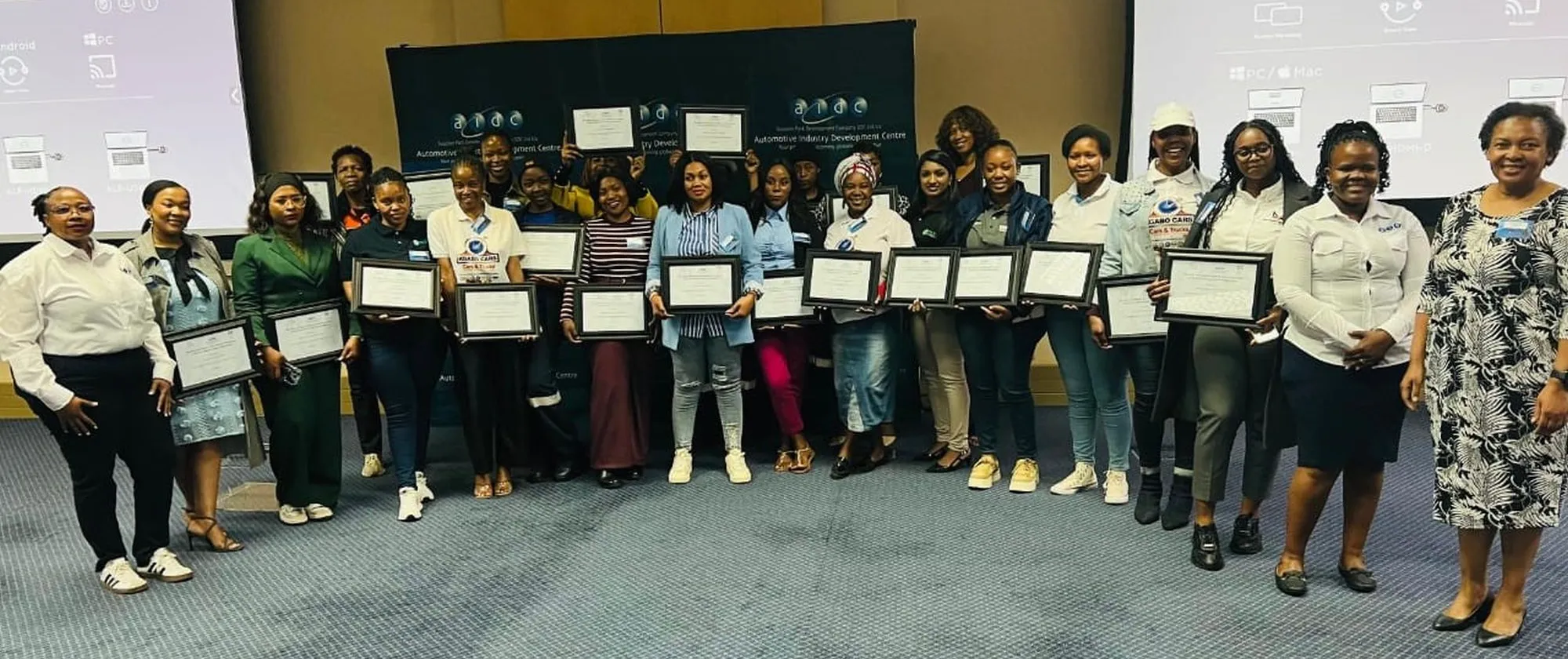
In celebration of Women’s Month, from 18 to 20 August 2025, the Gauteng Automotive Industry Development Center (AIDC) in South Africa organised a three-day training and coaching programme specifically tailored for women-owned enterprises in the automotive sector. Twenty (20) women owned enterprises participated and completed the Improve Your Business (IYB training), which is part of the globally recognised Start and Improve Your Business (SIYB) framework developed by International Labour Organization (ILO). This will be followed by individual coaching over a period of three months in which the enterprises are expected to develop a business improvement strategy and implement.
Since 2024 the ILO Productivity Ecosystem for Decent Work Project, provided SIYB Training of Trainers to trainers from Productivity SA, and the Department of Small Business Development (DSBD). They were certified in the various SIYB packages that include Generate Your Business Idea (GYB), Start Your Business (SYB), Improve Your Business (IYB) and Expand Your Business (EYB). The SIYB was introduced to promote the formalisation of informal enterprises and promotion of the township economy. To date 12 trainers have been certified, and 104 enterprises have benefited from the programme by the ILO. The SIYB initiative supports the programme’s second outcome, which seeks to address sectoral and enterprise-level constraints to productivity growth, decent work, and formalization, while ensuring long-term economic resilience and job creation.
This initiative targeted women-owned businesses involved in logistics, fleet management, and vehicle maintenance services, which all form part of the critical components of the automotive value chain. Most of the women who attended the training, which was hosted at the Automotive Supplier Park in Tshwane, are based in township areas. The intervention is in line with ILO’s focus to promote formalisation of small and medium enterprises (SMEs) and enhance their productivity and capacity to create jobs and decent working conditions. Delivering the keynote address, AIDC Board Member Ms. Princess Mangoma noted that the automotive sector is male dominated and encouraged women in the automotive sector to collaborate and be productive. “As women, do not remain stagnant, stay relevant, continuously seek opportunities, and invest in sustainable mechanisms for your businesses,” she said. She further emphasised the importance of programmes like IYB in promoting gender mainstreaming and the inclusivity of women in the automotive aftermarket, enabling them to become competitive players in the broader automotive sector.
Speaking at the same event, one of the previous years IYB beneficiary enterprises a mobile car repair and maintenance service pointed out that the IYB managed to provide them with practical business management as they only had automotive technical knowledge but lacked knowledge on how to manage a business. Due to the IYB course they were able to fully formalise their enterprise and became efficient and sustainable without any external funding as most SMEs do. Another beneficiary an autobody repair enterprise also pointed out that due to the training and coaching they received from the IYB course, they managed to get insurance approval for their business which allowed them to get more clients and become more productive.
About the Programme
The Productivity Ecosystems for Decent Work programme is implemented by the ILO with support from the Swiss State Secretariat for Economic Affairs (SECO) and the Norwegian Agency for Development Cooperation (NORAD). In South Africa, the programme focuses on the automotive and leather and footwear sectors, applying a systemic approach that targets root causes of low productivity and informality at macro, meso, and micro levels. By strengthening local and national capacities, the initiative aims to foster inclusive, sustainable economic growth.