Advancing social justice, promoting decent work
ILO is a specialized agency of the United Nations
English
“We should develop local regulation to protect the homeworkers”
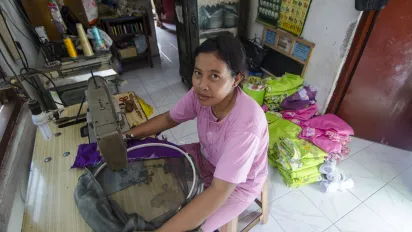
Totok Nurhandajanto, Head of Industrial Relations Division, Provincial Manpower Office of East Java Province, recognized similar conditions between India and Indonesia pertaining to homeworkers, where they faced various challenges including low wages, limited occupational safety and health protection, limited social security and long hours work.
Homeworkers are precarious, vulnerable and marginalized workers. The definition of homeworkers in ILO Convention No. 177 embraces the three common elements of an employment relationship under Indonesian labour law: defined work, remuneration and a degree of subordination. However, homeworkers are not recognized or explicitly defined by national laws or regulations, leaving them with no legal and social protection in Indonesia.
Totok Nurhandajanto
Totok Nurhandajanto, Head of Industrial Relations of Manpower, Transmigration and Population Office in East Java Province, is among the 22 participants who participated in a study tour to Self-Employed Women’s Association (SEWA), a membership-based organization, in Ahmedabad, India. The study tour was organized by the ILO-MAMPU Project in collaboration with SEWA from 16 to 25 September 2014. ILO-MAMPU is a project aiming to improve women’s access to employment and decent work, funded by the Government of Australia.
During the study tour, Totok was amazed with the achievements of SEWA that started with volunteers to reach and organize women home-based workers four decades ago, and now has almost two million members in several provinces of India.
He recognized similar conditions between India and Indonesia pertaining to homeworkers, where they faced various challenges including low wages, limited occupational safety and health protection, limited social security and long hours work. SEWA organizes homeworkers, links them to government social protection and welfare programs, and advocates their rights as workers to the government. Learning all of these challenges and achievements by SEWA over the past 40 years, he promised to himself to utilize his capacity as a civil servant to raise public awareness on homeworkers’ issue, particularly in East Java province.
Homeworkers are precarious, vulnerable and marginalized workers. The definition of homeworkers in ILO Convention No. 177 embraces the three common elements of an employment relationship under Indonesian labour law: defined work, remuneration and a degree of subordination. However, homeworkers are not recognized or explicitly defined by national laws or regulations, leaving them with no legal and social protection in Indonesia.
“Before I became involved in the ILO-MAMPU Project, I was not aware of the existence of homeworkers. Being involved in the Project and participating in the study tour, I learned about homeworkers and their working conditions, and also what we could do to recognize them as workers through regulations,” he said.
In addition to being the Head of Industrial Relations of the Manpower Office, Totok is the Head of Committee of Cooperation Body (Lembaga Kerja Sama – LKS) of the Tripartite (government, employers and workers) mechanism in East Java Province. Realizing the importance of developing regulations to acknowledge and protect homeworkers, he is utilizing the Cooperation Body to hold discussions on the need to protect homeworkers by also engaging relevant local NGOs supporting homeworkers.
He shared that the Body has not reached agreement on the need for regulations, and explained, “The main challenge in developing regulation at the local level is the absence of national laws that explicitly regulate homeworkers.” On the other hand, he has seen cases where local regulations were developed without the existence of national laws. “It highly depends on the commitment of the government and legislature in order to respond to the social condition. Learning from India, I am concerned that homework is becoming more prevalent in Indonesia. The number of homeworkers may be increasing but they are invisible and unprotected. We hope East Java could initiate regulation although it would not be easy. But if we start from small steps, I believe we will see some changes,” he concluded.