Advancing social justice, promoting decent work
ILO is a specialized agency of the United Nations
English
Waging a grassroots guerilla war in fighting for labour welfare
Setting up a trade union is the most effective strategy to fight for the welfare of workers. However, some reasons make workers unable to get involved in such a movement. The role of a labor associate is needed to keep the workers empowered and not just accepting of their destiny.
Setting up a trade union is the most effective strategy to fight for the welfare of workers. However, some reasons make workers unable to get involved in such a movement. The role of a labor associate is needed to keep the workers empowered and not just accepting of their destiny.
It is undeniable that many companies try through various means to restrict their employees from setting up trade unions. Although the rights to assemble and to set up a trade union are protected by the law, in fact, many workers are afraid to get fired if they are too outspoken in expressing their rights through activities in trade unions.
In a trade union itself, some factors can detract from the workers the interest to join. One of them is compulsory contribution, which burdens some workers. If their income is not even enough to sometimes support their lives, they will certainly be reluctant to pay contributions for the operational cost of a trade union.
Workers, who have to fight by themselves for their welfare, sometimes do not have any power if no one stands by their side and empowers them. Kasminah (42 years old), a former worker who was once actively involved in a trade union’s movement, got compelled to embrace workers scattered at the grassroots level and beyond the reach of trade unions’ elites.
"I do this because workers at the grassroots level need (my assistance) more than trade unions’ elites. If all of us take care of problems at the central level, no one will care about those at the regional levels,” Kasminah, who is a labor associate of the Daya Dharma Foundation (FDD), an organization under the coordination of the National Labor Associates’ Forum (FPBN), said.
For Kasminah, being a personal associate for workers is an experience, which is very different from what she did when she was on the frontline. Behind the scenes, she feels closer to workers and better understands labor problems than what she experienced when she was an executive of a trade union.
From her experience in advocating for workers, she can finally understand that a dispute between employees and a company is frequently derived from the lack of knowledge of the workers on their rights and obligations. She admitted that in many cases, companies often cheat, although some employees also misbehave or do not know how to adapt to their working conditions.
"For example, when a dispute happens, there should not be any layoffs. But, when workers insist on their demands and do some actions to force their company to grant their rights, the actions eventually lead to a criminal action, such as tearing the company’s announcement off from the bulletin board. It can be categorized as an unpleasant action. It frequently happens. SBKU also once dealt with an infamous case, Sandal Bolong, a case of Hamdani," Kasminah, who joined the Karya Utama Labor Union (SBKU) during her early years as a worker in 1996, recalled.
Problems of Female Workers’ Rights
Kasminah has also found many grassroots problems regarding the welfare of female workers. Companies often treat female workers discriminately, abusing their rights, either in terms of rights to get decent wages or facilities in accordance to the nature and reproductive function of female workers, which are indeed different from their male co-workers.
"Female workers have some strength. They are more careful in work, more patient and, the most important thing (for companies), more defenseless. Because they are only considered to be supporting their husbands, how much their salary is, they just accept it,” Kasminah, who was once actively involved in the Cisadane Labor Committee (KBC) and participated in pioneering the Confederation of Indonesian Trade Unions’ Alliances (KASBI), explained.
In addition to their low salaries, facilities for female workers are frequently not prioritized. Kasminah took a note that it is very few, or even almost no, companies providing a chance for female workers, who have just delivered their babies, to breastfeed or at least, to squeeze their breast milk as stipulated by the law.
Companies should provide adequate time for female workers, who are in the breastfeeding period. Besides adequate time, companies should also provide special places. In most cases, the place provided by companies to squeeze breast milk is a toilet, which is certainly not recommended because it is not sterile and does not have any refrigerator to store and keep the breast milk in good condition.
"I feel as though I am being tortured at work when I have to wait for five hours, for example. Every three hours, about 10 or 15 minutes should be given for breastfeeding. It’s very painful if the breast milk is not squeezed. I will feel sick,” Kasminah added.
Even the right to get a monthly period leave is ignored by companies by complicating the issuance of permits. Besides being threatened with non-payment if they do not work, some workers who suffer from dysmenorrhea are also obliged to enclose letters from their doctors or even face physical examination to prove whether they are really on their monthly period.
However, according to Kasminah, due to limited knowledge and strong economic reasons, some workers choose not to take their monthly period leave although they actually need it. Kasminah said that some workers just choose to work when suffering from dysmenorrhea in return of extra income promised by their companies if they do not take their monthly period leave.
"Due to economic reasons, many choose to keep working. They don’t care about their pains and finally, after one or two years, they get cysts. Why? Their dirty blood is not released, because they hold it when sitting down. It also creates another consequence. It is made as a justification for companies for not giving monthly period leave. They say, the workers don’t get sick if it is rewarded by money,” Kasminah said.
On the use of monthly period leave, Dr Astrid Widajati Sulistomo, SpOk, an occupational specialist at the Community Medical Department of the School of Medicines of the University of Indonesia, viewed it as the rights of female workers that must be provided by companies. No letter from the doctor is needed. It is enough to check their monthly records because from the records, it can be seen whether their cycles are normal or not.
"I don’t agree that a physical examination has to be done. Even some companies hire obstetricians or doctors whose duties are only to check whether the workers are really on their monthly period or not. Ethically, it is unnecessary. A letter from a doctor is not needed because it has become a worker’s rights to take two days in a month for a monthly period leave,” Dr Astrid said when contacted by phone.
Treatment of Pregnant Female Workers
On the treatment to pregnant female workers, Kasminah evaluated that much progress has actually been made in the past five years. The knowledge among workers over their rights to get special treatment when pregnant has made companies start to assign them for lighter works or transfer them to some sections that do not endanger their pregnancies.
Unfortunately, such treatment is only applied on permanent employees, not contract or even outsourcing workers. For pregnant contract and outsourcing workers, the choices are only to resign or to be fired if they are caught pregnant. Many choose to keep working until their pregnancies reach five months old due to economic reasons. It makes some suffer from miscarriage due to work overload.
"Thank God if companies allow them to take a rest, to take an unpaid leave or to temporarily resign with a guarantee that they will be allowed to work again later or at least to get priority when they apply for their job again. Such treatments have been regarded very, very kind, because in some companies, when their workers are caught pregnant, they are immediately fired,” Kasminah added.
The Indonesian Family Planning Association (PKBI) also highlighted a report by Kasminah that there are cases where female workers are not allowed to get pregnant. They linked it to the risk of unsafe abortion. Difficulties in finding a job make workers face a dilemma when they have to choose between keeping their pregnancy with risks of losing their jobs or stopping it by taking an abortion or a menstruation induction.
Suharsih, a researcher at PKBI’s Sexuality Study Center, noted that careers sometimes become a reason for female workers to undergo a menstrualtion induction. In a research she conducted in 13 reproductive health clinics in nine cities in Indonesia, women, who choose abortion to save their careers, included stewardesses, bank employees and employees who are on study assignments.
Suharsih admitted that the research she had conducted between 2008 and 2011 did not find any clients undergoing menstrual inductions from low-income workers, such as those advocated by Kasminah. But it does not mean that no one did it. Suharsih believed that it is more caused by the lack of information and chance to access reproductive health clinics that provide medically-safe menstrual induction service.
"It doesn’t mean that no one did it and not because their incomes are lower than those of bank employees (that keeping pregnancy will surely not be better than the risks to do abortion), but it’s more because of limited access. Who knows that there is such kind of service? Workers in rural areas certainly don’t know about a safe abortion service,” Suharsih, who expressed more worries that abortion will be done in places, which safety is not guaranteed, said.
Suharsih’s concerns are reasonable, because her research showed that 52 percent of menstrual induction clients, who visited reproductive health clinics, had earlier tried to stop their pregnancy by themselves. About 31 percent did it by taking herbal or modern medicines, 18 percent by seeing doctors or obstetricians and the rest by using the service of masseuses, etc.
Results of medical observations conducted in two clinics in Jakarta and Bandung showed that 34 clients did not successfully undergo vacuum aspiration (curettage) because their tissues stick on their uterus. The aspiration on 12 clients resulted in damaged tissues, while a client suffered from an incomplete abortion due to efforts of stopping pregnancy through unsafe methods.
Not Alone
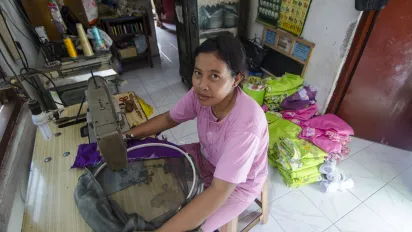
Kasminah is not alone in fighting for the welfare of workers through her personal advocacy at the grassroots level. Along with her other LDD volunteers, they share tasks to provide advocacy in labor pockets in various places in Tangerang, Banten.
Besides providing education on labor legislations, the advocacy given by those volunteers also reaches out to the real problems faced by workers. For example, when a worker of a shoe factory miscarried because she did not get any special treatment when pregnant, the volunteers provided suggestions and inputs.
"We don’t give any direct advocacy in their factories, only personal advocacy. We give them some knowledge to be independent. If their companies severely mistreat them, why should they continue to work there?” Sister Angelina, SFD, one of Kasminah’s colleagues who advocates for workers at LDD, said.
The volunteers also provided training on financial management through the Credit Union scheme. The training does receive more attention from Kasminah and her colleagues because it is most needed by the workers, whose status are generally only contract and outsourcing workers.
Without any secured future, the welfare of contract and outsourcing workers does raise concerns. Setting up a trade union still becomes the main weapon to fight for their welfare. However, individual labor empowerment through advocacy such as that done by Kasminah and colleagues is not less important, so that the workers can survive with all limitations they are facing. (*)
This is an in-depth article on working conditions of women workers written by AN Uyung Pramudiarja of DetikHealth and published on 27 May 2013. The article is part of the ILO’s media fellowship programme on gender and employment, jointly conducted in collaboration with the Alliance of Independent Journalists (AJI) Jakarta and six selected leading, national mass media. The media fellowship programme was part of the campaign conducted by the ILO through its Access to Employment and Decent Work for Women Project, funded by the Australian Government.