Advancing social justice, promoting decent work
ILO is a specialized agency of the United Nations
English
Voucher pliers: fate of home-based workers
After sunset, the hustle could still be felt in the narrow alleys of Jati Bundar area in Tanah Abang. Some residents were having fun; chatting and talking in their house terraces, while watching the traffic of people in the densely populated area. In a small house, two women were glued in front of a 21-inch television. Tuti (54) and Teti (43) were relaxing after arriving home from work that day.
After sunset, the hustle could still be felt in the narrow alleys of Jati Bundar area in Tanah Abang. Some residents were having fun; chatting and talking in their house terraces, while watching the traffic of people in the densely populated area. In a small house, two women were glued in front of a 21-inch television. Tuti (54) and Teti (43) were relaxing after arriving home from work that day. Just like other housewives, soap operas were their favorite television program. Sometimes they laughed; sometimes they scowled, engrossed in the plot of the soap opera.
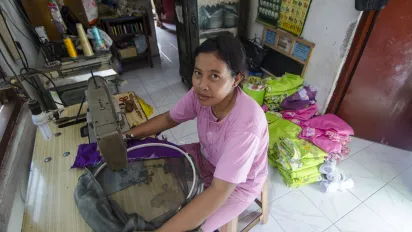
However, unlike other housewives, Tuti and Teti were not only watching television. While their eyes could not turn from the television screen, their skillful hands kept plying prime vouchers of a telecommunication operator. Once in a while, their attention switched to a pile of papers, which had not been plied. They also sometimes had to bind and pile the vouchers, which had been plied, into wooden boxes in front of them.
"Yeah, it’s easy work; it can be done while watching television or serving customers,” Tuti, who also has a small kiosk in front of their house, said. A day earlier, Tuti and Teti had received an order to ply 8,000 Telkomsel cards.
"The order usually comes in the afternoon, at 4 p.m., and then, after sunset, when we are relaxed, we start plying the vouchers until 9 p.m. If we can’t finish the work, we’ll continue to do it the next morning and send them back when the work has been done. There is no target on the number of vouchers we need to ply,” Tuti added.
Tuti and Teti, who are sisters, are two among 702 home-based workers in Kebon Melati Subdistrict, Tanah Abang. Besides plying the voucher packages of Telkomsel, LSM Homenet Indonesia recorded that the residents at the Residential Community (RW) No. 14 of Kebon Melati Subdistrict also work at home, embedding sequins on veils and buckles on bra straps. As far as Tuti remembered, there were about 150 housewives and young women who ply prime vouchers of Telkomsel operator at RW 14 of Kebon Melati Subdistrict in Tanah Abang.
The International Labour Organization defines home-based workers as those who work at home or in other places out of the place of those, who send them orders to produce products and services specifically requested by those who place the orders, in efforts to get money. In practice, home-based workers do not often receive any payment for the equipment they use and receive wages based on a piece-work system or working volume. They predominantly work based on verbal agreement and have no bargaining power to determine their wage.
It has been 13 years since Tuti and Teti started their side jobs as cellular phone voucher pliers. All began on a day in 2000 when Tuti was taking her youngest child to kindergarten. While waiting for her child, Tuti saw a group of mothers busy plying Telkomsel prime cards. She was curious and wanted to know what those women were doing.
After asking around, Tuti was finally invited to join them in plying cellular phone prime vouchers as a side job. "It’s good, because while waiting for my child at school, I can spend the time plying vouchers. There are still some vacancies,” Tuti quoted her friend as saying at that time. Accompanied by her friend, Tuti registered herself to PT Kreasi Prima, a printing house that prints the prime vouchers. The area around Lontar Raya Street in Kebon Melati, Tanah Abang, has long been known as a center for the small-scale printing industry.
There is neither agreement nor contract for this job. Teti remembered that around 2004, she and other women who ply the vouchers were once asked to sign a piece of document from the printing house. Teti was not sure whether the document was a working contract. After signing it, the document was returned to Kreasi Prima’s staff. She has never kept the document for herself.
"I don’t know whether it was a contract or not. It was only a piece of paper in folio size with a list of names. I just signed it. They said it was data for Telkomsel," the woman, who graduated from an economic vocational senior high school, said.
On the paper, a statement was written saying that a voucher plier would be paid Rp. 17,500 a day. However, Kreasi Prima has never paid the voucher plier in accordance to the articles stipulated in the document.
In practice, the job uses a piece-work system. "When there is an order, there will be money,” Teti said. At first, there were a lot of orders. The price of a voucher was between Rp. 35 and Rp. 45 higher than the current price with weekly routine orders. It was because a plied voucher had more components and was thicker, while the number of voucher-plying workers had not been as many as today. After plying vouchers for a week, Tuti and Teti could earn more than Rp. 200,000 each.
But, the situation now has changed. A Telkomsel-owned Simpati/AS Facebook voucher is Rp. 15, while Flash voucher is Rp. 20 a piece and card holder Rp. 5. Furthermore, since 2007, the number of voucher plying workers of PT Kreasi Prima Printing has doubled from the previous one, which was 200, and is spread in several areas in Jakarta.
The consequence is that in a week, the average order only comes twice or three times. Once he or she receives an order, a voucher plyer will get a quota between 2,000 and 4,000 vouchers for being plied. They once did not get any orders at all for a month. Now, to be able to get between Rp. 200,000 and Rp. 300,000, they have to wait for orders for a month.
The money, according to Tuti, is not directly taken, but saved first at Kreasi Prima. Each voucher-plying worker gets a saving book that records the number of vouchers he or she has already plied in a piecework order. If they need money, they can withdraw the saving. The withdrawal usually can be done when they have collected a substantial amount of moneyfrom the side job. “Once they withdraw the money, Tuti and Teti bring home between Rp. 400,000 and Rp. 700,000.”It’s for additional income, cooking or other necessities,” Tuti said.
There is also a kassa bon (Dutch: certificates of deposit) system, in which voucher-plying workers can borrow the money first. Kreasi Prima Printing will later deduct it from their savings. Besides the permanent wage, prior to Eid al-Fitr, the voucher-plying workers will receive Islamic Holy Day packages consisting of cooking oil, rice and other commodities.
Tuti has never thought that she should have been paid higher than the current wage she receives from plying vouchers. "We don’t have any idea about that. What’s important is that we are paid by the printing house,” she said. Teti said that she and other voucher-plying workers cannot demand higher wage because their status is only non-permanent or daily-based paid workers.
Although working for very low wages and without clear working contracts, for Tuti and Teti, the side jobs have helped a lot to their families’ income. Tuti’s husband is only a gold cenkau in Tanah Abang. Her husband’s average income is Rp. 600,000 a month, while the couple has three children who still go to school.
Meanwhile, Teti is a widow with two children. Teti has been living with Tuti’s family for a long time in the small house and earns living from the small kiosk in their house.
This is an in-depth article on women home workers written by Agustinus Beo Da Costa of Kontan and published on 31 May 2013. The article is part of the ILO’s media fellowship programme on gender and employment, jointly conducted in collaboration with the Alliance of Independent Journalists (AJI) Jakarta and six selected leading, national mass media. The media fellowship programme was part of the campaign conducted by the ILO through its Access to Employment and Decent Work for Women Project, funded by the Australian Government.