Advancing social justice, promoting decent work
ILO is a specialized agency of the United Nations
English
Utilizing knowledge and experience for a better work
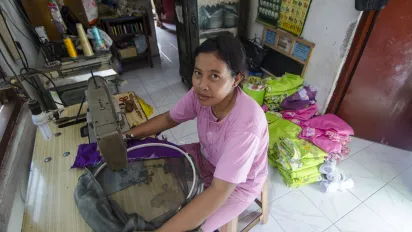
Siti Zamzanah has been making button holes and sewing buttons for 16 years now. She generally enjoys her life – spending time with family and working from home – but she is not fully satisfied with her work.
Siti Zamzanah
Siti Zamzanah (58) lives in Notoprajan village, Ngampilan, Yogyakarta city with her two adult children, a son in-law and two grandchildren in a house that belongs to her upon her husband’s passing in 2002. After graduating from senior high school in mid 70s, she started to work different kinds of work. By the time she met her husband in the late 70s, she had already experienced part-time and full-time, formal and informal works, mostly in the garment industry.
She continued working full-time in a sewing/fashion house after getting married, but when their youngest child was becoming a teenager, sometimes in 1998, she felt she needed to dedicate more time and attention to her family. She left her full-time job and took on a homework of making button holes on clothes and sewing the buttons. As a first step, she borrowed money from a local cooperative to buy herself a sewing machine and materials (threads, needles, etc). She then got in touch with middle persons whom she knew from fellow homeworkers and her last full-time job.
“Previously, I measured the distance between two button holes by using my fingers or just made an approximation. After I learned about work quality, I understand that I must offer good quality products. Since then, I bought a measure tape and pencil; and measure the distance with centimeters. The distance between any two holes is now uniform.”
Siti has been making button holes and sewing buttons for 16 years now. She generally enjoys her life – spending time with family and working from home – but she is not fully satisfied with her work. She is paid IDR200 (USD1.8cents) per button hole and IDR450 (USD4cents) per button hole and putting on the button. She is able to make approximately IDR1,000,000 (USD90) in a month, which she must allocate to buy more sewing materials and paid for electricity and maintenance of her sewing machine. Her children and in-law work different jobs, but also in informal sector and on part-time basis. Their combined income is just sufficient for the family to meet their basic needs. They cannot afford social protection programs such as Jamkesmas and BPJS, but they are not considered as “poor” either by the government, which otherwise will provide them with the protections for free.
In 2008, she joined home-based workers groups organized by Yasanti, a local NGO working in DI Yogyakarta and Central Java and is one of Implementing Partners of the ILO-MAMPU – Access to Employment and Decent Work for Women Project funded by the Government of Australia. She has since actively involved in group discussions and activities.
“I am happy to learn about new topics through this group, such as about gender, human rights and work quality,” she said. She has, for instance, utilized her knowledge to improve her product quality. “Previously, I measured the distance between two button holes by using my fingers or just made an approximation. After I learned about work quality, I understand that I must offer good quality products. Since then, I bought a measure tape and pencil; and measure the distance with centimeters. The distance between any two holes is now uniform.”
She shared that never once did her middle persons offered a wage increase. In the 16 years of doing the same work, her hole and button price has slowly increased only from IDR150 (1.4cents) to IDR450. This increase is possible only because she asked for it. She highlighted that she always supports her request for an increase with facts of price increase in the materials or electricity. She learned this by herself, way before she joined Yasanti groups. Now, she is happy to share her approach with other members of the group. “I am glad that all of us can share each other’s experiences and support each other in this group. That way, hopefully all of us can have a better work condition.”