

Uganda signs third decent work country programme
Uganda signs its Third Decent Work Country Programme (2024/25–2029/30), reinforcing its commitment to social justice, decent employment, and the elimination of child labour and human trafficking. The official launch was on the Labour Day, 1 May 2025.
24 April 2025
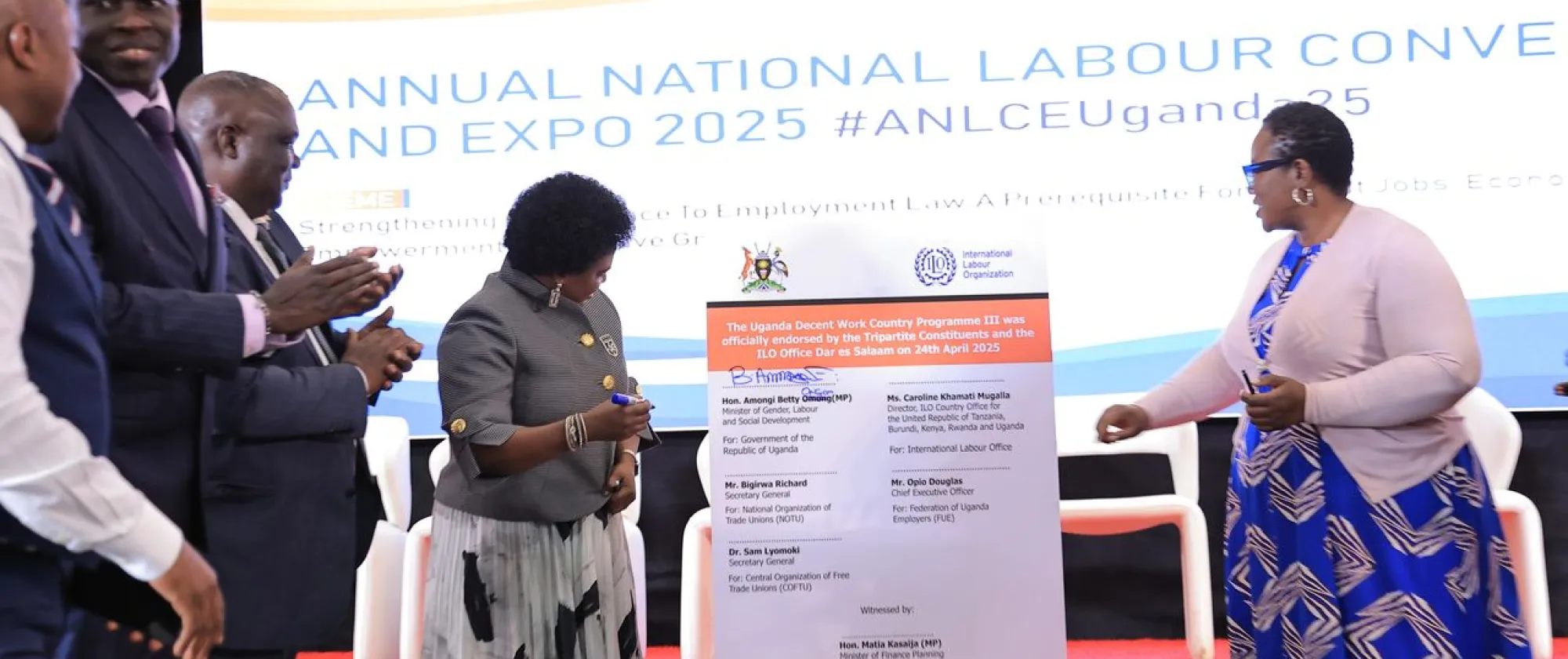
KAMPALA, Uganda (ILO News) – Uganda’s commitment to social justice and decent employment took a significant step forward with the signing of the country’s Third Decent Work Country Programme (DWCP III) for 2024/25–2029/30. The Tripartite Partners officially signed the DWCP during the Annual Labour Convention held on 24th April. The event brought together Uganda’s tripartite partners— government, employers, and workers’ organizations.
The DWCP III was formally launched on 1 May 2025, during International Labour Day celebrations, presided over by the President of the Republic of Uganda.

Betty Amongi, Minister of Gender, Labour and Social Development, pledged the Government’s commitment to ensuring that the DWCP is implemented, monitored, and evaluated in a manner that is responsive to the needs of all Ugandans.
“The third DWCP represents a renewed commitment to promoting decent work, social justice, and economic growth in Uganda,” she stated. “It offers tripartite-plus partners in Uganda with an opportunity, through an integrated and collaborative framework, to promote decent work as a key component of the country’s national development agenda.”
Speaking on behalf of the International Labour Organization (ILO), Caroline Khamati Mugalla, Director of the ILO Country Office for Tanzania, Burundi, Kenya, Rwanda, and Uganda, commended the collaborative efforts of Uganda’s tripartite constituents in shaping a nationally owned and forward-looking Programme. “Uganda, we are honoured to walk this journey together,” she noted, reaffirming the ILO’s full support for implementation through technical cooperation, policy guidance, and innovation-driven capacity building.
Uganda’s position as an Alliance 8.7 Pathfinder Country places it among a select group of nations leading the global effort to eliminate child labour, forced labour, and human trafficking. By embedding the goals of Alliance 8.7 within this DWCP, Uganda is once again showing leadership and inspiring other countries to act with urgency.
Caroline Khamati Mugalla, Director of the ILO Country Office for Tanzania, Burundi, Kenya, Rwanda, and Uganda
A key element of the DWCP III focuses on enabling children engaged in child labour and survivors of trafficking in persons (TiP) to find safe, dignified, and voluntary solutions to rebuild their lives sustainably. The Programme emphasizes the withdrawal, rehabilitation, and reintegration of affected children, the provision of skills training, legal support services to families, and the strengthening of inspection and enforcement systems. It also aims to enhance government capacity to identify and rescue victims of trafficking and provide them with shelter and psychosocial support. This comprehensive approach reflects Uganda’s commitment to protecting vulnerable populations and fostering a labour market that leaves no one behind.
The DWCP III aligns with Uganda’s Vision 2040, the Fourth National Development Plan, and the UN Sustainable Development Cooperation Framework. It also embeds Uganda’s role as an Alliance 8.7 Pathfinder Country, reinforcing national and global efforts to end child labour, forced labour, and human trafficking.
The ACCEL Africa project provided technical guidance to the drafting process of the DWCP III.
Relevant projects
Accelerating action for the elimination of child labour in supply chains in Africa (ACCEL Africa)