

A tripartite workshop paves the way for apprenticeship reform in Guinea
Guinea is taking a decisive step towards reshaping its apprenticeship training system. From February 4 to 7, 2025, a tripartite consultation workshop brought together public authorities, social partners (employers and trade unions), civil society and other stakeholders in Conakry. The goal was to develop a national strategy for quality apprenticeship, in line with the principles of decent work and social justice, to meet the country's economic and social challenges.
20 February 2025
Apprenticeship: a cornerstone of decent work
Apprenticeships have always been one of the most effective ways of ensuring the transmission of skills, enabling younger generations to enter the world of work in a sustainable manner. For several decades, the International Labour Organization (ILO) has supported the development of quality apprenticeships as an essential instrument for guaranteeing decent work, reducing skills shortages and fostering inclusive economic growth. The ILO promotes apprenticeship systems that are not only adapted to the needs of the labour market, but also respect the principles of social justice, offering equal opportunities to all, and particularly to young people and vulnerable populations.
In June 2023, the International Labour Conference adopted Recommendation No. 208 on quality apprenticeships, which stresses the importance of establishing a regulatory and contractual framework to ensure fair, quality and inclusive apprenticeships. This recommendation aims to protect apprentices' rights, promote gender equality, and ensure that working conditions for apprentices respect their rights, in line with international labour standards.
A promising context, with significant challenges
With its rich natural resources and dynamic craft sector, Guinea faces considerable challenges in terms of skills and lifelong learning. With more than 77% of its population under the age of 35, it is becoming essential to design a skills development system which is high-quality, inclusive and adapted to market needs. This approach is fully in line with the ILO's objective of promoting decent work, by training young people in the skills required by key economic sectors.
Representing a significant contribution to the national economy, the informal economy is characterized by a lack of skills and often inadequate training. Traditional apprenticeships, while playing a pivotal role, need to be modernized to meet current standards and improve access to decent work for young people, particularly those from rural areas and marginalized communities.
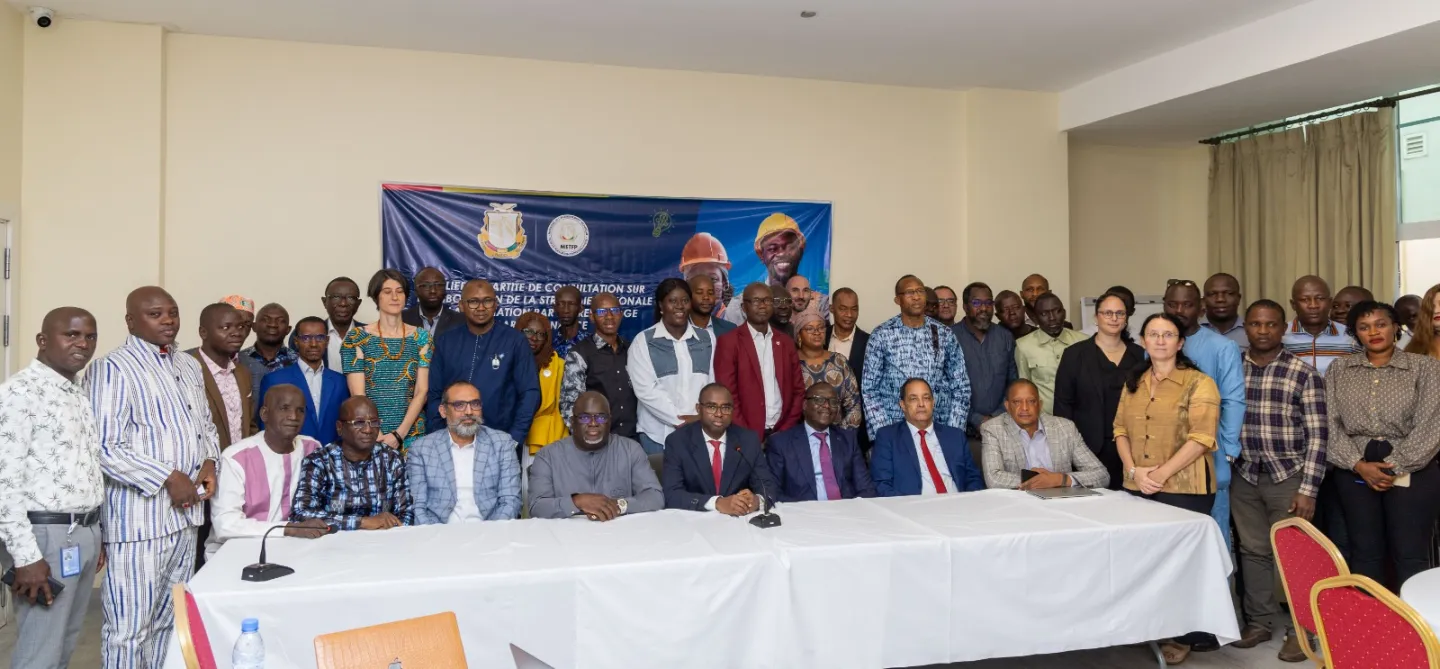
The workshop seeks to improve the apprenticeship strategy
The workshop was organized by the Ministry of Technical Education, Vocational Training and Employment (METFPE), with technical support from the International Labour Organization (ILO). It brought together 42 participants from government, trade unions, employers, civil society and international partners. These stakeholders worked together to develop a national strategy for quality apprenticeship, aligned with ILO objectives, particularly in terms of decent work and social justice.
Discussions focused on key issues for the reform of the apprenticeship system, such as:
- the legal and regulatory framework for apprenticeship, in line with international labor standards
- The financing of apprenticeships, by promoting partnerships with the private sector and ensuring the sustainability of programs
- Matching training to actual labor market needs, ensuring a relevant, high-quality training offering
- Inclusion and diversity in access to apprenticeships, to ensure that young people from all backgrounds can benefit from equal opportunities.
The recommended solutions for a high-performance, inclusive system
Several recommendations were formulated at the end of the workshop:
- Involve all stakeholders in the execution of the strategy to ensure its effectiveness and impact.
- Promote quality apprenticeships and work-study programs, a form of training that is more inclusive and more in tune with economic and social realities, to ensure access to relevant, sustainable skills.
- Enhance traditional apprenticeships, particularly in the craft sector, and transform the system into a quality training model that complies with international labour standards.
- Reform the legal framework and governance of apprenticeship to encourage the creation of fair and balanced apprenticeship contracts.
- Adapt curricula to meet the actual needs of the market, while encouraging training that takes place both on and off the job.
- Strengthen training for master craftspeople and in-company trainers to ensure that apprentices are supervised in accordance with quality and safety standards.
- Promote digital and distance learning, to make training more accessible, particularly for young people in remote areas.
- Develop bridges between training courses and qualifications, to offer opportunities for career advancement and mobility.
Strengthen social dialogue to ensure tripartite governance, with workers, employers and the government working closely together to guarantee a fair and inclusive apprenticeship system.

Opening ceremony of the tripartite consultation workshop - Participants watching the presentations of the working groups' results / © OIT A new era for apprenticeship in Guinea: moving towards decent work for all
This workshop represents a strategic shift in the reform of the apprenticeship system in Guinea. It reflects the ILO's commitment to decent work and social justice, supporting the government's efforts to develop a quality and inclusive apprenticeship strategy. With this technical support, Guinea can look forward to transforming its skills development system, strengthening the competitiveness of its economy and offering new prospects to its youth, while respecting the principles of decent work and promoting equal opportunities for all.
This initiative is part of the ongoing cooperation between the Guinean government and the ILO, which is actively supporting the country in the implementation of its decent work agenda, covering key areas such as social protection, international labour standards, and improving the employability of young people. Guinea stands ready to embark on a new era of more structured, equitable and rights-based learning, in line with the ILO's objectives for sustainable, inclusive and socially responsible development.