

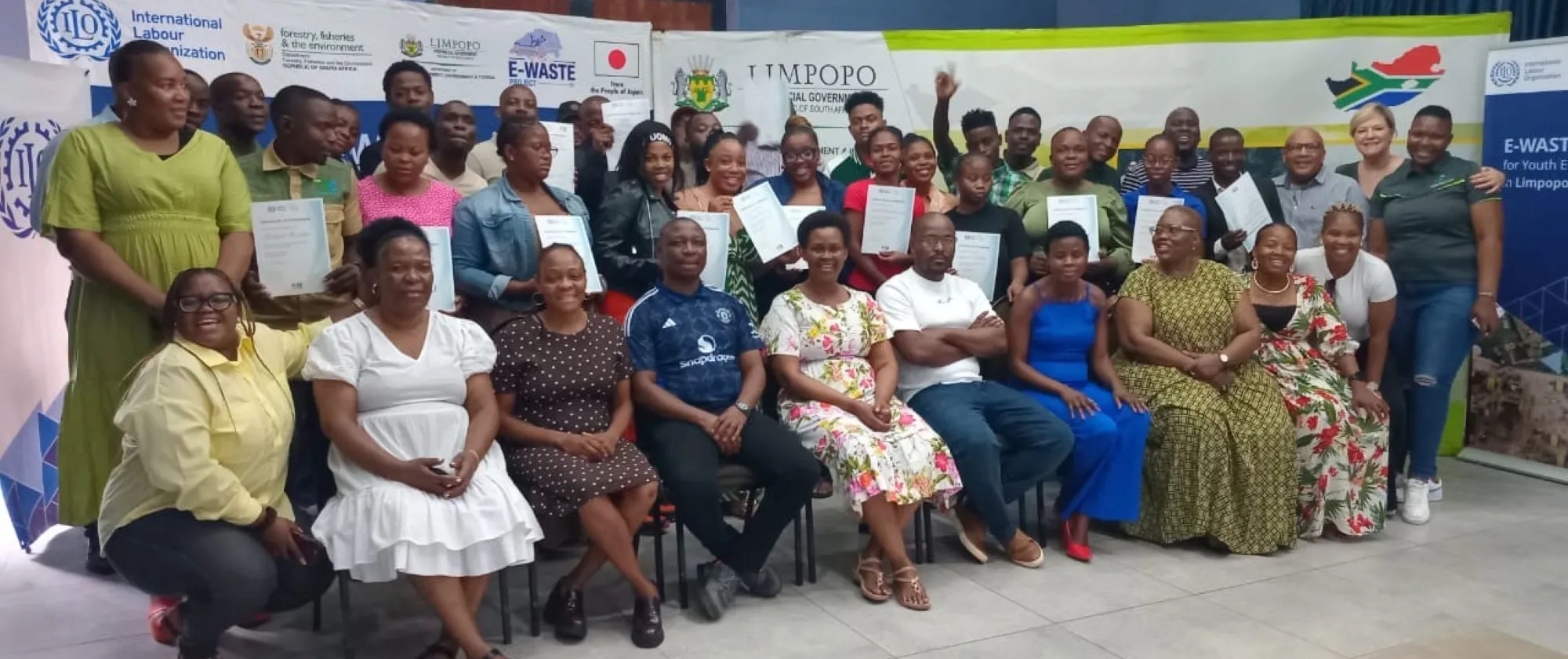
Technical and Vocational Education and Training trainers deliver entrepreneurship training to youth in E-Waste Project
The ILO and public Technical Vocational Education and Training colleges in Limpopo delivered SIYB entrepreneurship training to 22 youth in the E-Waste Youth Employment Project, strengthening local capacity and supporting youth-led green enterprises in the circular economy.
28 November 2025
South Africa, Modimolle (ILO News) - The International Labour Organization (ILO), in partnership with public Technical and Vocational Education and Training (TVET) colleges in Limpopo Province, recently delivered a Start and Improve Your Business (SIYB) training programme to 22 young participants of the E-Waste Youth Employment Project. This marked the first successful rollout led by newly capacitated SIYB trainers from the province’s TVET colleges, demonstrating strengthened local capacity to support youth entrepreneurship and green enterprise development.
Earlier on, TVET lecturers underwent a Training of Trainers to familiarise themselves with the SIYB methodology. Equipped with these skills, they took the lead in delivering a full week of entrepreneurship training to youth beneficiaries already engaged in e-waste collection, dismantling and recycling activities under the project. Their role was central in guiding the participants from technical skills acquisition toward developing viable business concepts in the emerging circular economy.
The SIYB sessions introduced the youth to practical tools for identifying business opportunities, understanding cost structures, carrying out basic market assessments and planning operations for small enterprises. Through group exercises, business simulations and case studies rooted in the realities of the local e-waste sector, the youth were supported to refine ideas such as e-waste collection services, safe dismantling operations, sales of sorted components and small repair or refurbishment enterprises. Many entered the programme with strong technical skills but limited exposure to entrepreneurship; by the end of the training, they demonstrated improved confidence, clearer business ideas and a stronger sense of what it takes to start and grow a micro-enterprise.
A key outcome of the training was the development of draft business plans tailored to the e-waste value chain. Participants gained a deeper understanding of pricing, costing, cash flow, safe operational planning and customer relations, enabling them to approach enterprise development in a more structured and realistic manner. The programme also strengthened their understanding of how to engage with formal recyclers, municipalities and community collection points, helping them map out the networks required to operate effectively in a provincial circular economy.
For the TVET trainers, the rollout served as an important demonstration of how colleges can support local economic development beyond traditional classroom teaching. Their delivery of SIYB reflected a shift toward a more active role in community-level entrepreneurship promotion, ensuring that students and out-of-school youth receive relevant support to pursue self-employment pathways. The activity also highlighted the effectiveness of integrating technical green skills training with entrepreneurship development, enabling young people not only to gain practical competencies but also to convert those competencies into income-generating opportunities.
The results of the training contribute directly to the aims of the E-Waste Youth Employment Project: increasing youth access to green jobs, strengthening enterprise development in rural municipalities and promoting environmentally sustainable practices. With 22 youth now equipped with both the technical and entrepreneurial foundations needed to start or improve their small e-waste businesses, the project is well positioned to continue supporting their journey through mentorship, enterprise coaching and linkages to local recyclers and markets.
As the initiative moves forward, the involvement of TVET colleges will remain central. Their expanded capacity ensures that more young people across Limpopo will have access to quality entrepreneurship training, reinforcing the long-term sustainability of the project and contributing to broader provincial and national efforts to promote decent work within the green and circular economy.