

SUSTAIN workshop highlights opportunities to strengthen linkages between trade, investment, and decent work in Lesotho
23 October 2025
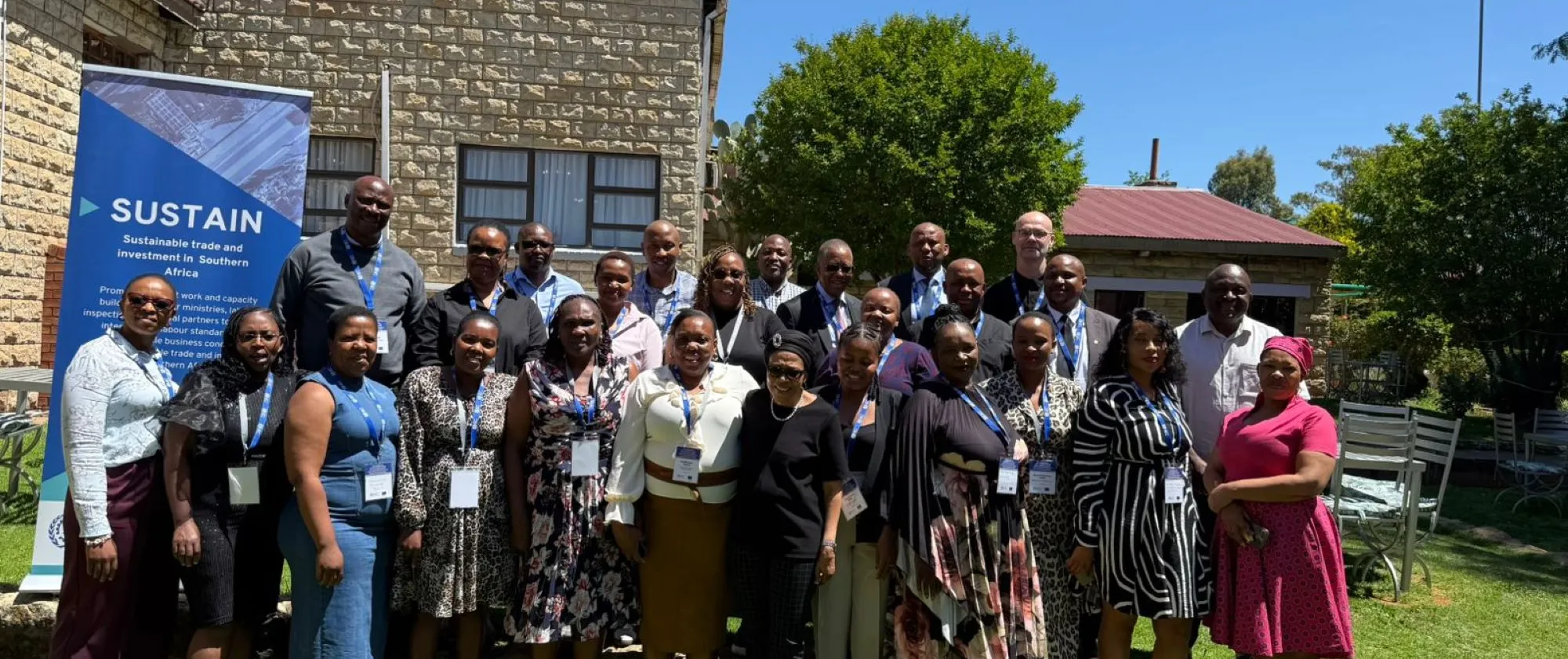
Maseru (ILO News) - Key stakeholders from the Ministry of Labour and Employment, the Ministry of Trade and Entrepreneurship, the Lesotho National Development Corporation, and employers’ and workers’ organizations convened to discuss ways to deepen the linkages between trade, investment, and decent work in Lesotho.
The workshop was organized under the leadership of the Ministry of Labour and Employment, within the framework of the EU-funded SUSTAIN – Trade and Investment in Southern Africa Project, implemented by the International Labour Organization in Lesotho, Namibia, South Africa and Botswana.
Addressing critical economic challenges
The event came at a pivotal moment, as Lesotho continues to face trade volatility, external shocks, and a shifting global economic landscape—all of which are putting pressure on the country’s export-oriented sectors and the livelihoods of thousands of workers and the resilience of local SMEs. This situation calls for new and innovate approaches through economic diversification, value chain development, productively and competitiveness related measures and further harnessing the trade and investment ecosystem for decent work and sustainable development.
In her opening remarks, Ms. Anna Renieri, EU Head of Cooperation at the EU Delegation in Lesotho, underscored the importance of strengthening trade and investment systems that deliver inclusive and sustainable growth, while ensuring decent work opportunities for all
The European Union firmly believes that sustainable and inclusive development thrives when economic competitiveness goes hand in hand with respect for human capital. This means aligning trade and investment strategies with Environmental, Social, and Governance (ESG) principles, ensuring that growth is not only profitable but also fair, transparent, and environmentally responsible.'
Echoing these sentiments, Mr. Limpho Mandoro, Senior ILO Official, highlighted the value of the ILO’s normative framework and the organization’s tripartite approach, emphasizing that inclusive social and economic development requires close cooperation and dialogue among government, employers, and workers. The ILO Tripartite Declaration concerning Multinational Enterprises and Social Policy provides a useful framework in this regard.
''The MNE Declaration is unique in that it is the only ILO instrument adopted in a tripartite setting—by governments, employers, and workers—that speaks directly to enterprises. It provides practical guidance on how businesses can adopt inclusive, responsible, and sustainable workplace practices, and how governments can develop coherent policy frameworks and effective public–private partnerships in support of responsible business conduct and decent work."
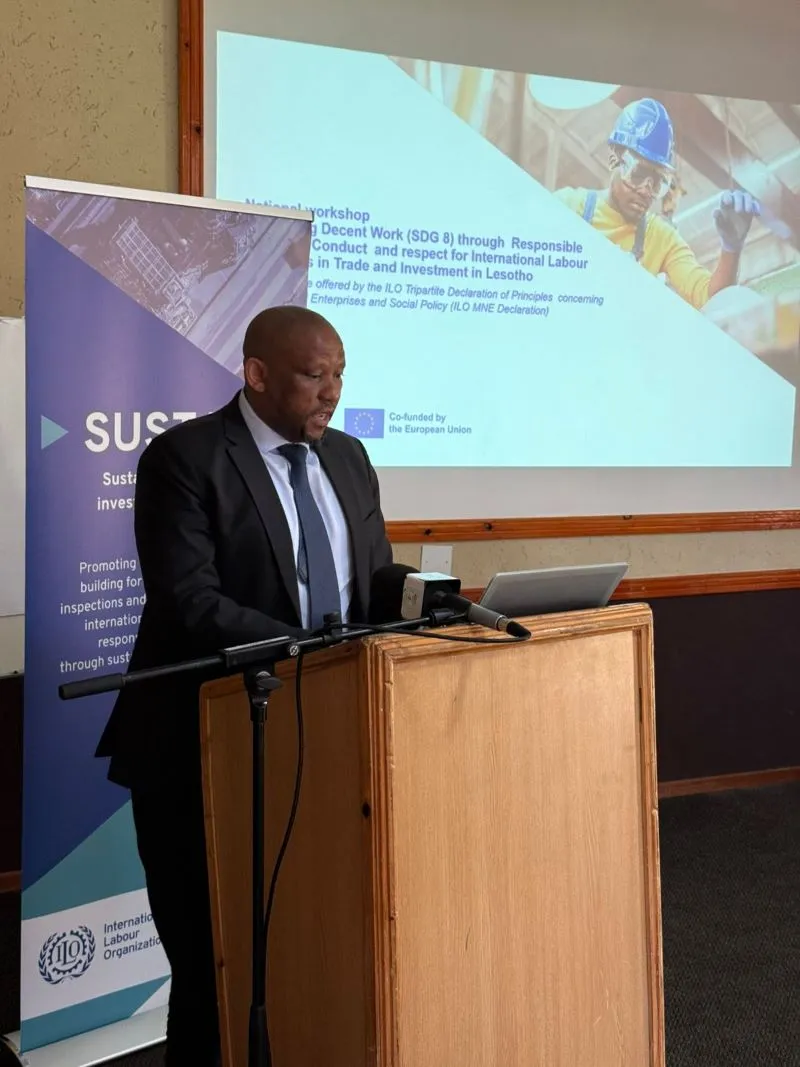
Officially opening the workshop, Mr. Moshe Mosaase, Principal Secretary of the Ministry of Labour and Employment, reaffirmed the government’s commitment for a resilient and inclusive economy and decent work.
''International trade and investment are expected to promote job creation and economic growth. This aligns with a key priority area of the National Strategic Development Plan, which emphasizes sustainable and inclusive, private sector–led job creation and economic development. However, this is not always the case. If not properly managed, international trade and investment can lead to job losses, precarious employment, and poor working conditions—especially when there is limited involvement of broader stakeholders in the policymaking process."
Identifying priorities for inclusive growth
The workshop discussions focused on identifying key national priorities and opportunities aligned with Lesotho’s broader development agenda—particularly those that can be advanced through a more strategic use of trade and investment.
Participants emphasized several core areas for action, including:
- Strengthening social dialogue for social and economic progress;
- Promoting a whole-of-government and whole-of-society approach for policy coherence and inclusive development to drive sustainable and inclusive growth;
- Enhancing accountability and access to data to support evidence-based policy decisions;
- Fostering sustainable, private sector–led economic growth;
- Advancing the implementation of Fundamental Principles and Rights at Work, especially regarding child labour and occupational safety and health; and
- Investing in human capital to build a skilled and competitive workforce.
By aligning trade and investment strategies with decent work objectives, Lesotho aims to strengthen its economic resilience, create quality jobs, and ensure that no one is left behind in the country’s journey toward sustainable development.
The workshop concluded with the adoption of a ”National roadmap for an enabling environment for the promotion and implementation of responsible business conduct and respect for international labour Standards” , aimed at advancing decent work within business, trade, and investment. This roadmap outlines key entry points, actions, and initiatives that will enable the Government of Lesotho and its social partners to address the aforementioned challenges and advance national development priorities.
Among other actions, the roadmap includes the designation of national tripartite focal points for the promotion of the ILO MNE Declaration, the establishment of a Technical Working Group/Secretariat on RBC and the MNE Declaration—coordinated by the Ministry of Labour and Employment—as well as capacity-building initiatives across government and social partners. The roadmap also envisions the organization of a “High-Level Forum on Decent Work, Trade, and Investment’’, to be held during the course of 2026.
About the SUSTAIN Project:
The project “Promoting decent work and capacity building for labour ministries, labour inspections and social partners to advance international labour standards and responsible business conduct through sustainable trade and investments in Southern Africa (SUSTAIN – Southern Africa)” aims to further harness trade and investment to advance decent work opportunities for women and men in Southern Africa through increased respect for International Labour Standards and the adoption of responsible and sustainable business practices, guided by the ILO MNE Declaration. The SUSTAIN project is financially supported by the European Union
Relevant projects
SUSTAIN
Sustainable Trade and Investment in Southern Africa