

Occupational safety and health
Strengthening occupational safety and health awareness and practice on farms in Lebanon
A new set of occupational safety and health visual guides and targeted training is helping workers, technicians and service providers adopt safer practices across farms in Lebanon.
19 February 2026
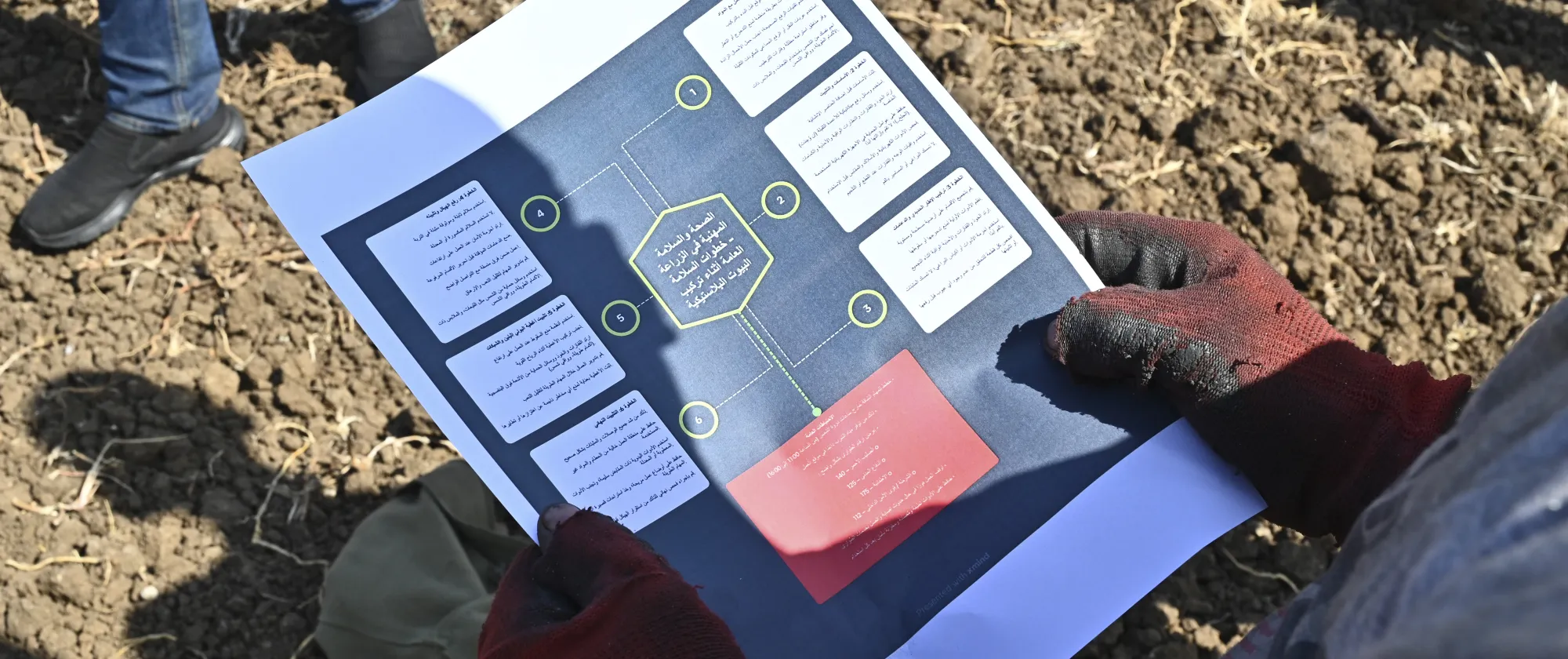
BEIRUT (ILO News)- Building on the national occupational safety and health (OSH) in Agriculture manual developed by the ILO and the Ministry of Agriculture, the BOUZOUR project, funded by the Swedish International Development Cooperation Agency (Sida), produced a series of practical infographics that translate the manual’s key messages into accessible visual guidance for workers and farmers.
The infographics address common risks in crop production, including chemical exposure, mechanical and physical hazards, biological risks, and poor ergonomic practices. They were designed to support real-time decision-making, enabling workers to quickly identify hazards and adopt safer practices during daily tasks.
To maximize outreach, the infographics were disseminated through chambers of agriculture, cooperatives, agribusinesses, municipalities, technicians, and extension agents. Their use in routine farm interactions has helped promote a more consistent level of OSH awareness across a diverse range of agricultural settings.
Training technicians and service providers to scale OSH awareness
In parallel, the project engaged agricultural businesses, service providers, and stakeholders involved in farm management, labour recruitment, and technical support. Among these partners is Plant Lab, whose engineers and technicians work across multiple regions and directly support workers during key agricultural operations.
Through a Training-of-Trainers approach, 56 technicians and workers were coached on how to identify hazards, communicate safety instructions, and model safe work practices for seasonal and rotating workers. Because these technicians move frequently between farms, the training created a natural scaling mechanism, providing clear training information to workers on multiple farms in order to achieve wider adoption of OSH practices.
This approach helped extend OSH awareness to 25 farms across Lebanon, strengthening safe routines and improving practices in locations where formal training is often limited or unavailable.
Visible improvements across supported farms
Farms employing workers who participated in the OSH sessions have already demonstrated tangible improvements in work organisation and safety practices. Changes observed across these farms include:
- Clearer chemical handling routines, with designated shelves for storage and better understanding of safe mixing, application, and disposal procedures.
- Adjusted work schedules to reduce heat exposure, including shifting labour-intensive tasks to earlier hours and limiting work during peak heat periods.
- More systematic use of Personal Protective Equipment (PPE), with gloves, masks, boots, and face protection made more accessible near work zones.
- Improved organisation of tools and equipment, helping reduce trips, slips, falls, and unplanned downtime.
These changes reflect sustained behavioural shifts rather than isolated actions.
As the Operations Manager at Plant Lab Abdallah Mohanna explained, “We now see workers asking questions, reporting unsafe practices, and insisting on clarity before starting tasks. Once the information is repeated and reinforced, safety becomes part of their routine rather than an instruction.”
Extending OSH awareness across the agriculture sector
The combined approach, visual tools, consistent dissemination, and trained intermediaries, has helped broaden OSH awareness beyond the project’s direct work sites and contributed to safer, better-organised, and more resilient agricultural workplaces across Lebanon.
ILO encourages actors across the agriculture sector, including NGOs, cooperatives, service providers, and extension offices, to display the OSH infographics in their facilities and integrate them into ongoing awareness and training activities.
Related content
Project
Building Inclusive Markets and Decent Work for Syrian Refugees and Lebanese Host Communities (BOUZOUR)
Relevant projects
Project
Building Inclusive Markets and Decent Work for Syrian Refugees and Lebanese Host Communities (BOUZOUR)