

Labour Migration in East and Horn of Africa
Strengthening the Capacity of Key Migration Actors in Africa on Labour Migration
30 November 2024
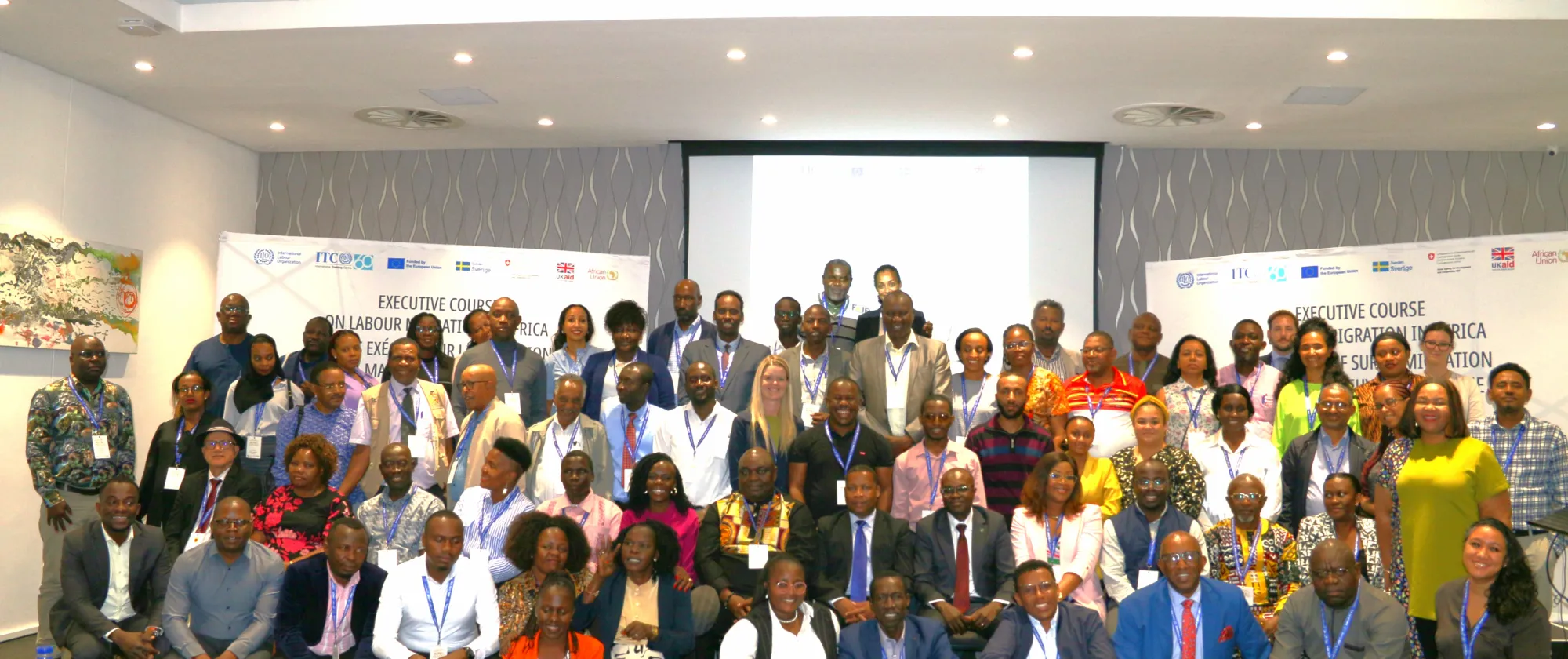
Given the significance of labour migration and mobility in Africa, the International Labour Organization (ILO), in partnership with ITC-ILO, and the African Union (AU) organised an Executive Course on Labour Migration, with the aim of enhancing the capacity of actors working on labour migration to implement effective governance frameworks, safeguard the rights of migrant workers, and maximize the development potential of labour migration. The training comprised three parts, the introductory online webinars was held from 6 November 2024 to 24 November 2024, the Residential phase was held from 25 - 29 November 2024 in Cape Town, South Africa, and the Concluding Online Phase was held from 2 December 2024 to 13 January 2024.
The training was attended by 79 participants (32 female) representing the African Union (AU), Regional Economic Communities (RECs), government institutions, employers’ organizations, workers’ organizations, regional social partners (ITUC-Africa, OATUU, Business Africa), the ILO, and employment agencies from different parts of Africa.
The training provided advanced knowledge and enhanced the capacity of key migration actors in Africa to better understand and effectively address labour migration challenges and opportunities in the dynamic social, political, and economic context, globally as well as in the African continent. The course covered a wide range of cross-cutting themes pertaining to advancing fair and effective labour migration in Africa.
Participants engaged in dynamic group work, plenary sessions, and thematic electives, exploring various critical aspects of labour migration governance. These included developing and implementing rights-based and gender-responsive policies, extending social protection to migrant workers, establishing fair recruitment practices, developing bilateral labour migration agreements and understanding the linkage between skills and labour migration, while integrating gender perspectives into migration governance was streamlined across the different thematic elective courses.
Interactive sessions allowed attendees to simulate real-world policy development processes, strengthening collaboration and practical problem-solving. The training concluded with group presentations and a closing ceremony that emphasised shared commitments to advancing the labour migration agenda. Participants gained practical tools and insights to address challenges, aligning their efforts with global and continental frameworks.
Relevant projects

East and Horn of Africa
Better Regional Migration Management