

Decent Work
Rwanda updated employment policy puts implementation at the centre
Rwanda’s ambition under Vision 2050 and the National Strategy for Transformation 2 is clear, to build a more prosperous, inclusive and productive economy, with decent and productive employment at the centre of national transformation.
21 October 2026
The updated National Employment Policy 2026 - 2036 is one of the instruments through which this ambition can be translated into coordinated action and clearer pathways to decent work, especially for young people and women.

The review and development of the updated National Employment Policy is led by the Ministry of Public Service and Labour (MIFOTRA), with technical support provided by the International Labour Organization (ILO). MIFOTRA’s leadership reflects a strong commitment to creating an enabling policy ecosystem for employment and decent job creation. It also recognizes that employment outcomes are shaped not by one institution alone, but by how fiscal and monetary frameworks, trade and investment policies, education and training systems, enterprise development, labour market services, investment, social dialogue, district-level delivery and partners work together around shared national priorities.
Government leadership and a consultative process
The updated National Employment Policy has been developed through a consultative and evidence-informed process, bringing together a wide range of actors engaged in employment policy and programming, including government institutions, employers’ and workers’ organizations, national experts, development partners, training institutions, social partners and technical specialists. The engagement of employers’ and workers’ organizations throughout has been an important part of the policy review process and particularly appreciated. Their engagement reflects a shared commitment to Rwanda’s employment vision and brings the perspective of enterprises and workers into the policy process and helps build national ownership and consensus around Rwanda’s employment priorities.

This tripartite and participatory approach is important because a national employment policy is strongest when it reflects the realities, mandates and perspectives of those engaged in its implementation. The process created space to review policy priorities, clarify areas of collaboration, and ensure that the updated policy is grounded in Rwanda’s employment and labour market realities.
Validation focused on implementation
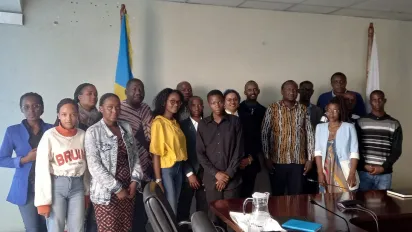
On 7 and 8 October 2026, the consultation, validation and policy learning exchange brought this process to its next stage, with discussions focused not only on the policy draft, but on the practical steps needed to support implementation.
Across the two days, participants reviewed revised policy priorities, reporting and implementation arrangements, priority actions, the implementation plan, costing considerations, the results framework, coordination, accountability mechanisms and next steps.
This implementation focus is central. A strong National Employment Policy helps provide clarity on priority actions, roles, sequence, resources and results. It gives government institutions and partners a shared framework for employment and decent job creation.
Digital jobs, skills and the future of work
The ILO project on Boosting Decent Jobs and Enhancing Skills for Youth in Rwanda’s Digital Economy, funded by the Government of Luxembourg, connects directly with the updated policy’s focus on digital transformation and inclusive employment.
The policy recognizes that digital technologies, including artificial intelligence, are changing the nature of work, production systems, business models and labour markets, while creating new opportunities in ICT, data, e-commerce, digital entrepreneurship, remote work and platform work.
It also highlights that Rwanda’s opportunity goes beyond specialized ICT jobs. It includes digitally enabled jobs across the wider economy, including agriculture, financial and business services, tourism, logistics and other growing sectors. This closely aligns with the project’s work at the intersection of digital skills, enterprise development, labour market systems and young people’s transitions into work.
Through the same participatory approach, the validation also created space for exchange on minimum wage, drawing on ILO experience from across Africa. The session offered practical insights into how wage-setting processes can be approached as part of broader efforts to strengthen fair, productive and inclusive labour markets.
This is where technical cooperation is most useful, connecting Rwanda’s digital employment agenda to the wider policy ecosystem. This includes how young people build relevant skills, how enterprises digitalize and grow, how employment services respond to new forms of work, and how decent work principles remain part of the digital transformation.
Policy learning that feeds into the updated policy
As part of the validation process, a series of thematic technical sessions were organized under the EU–ILO Youth Employment Expert Network, established through the project 'Supporting Youth Employment and Investment in Skills in Developing Countries', co-funded by the European Commission and implemented by the ILO. These sessions created space for evidence-based policy learning, knowledge exchange and practical discussions on implementation, supported by ILO’s technical team and the Youth Employment Experts Network.
Sessions on youth employment programmes, meaningful youth engagement and partnerships for youth employment in Africa invoked exchanges of national and international evidence, technical expertise and practical experiences to inform the implementation of the updated National Employment Policy (NEP). Particular attention was given to evidence on what works in youth employment programming, effective approaches to involving young people in policy processes, and the role of partnerships in translating policy priorities into concrete interventions.
The value of these exchanges was in how they connected different layers of the employment agenda: policy priorities, labour market evidence, decent work, social dialogue, implementation experience and lessons from other countries. This helped keep the validation grounded in Rwanda’s national priorities, while opening space for practical learning that can inform the next stage of the policy process.
Shared investment in Rwanda’s employment agenda
The consultation and validation process showed the importance of bringing together national leadership, technical expertise, and partner investment around a shared policy agenda. Across the process, government institutions, employers’ and workers’ organizations, the private sector, development partners, training institutions and technical experts brought their perspectives and experience into a shared discussion on Rwanda’s employment priorities.
The ILO appreciates the Government of Luxembourg for its investment in decent jobs and skills for youth in Rwanda’s digital economy, and the European Commission for supporting technical exchange and implementation learning through the EC-ILO collaboration.

This is the value of the updated National Employment Policy process: it brings the right actors together, strengthens shared ownership, and keeps implementation at the centre.
For Rwanda, the next decade of employment action will require exactly this kind of policy ecosystem: nationally led, evidence-informed, partner-supported and focused on turning priorities into better pathways to productive and decent work.
Relevant projects
Digital Economy
Boosting Decent Jobs and Enhancing Skills for the Youth in Rwanda’s Digital Economy