

A Return, a Loan, and a Fresh Start
“I started my business with only one hundred thousand shillings, half from my savings and the other half borrowed from a friend,” she said.
13 January 2026
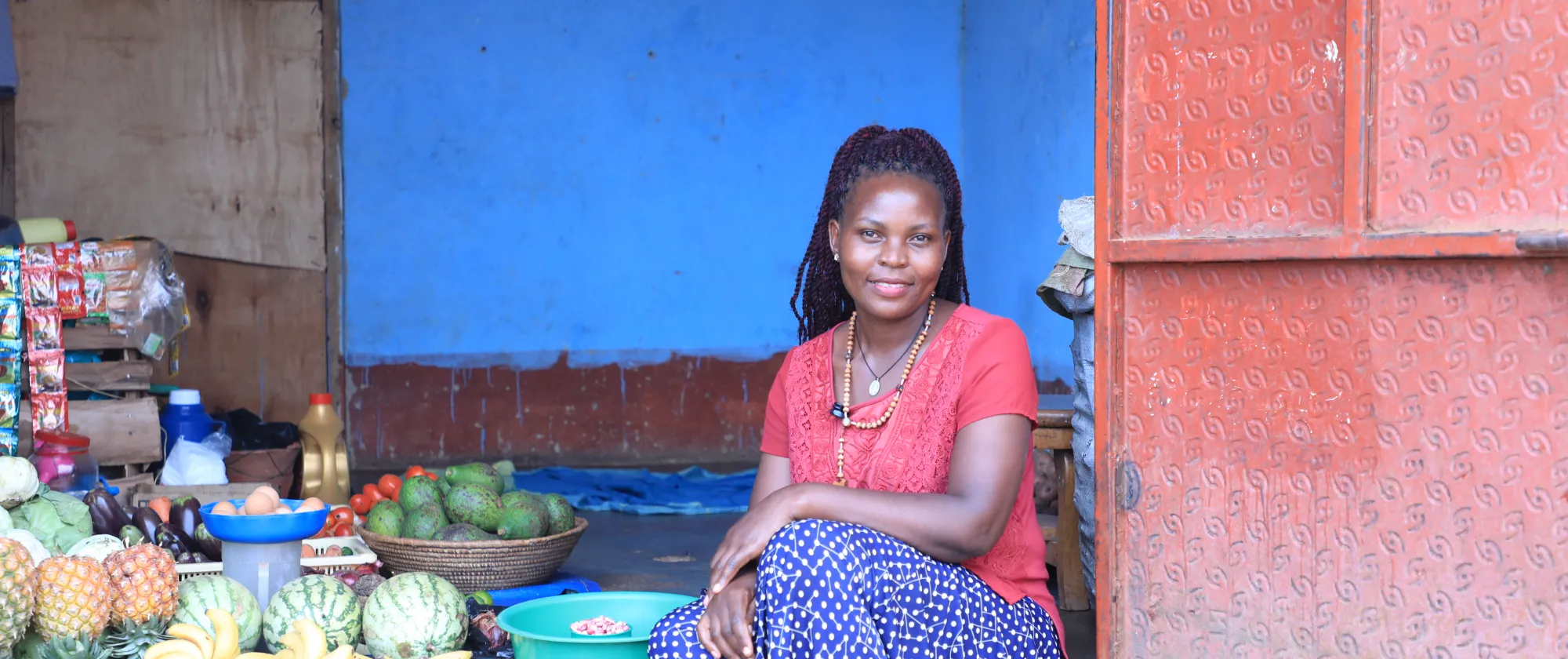
Ruth Naluwooza is a Ugandan returnee and a single mother of four who currently runs a small retail business selling fresh fruits and vegetables. Before migrating, Ruth was responsible for providing for her children under difficult economic conditions, with limited and unreliable income opportunities. Like many women in similar circumstances, she saw labour migration as a pathway to support and improve her family's situation and build a more stable livelihood.
As a result, Ruth migrated to Dubai in 2020, where she worked for two years as a domestic worker. However, the reality of life abroad was far more demanding than she had anticipated. Long working hours, limited rest, and constant pressure defined her daily routine. Despite these challenges, Ruth remained determined, continuing to work with the hope of saving enough money to support her children and eventually start a small business when she returned home.
“I worked day and night, but even in this extreme condition, saving money was not easy,” Ruth explained, reflecting on her time abroad.
Upon returning to Uganda, Ruth was confronted with a difficult reality. The salary she had managed to save was minimal, which wasn't enough to last her for a while, and the responsibility of caring for her four children remained entirely on her shoulders. Despite the uncertainty, she chose to start again, using the small resources she saved to begin a small retail business.
“I started my business with only one hundred thousand shillings, half from my savings and the other half borrowed from a friend,” she said.
At the beginning, Ruth relied largely on instinct rather than structured planning. She sold fruits and vegetables to earn a living, but struggled to expand her business and stabilise her income. The absence of proper record keeping, limited experience in managing customers, and uncertainty about handling borrowed money made progress challenging.
Ruth’s turning point came when she joined the entrepreneurship training offered under the ILO Better Regional Migration Management (BRMM) Programme implemented in partnership with Wezesha Impact. Through the training, she participated in sessions covering Generate Your Business Idea, Start Your Business, and financial education. For Ruth, it was the first time she had encountered structured guidance on how to manage and grow a small business.
The ILO BRMM Programme, funded by the UK Foreign, Commonwealth and Development Office, supports returned migrant workers in Uganda to rebuild sustainable livelihoods through entrepreneurship training, financial education, and market-oriented business development. By strengthening practical business skills and confidence, the programme enables returnees to stabilise their incomes and regain control over their economic futures after return.
“The training taught me how to handle customers and manage money properly,” she explained.
One of the most significant changes for Ruth was learning the importance of financial discipline. Before attending the training, she ran her business without written records and struggled to separate business money from household expenses. However, through the financial education sessions, she learned the value of planning, accountability, and saving.
“I learned that when you borrow money, you must plan how to pay it back,” she said.
Today, Ruth maintains a simple yet consistent record of her sales and expenses, allowing her to understand whether her business is growing or struggling at any given time.
“Before the training, I did not keep records. Now I write down every sale,” she noted.
Although ongoing challenges, especially the lack of capital to grow her business, Ruth feels more confident and better equipped to manage what she has. Her small shop continues to provide daily income for her family, and she now approaches business decisions with greater caution and clarity.
Her story mirrors the experiences of many returned migrant women who must start again with limited resources. With support from the BRMM Programme, Ruth has begun transitioning from basic survival trading to a more organised and stable livelihood grounded in practical business skills and confidence.