

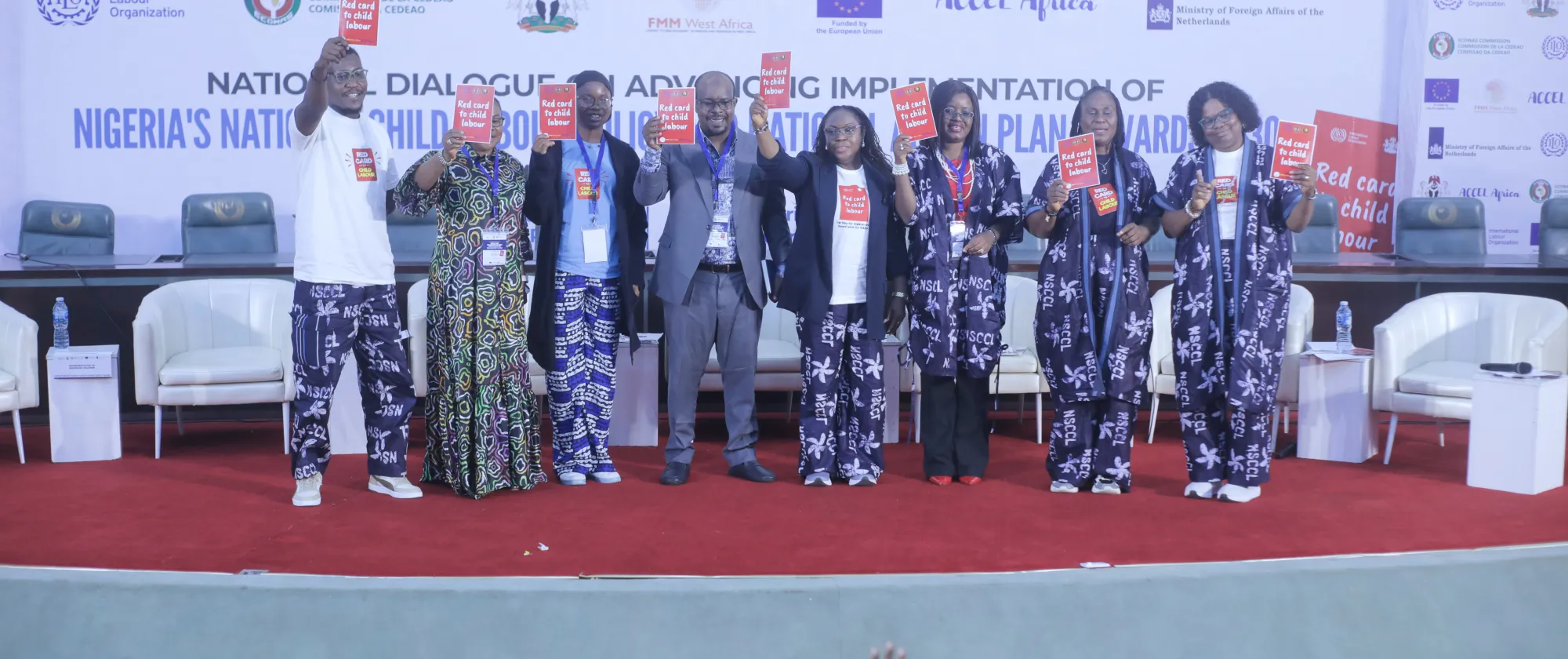
Nigeria launches National Policy and Action Plan to accelerate elimination of child labour
Nigeria has launched the third edition of its National Policy on Child Labour and National Action Plan for the Elimination of Child Labour, reinforcing the country's commitment to accelerate action towards 2030. The ILO is supporting these efforts through the ACCEL Africa Project, financed by the Ministry of Foreign Affairs of the Netherlands.
29 September 2026
ABUJA (ILO News) - Nigeria has renewed its commitment to eliminating child labour with the launch of the third edition of the National Policy on Child Labour and National Action Plan for the Elimination of Child Labour, placing stronger emphasis on translating national commitments into concrete action for children, families and communities.
The policy and action plan were launched on 16 September 2026 in Abuja during the National Dialogue on “Advancing the Implementation of Nigeria’s National Policy and National Action Plan towards 2030: From Commitment to Action.”
President Bola Ahmed Tinubu, represented by the Secretary to the Government of the Federation, Senator George Akume, described the elimination of child labour as a national development priority. The Government pledged to strengthen labour administration, including through improved labour inspection, while addressing underlying factors that increase children's vulnerability to child labour, such as poverty, inadequate access to quality education and gaps in social protection and child protection systems.
“The Federal Government considers the elimination of child labour not merely as a labour issue, but as a national development priority,” President Bola Ahmed Tinubu, represented by the Secretary to the Government of the Federation, Senator George Akume
The Minister of Labour and Employment, Dr. Muhammad Dingyadi, described child labour as a significant challenge to human dignity, social justice and sustainable development, stressing that eliminating it requires coordinated action across government and society.
He called on state governments to domesticate and implement the National Policy and National Action Plan and encouraged the Nigeria Governors’ Forum and Nigeria Governors’ Spouses Forum to champion child protection initiatives at state level. He also highlighted the role of the National Assembly in strengthening legislation and supporting initiatives that protect children and vulnerable families.
The dialogue highlighted the importance of translating national policies into action at state, community and supply-chain levels. This includes strengthening institutions, improving protection for vulnerable households, promoting decent work for adults and ensuring that children have access to education and other essential services.
The Ambassador of the Kingdom of the Netherlands to Nigeria, H.E. Bengt van Loosdrecht, highlighted the importance of responsible and sustainable supply chains in addressing child labour. Through the ILO’s Accelerating Action for the Elimination of Child Labour in Supply Chains in Africa (ACCEL Africa) Project, the Netherlands supports efforts to address child labour in Nigeria, with particular attention to the cocoa and gold supply chains.
The Ambassador emphasized that responsible sourcing, stronger relationships with suppliers, and progress towards living wages and incomes can contribute to more resilient supply chains while reducing the risks of child labour. Addressing human rights risks in supply chains, he noted, is not only a question of meeting international standards but also makes long-term business sense by reducing reputational, production and supply-chain risks.
He welcomed ACCEL Africa’s approach of working simultaneously with public institutions, the private sector and civil society to address the complex and interconnected drivers of child labour.
“What encourages us about the ILO ACCEL Africa project is precisely this integrated approach – strengthening institutions, engaging the private sector and supporting civil society at the same time,” Ambassador of the Kingdom of the Netherlands to Nigeria, H.E. Bengt van Loosdrecht
ILO Country Office for Nigeria Director, Dr. Vanessa Phala, highlighted Nigeria’s role as an Alliance 8.7 Pathfinder Country and its efforts to incorporate the Marrakech Call to Action recommendations into its national policy and action plan. This, she noted, demonstrates national ownership and continued commitment to accelerating progress towards the elimination of child labour.
The launch also marked an important transition from policy development towards implementation and measurable results.
“Today is more than a national dialogue. It marks our collective movement from policy formulation to implementation, from commitment to measurable action and from aspiration to tangible results for Nigerian children and their families,” ILO Country Office for Nigeria Director, Dr. Vanessa Phala.
She called on stakeholders to ensure that the National Policy and National Action Plan become practical instruments for change as Nigeria works towards its 2030 objectives.
The National Dialogue brought together government institutions, employers’ and workers’ organizations, development partners and other stakeholders, underscoring the importance of coordinated action to address the multiple factors that contribute to child labour.
Goodwill messages were also delivered by representatives of the ECOWAS Commission, the Nigeria Governors’ Spouses Forum and social partners, including the Nigeria Employers’ Consultative Association (NECA), Nigeria Labour Congress (NLC) and Trade Union Congress (TUC).
Through the ACCEL Africa Project, the ILO continues to support Nigeria in strengthening institutional capacity, promoting responsible business practices and fostering collaboration among government, employers, workers and civil society to accelerate progress towards the elimination of child labour.
Relevant projects

Accelerating action for the elimination of child labour in supply chains in Africa (ACCEL Africa)