Advancing social justice, promoting decent work
ILO is a specialized agency of the United Nations
English
News-casting laborer
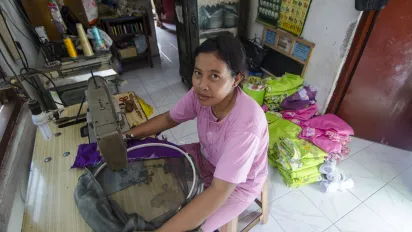
This is Ari Widiastari’s activity when she does not work at her factory. Her expertise in public speaking shall not be doubted any longer. At least twice a week, Ari Widiastari, who is popular with her nickname Dias, says hello to her fans on air.
This is Ari Widiastari’s activity when she does not work at her factory. Her expertise in public speaking shall not be doubted any longer. At least twice a week, Ari Widiastari, who is popular with her nickname Dias, says hello to her fans on air.
And, this is where Dias always works, at a community radio called “Marsinah”, which is named after a female worker who was murdered in 1993 and whose case remains unsolved till today. This name then inspires female workers to be brave, progressive and smart.
[sound on tape] Dian Septi Trisnanti, Marsinah FM Person-in-Charge “Yes, we chose the name of Marsinah, because Marsinah is indeed the name of a woman, a figure who had courage to fight against cheap labor, which is still one of the labor problems now.”
For workers at Kawasan Berikat Nusantara industrial estate in Cakung, North Jakarta, the name of Marsinah radio is not something new, because this radio has given a lot of enlightenment, particularly for female workers.
Also at this radio, Dias learns a lot of things. Dias is not a professional newscaster. She is only a factory workers who very much wishes to learn.
[sound on tape] Ari Widiastari, Newcaster of Marsinah FM Radio "One of them is to improve knowledge, learning a lot. That’s the reason why I could get involved in this Marsinah radio.”
Dias’ awareness on the importance of labor normative rights did not just suddenly come up. Her past experience has been a precious lesson for her that the rights of female workers are actually equal to their male colleagues.
Now, through “Perempuan Pelita” talk-show, which is on air at 4 p.m. every Thursday, Dias wants to inspire women to not easily give in to the conditions they are facing. Moreover, female workers at Kawasan Berikat Nusantara also receive a lot of mistreatment, such as oppression or sexual harassment, and most of them are reluctant to speak. Therefore, this radio was established to encourage female workers to speak.
[sound on tape] Ari Widiastari, Newscaster of Marsinah FM Radio “I was interested to join because I also experienced some discrimination. Most of the workers at KBN (Kawasan Berikat Nusantara) are women. We want to be equal. Men and women must be equal. In this case, we want our wages to be equal, because we have equal working power.”
Unlike other radios in general, Dias is not paid to work at this community radio. She does her works voluntarily and without payment, because Marsinah radio is only a non-profit community radio.
[sound on tape] Dian Septi Trisnanti, Marsinah FM Person-in-Charge "Besides those from newscasters, the contributions come from the Cross-Factory Labor Forum. They bind each other. We wish Marsinah to be independent, but it is still difficult, because at present, it comes only from the Cross-Factory Labor Forum whose members are about 5,000 workers.”
For Dias, opportunities to learn and share with other workers are more valuable than others. And, it cannot be replaced by money. Therefore, Dias is not tempted to leave this radio.
[sound on tape] Ari Widiastari, Newscaster of Marsinah FM Radio “I don’t have any wish to quit. What I dream of is how to make it bigger, to make it improved, because it is our radio.”
Dias’ resoluteness in fighting for the rights of female workers is not just empty words. It can be seen from her activities either in mass protests or radio campaigns in fighting for the rights of female workers. Therefore, it is not surprising if many of her colleagues very much respect her.
[sound on tape] Roy, Ari’s colleague “Now, she knows more about law. She really wants a change for workers, so they will not be just workers. She is the best, because she knows a lot about law.”
[sound on tape] Sari, Ari’s neighbor “In the past, she was just a worker. But now, she is more experienced, different from her past days. She once focused only on her job and then, just stayed at home. Now, she has many friends, many acquaintances. She shares everything with her friends. It’s good for them, too, to improve themselves.”
When morning has broken, Dias immediately packs up. On this day, she has to work the morning shift. From her house, Dias is going to her toothpick factory, her workplace that is about 2.5 kilometers away at Kawasan Berikat Nusantara. Dias has been working for five years for the factory.
Kawasan Berikat Nusantara is indeed identical to laborers, because in the industrial estate, hundreds of factories employ about 80,000 workers and 90 percent of them are female workers. And female workers are mostly vulnerable to many things. Therefore, awareness for female workers is important. Female workers are demanded to be more courageous in expressing their opinions.
In line with technology development, information sharing on labor issues is not a difficult thing to do. The birth of various media, such as Marsinah FM Radio, has proven that the needs of female workers must be paid attention.
[sound on tape] Ari Widiastari, newscaster of Marsinah FM "Soon after Marsinah was established, I have been trying to make it a place or a facility for my colleagues to express their anger. We also feel helpful with political issues, which have been on the rise.”
Now, Marsinah Radio has been one of pioneer radios in Indonesia that focuses itself on the issues of workers and women. And Dias is one among many examples of laborers who have been aware that it is only through information media, that female workers will be enlightened.
This script is the first script on from a series of three segments of TV documentaries on labour media campaign through radio by Jekson Simanjuntak and Dina Karina of Berita Satu TV and broadcasted on 15 May 2013. The script is part of the ILO’s media fellowship programme on gender and employment, jointly conducted in collaboration with the Alliance of Independent Journalists (AJI) Jakarta and six selected leading, national mass media. The media fellowship programme was part of the campaign conducted by the ILO through its Access to Employment and Decent Work for Women Project, funded by the Australian Government.