

Labour Migration Governance in Focus: Youth and Media Engagement in Uganda
On the same day in Kampala, university students and journalists were pulled into the same conversation about labour migration from opposite ends, one through a public lecture at Makerere, the other through a media breakfast, each leaving better equipped to navigate or report on it responsibly.
31 October 2025
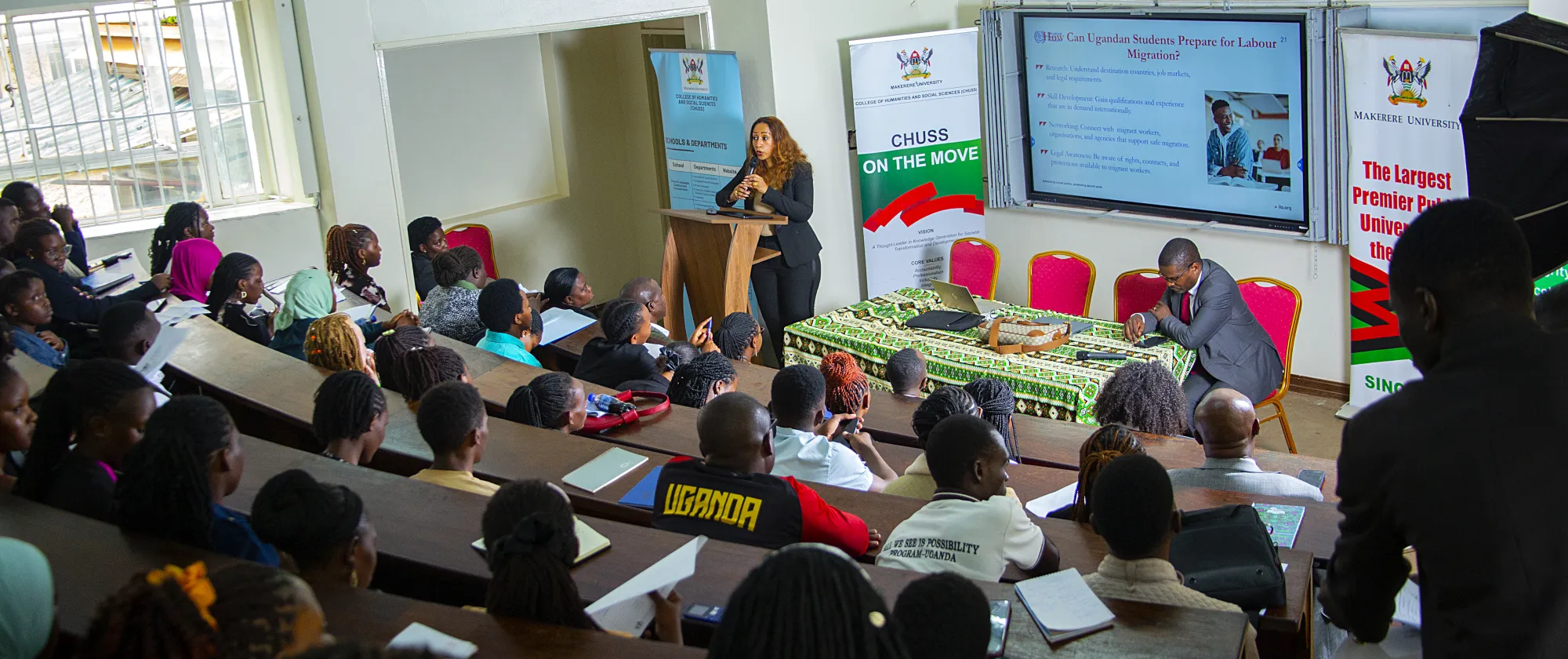
On 30 October 2025, the International Labour Organization (ILO) under the UK FCDO-funded Better Regional Migration Management (BRMM) Programme, convened two complementary engagements in Kampala: a public lecture at Makerere University and a Media Breakfast Meeting at Fairway Boutique Hotel. These events brought together eighty plus university students, media professionals, government representatives, workers’ and employers’ organisations, and other migration stakeholders, to strengthen understanding of Uganda’s labour migration dynamics. Both engagements focused on promoting safe, regular, and orderly labour migration grounded in evidence, rights-based approaches, and informed public discourse.
Uganda plays a significant role in the East and Horn of Africa migration landscape, as both a country of origin and destination. The country hosts large numbers of refugees and internally displaced persons, with migration flows driven by economic pressures, conflict, and environmental shocks. In Uganda, with approximately 78 per cent of the population under the age of 35, youth unemployment and underemployment remain pressing challenges. At the same time, Uganda is a major country of origin for migrant workers, particularly to Gulf Cooperation Council (GCC) countries, with remittances estimated at USD 1.42 billion in 2024. In this context, access to accurate information and increased public awareness are critical.
At Makerere University, the public lecture delivered by the ILO BRMM Chief Technical Advisor, Ms. Aida Awel, examined the relevance of labour migration for Uganda’s youth. The session highlighted key drivers of migration, including economic aspirations and skills development opportunities, while also addressing the risks associated with poorly governed migration. The lecture presented global, regional, and national migration trends, noting that there were an estimated 167.7 million migrant workers worldwide in 2022, alongside rising labour migration flows from Uganda to Arab States. Ms. Awel further provided an overview of Uganda’s legal and policy framework and outlined the labour migration cycle, including pre-departure preparation, employment rights, contract requirements, grievance mechanisms, and reintegration considerations.
The engagements enhanced students’ awareness of safe migration practices, including the importance of verifying information, understanding contractual obligations, and accessing support services before departure.
The Media Breakfast Meeting brought together approximately 50 journalists and editors, alongside representatives from the Ministry of Gender, Labour and Social Development, the National Organisation of Trade Unions, the Federation of Uganda Employers, Wezesha Impact, and other stakeholders. The programme featured opening remarks, a keynote address on Uganda’s labour migration landscape, a presentation on BRMM regional interventions, and a technical session introducing the ILO media toolkit and guidance on ethical migration reporting.
Media participants were equipped with updated migration data, terminology guidance and practical tools to support accurate and responsible reporting. Discussions emphasised the media’s role in countering misinformation, amplifying migrant voices, and shifting narratives from crisis-orientedreporting to more balanced, human-centred and evidence-based storytelling. The importance of collaboration between journalists and migration stakeholders was also highlighted as key to improving public discourse.
Together, the two engagements underscored the critical role of youth and media in shaping labour migration outcomes in Uganda. Strengthened collaboration between academic institutions, media, government, and social partners will be essential to promoting safe, regular, and orderly labour migration. The ILO BRMM Programme reaffirmed its commitment to supporting informed dialogue and advancing labour migration governance in Uganda and across the region.
Relevant projects

East and Horn of Africa
Better Regional Migration Management