


Investment facilitation for decent work
Strengthening the role of Investment Promotion Agency in promoting quality Foreign Direct Investment and the creation of more and better jobs
13 July 2026
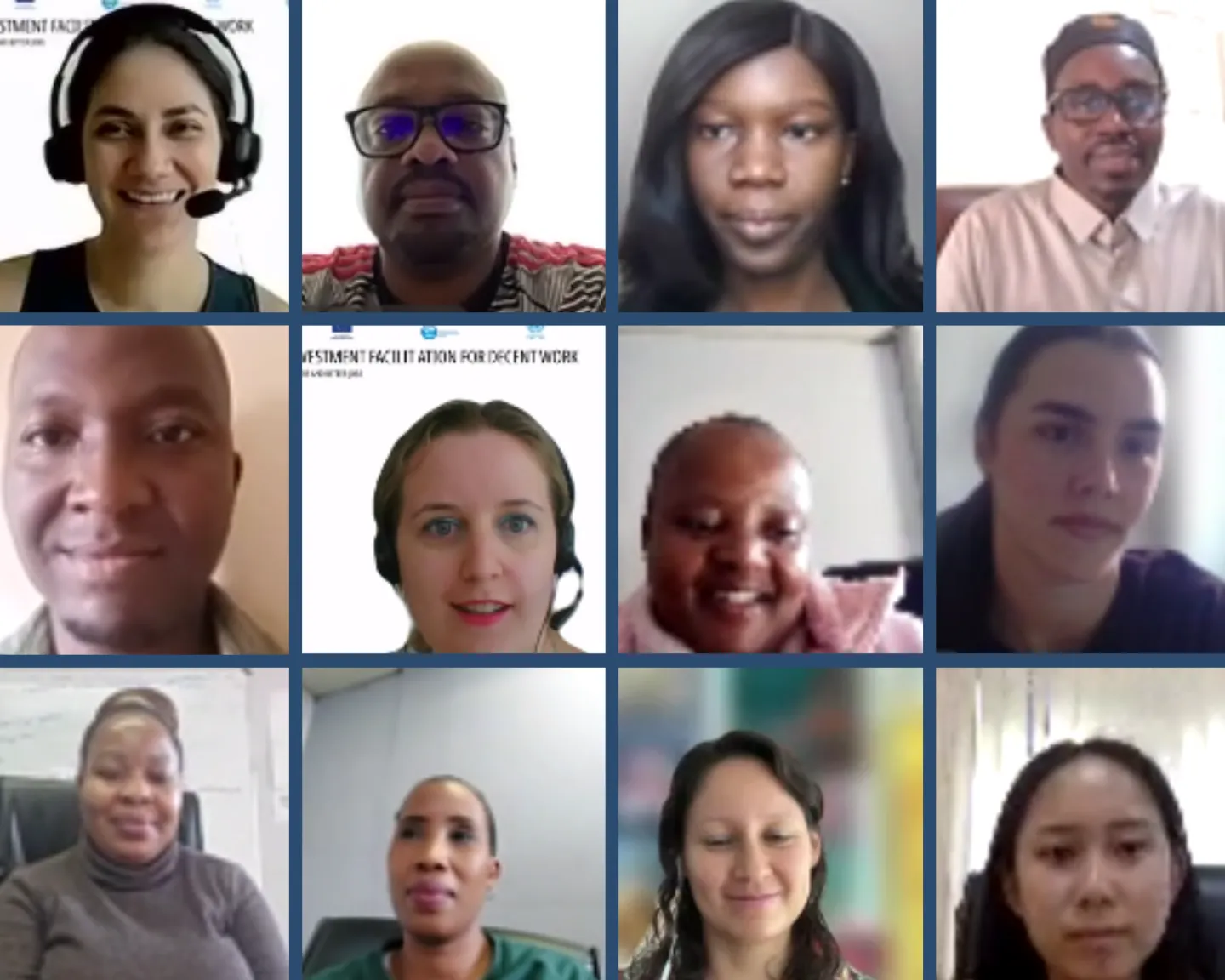
Investment promotion agencies (IPAs) from Africa and beyond took part in the course "Effective Investment Facilitation for Decent Work", organized by the International Labour Organization and the World Association for Investment Promotion Agencies (WAIPA), facilitated by the International Training Centre of the ILO – ITCILO.
The course was presented in a virtual online format and took place from 29 June to 10 July. The main objective of the course was to further develop the capacities of Investment Promotion Agencies on how to further embed decent work and employment considerations into the investment facilitation cycle, through the promotion of International Labour Standards and standards of responsible business conduct, in particular the ILO Tripartite Declaration of Principles concerning Multinational Enterprises and Social Policy.
The course, which takes place annually, responds to a growing policy priority: how to make sure FDI leads to more and better jobs, and how to further align foreign direct investment with national development priorities. This requires a shift in strategy and thinking about FDI. In particular, ensuring that investment attraction and facilitation strategies not only focus on the quantity of FDI but also on its quality and development impact.
Participants discussed how IPAs can help translate investment into decent work outcomes by promoting job creation, skills development, gender equality, occupational safety and health, local linkages, productivity, innovation and alignment with national development priorities.
A central focus of the training was the role of responsible business conduct in defining and guiding quality FDI. Participants examined key international frameworks, including the ILO MNE Declaration, the UN Guiding Principles on Business and Human Rights and the OECD Guidelines for Multinational Enterprises for Responsible Business Conduct, and considered how these instruments can help IPAs communicate expectations to investors, advise governments on enabling policy environments and support partnerships that strengthen the contribution of investment to decent work.
The course also introduced practical tools for measuring and managing investment impact. Participants explored the OECD FDI Qualities indicators and the ILO-WAIPA KPIs for Decent Work, with a focus on how IPAs can move beyond traditional indicators, such as investment value and jobs announced, toward a more comprehensive assessment of job quality, skills, social protection, local sourcing, responsible business conduct and sustainable development outcomes. Discussions emphasized that IPAs do not need to measure everything at once, but can start with a small set of feasible indicators, use existing investor interactions and build partnerships with government institutions, employers’ and workers’ organizations, academia and development partners.
Peer learning was an important element of the course. IPAs from Ghana, Egypt and Botswana shared practical experiences on investment value propositions, monitoring and impact measurement, aftercare services and partnerships. These examples helped participants reflect on how similar approaches could be adapted to their own institutional contexts and used to strengthen investor support, policy advocacy and long-term development impact.
The final session consolidated learning through a quiz and participant reflections on key takeaways, including the importance of quality FDI, aftercare, KPIs, local linkages, skills development and measuring investment impact beyond the value of FDI attracted. Participants were encouraged to join the community of practice for IPAs to continue peer-to-peer exchange after the course. As a final assignment, teams are tasked with developing practical action plans that their IPAs or related organizations could begin implementing within 6-12 months to better integrate decent work and responsible business conduct into investment facilitation activities.
By combining international frameworks, practical tools, country experiences and peer exchange, the course strengthened participants’ capacity to promote investment facilitation strategies that support sustainable development and more and better jobs.
About the SUSTAIN Project:
The project “Promoting decent work and capacity building for labour ministries, labour inspections and social partners to advance international labour standards and responsible business conduct through sustainable trade and investments in Southern Africa (SUSTAIN – Southern Africa)” aims to further harness trade and investment to advance decent work opportunities for women and men in Southern Africa through increased respect for International Labour Standards and the adoption of responsible and sustainable business practices, guided by the ILO MNE Declaration. The SUSTAIN project is financed by the European Union
Relevant projects
SUSTAIN
Sustainable Trade and Investment in Southern Africa