Advancing social justice, promoting decent work
ILO is a specialized agency of the United Nations
English
International Day of Care
Inclusion, care and support: Meet the Disability Inclusion Facilitators
Disability Inclusion Facilitators are ensuring persons with disabilities get equal access to opportunities in an effort to advance social justice and decent work for all.
“We’re helping people with disabilities realise that they can do everything persons without disabilities can, as long as they get the right support” – Aarti, Disability Inclusion Facilitator.
Of the 1.3 billion people in the world, 16 per cent, live with some form of disability. This is almost the size of the population of India – no small metric. Historically, persons with disabilities (PwDs) face socioeconomic marginalization owing to poorer health, educational and nutritional outcomes that can keep them trapped in a cycle of poverty. A majority of them are concentrated in rural communities, with whom Disability Inclusion Facilitators (DIFs) like Sumitra, Aarti and Dattatray are working to raise awareness, advocate for their rights and converge with various government departments to enable them to access social protection services, benefits and employment.
Who is a Disability Inclusion Facilitator (DIF)?
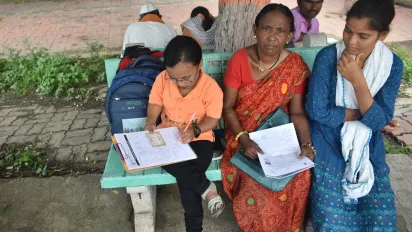
Aarti is a DIF, one of the 11 young persons with disabilities, who was identified through a participatory process by the ILO’s SPARK project in Maharashtra’s Washim district. DIFs like her, Sumitra, and Dattatray have diverse disabilities like physical impairments or low vision and speech impairments. They are being trained on disability inclusion strategies, approaches and models, how they should communicate about the barriers they face, and the legislations and schemes available for persons with disabilities. The DIFs act as a bridge between persons with disabilities, the community and Self-Help Groups (SHGs), which are savings and lending groups that help people access microfinance. They are working to change attitudes and perceptions of and about persons with disabilities through awareness raising and capacity building to help integrate persons with disabilities with SHGs to start their own enterprises.
Why are DIFs important?
Sumitra understands first-hand the barriers faced by persons with disabilities, which range from physical barriers preventing people from accessing certain spaces to attitudinal barriers that reflect in people’s prejudices and beliefs resulting in discriminatory and exclusionary practices. Before becoming a DIF, she worked at a Common Service Centre and was also trained in sign language in Marathi to teach children up to the age of nine. With 25 villages to service, her days are long, as she holds dialogues with persons with disabilities and their caregivers, families and community members.
Initially, people engaged reluctantly, as they were used to the charity or medical model of disability, wherein they were treated as only recipients of care or persons in need of medical attention, not as people with equal rights who needed reasonable accommodation to integrate and participate in the society and economy. Awareness raising is at the core of a DIF's work, to advocate and demonstrate how any sphere can become disability inclusive when the right support is provided to people depending on their needs.
“People have cried in front of me as they felt that for the first time, they were being spoken to and not spoken at” – Sumitra, Disability Inclusion Facilitator.
A day in a DIF’s life
In Washim, dozens of villages range from 300 to 8000 inhabitants. Estimates suggest that nearly 2.21 per cent of the population is persons with disabilities, which makes it approximately 10 to 80 persons with disabilities in any village. By mainstreaming disability and helping people fully participate in the economy by linking them with livelihood opportunities, communities can help advance social justice and promote decent work for all women and men.
From bringing a mindset change in her community and the local administration to practically helping people access government schemes, loans and skills training, a DIF’s work is tireless. 19-year-old Aarti either takes the bus or walks a few miles to visit different villages, as she recognises the importance of her work to bring a grassroots-level shift and impact.
“As persons with disabilities can need physical support from people around them, they are discriminated against and have a lesser voice in decision-making spaces. Through the SPARK project, they are feeling encouraged to do more with their lives” – Aarti, Disability Inclusion Facilitator
As a step towards disability inclusion, the Government of India enacted the Rights of Persons with Disabilities Act 2016, which is based on the principles of the UN Convention on the Rights of Persons with Disabilities (CRPD). The DIFs help persons with disabilities access benefits meant for them, such as cash transfers, assistive devices, and access to employment, by ensuring the Unique Disability ID (UDID) cards issued by the Government of India are provided to them.
Another important aspect of their work is to link people with Self-Help Groups. One woman linked with the SHG was able to get an INR 25,000 loan and started a goat-rearing business, while another visually impaired woman began a turmeric business. One DIF also secured financial assistance of INR 40,000 from the District Social Welfare Office for an assistive device for mobility.
The DIFs are also promoting disability inclusion and the rights of persons with disabilities by writing slogans in prominent areas in the villages.
What are their challenges and the changes they see?
Dattatray worked with a private telecom company before becoming a DIF. He covers the villages of the most marginalized tribal communities, making gaining their confidence to bring them to mobilization and awareness-raising meetings time-consuming. Even the local administration took several meetings with the DIFs to warm up to the idea of disability inclusion. However, they have seen a breakthrough as the administration is now more forthcoming in their engagements with the DIFs and persons with disabilities, while even the communities are more receptive to information and taking proactive action.
“I want to change the mindset of ‘I can’t do anything’ to ‘I can do anything’ of persons with disabilities” – Dattatray, Disability Inclusion Facilitator
Sumitra finds the challenges more tactical, with facilities at the Common Service Centres spread far apart, which makes it difficult for persons with disabilities to access the services they need easily. She wishes to incorporate the principles of reasonable accommodation for everyone’s benefit.
As for Aarti, she is perceptive to the discrimination that persons with disabilities face and the additional discrimination faced by women.
“Women don’t have the same freedoms as men to move about. I also live with a disability; however, my family is supportive, and I wish to see the same mindset for others” – Aarti, Disability Inclusion Facilitator
About the SPARK project
In India, Disability Inclusive Rural Transformation – SPARK project is implemented in collaboration with Mahila Arthik Vaikas Mahamandal (MAVIM), Government of Maharashtra for inclusion of Persons with Disabilities in International Fund for Agricultural Development (IFAD) supported Nav Tejaswini project in Maharashtra. The Nav Tejaswini project aims to enable one million poor rural households overcome poverty sustainably while improving rural women’s capacity to develop sustainable enterprises, engage in remunerative employment, and access markets.