Advancing social justice, promoting decent work
ILO is a specialized agency of the United Nations
English
“I want homeworkers to be acknowledged as workers”
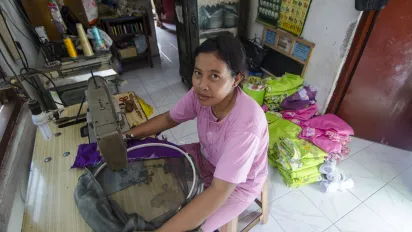
Ida Fitriany has learned a lot about homeworkers issues since joining Yasanti’s programme with ILO MAMPU Project. She now knows that homeworkers are workers and have the rights as other workers and she wants to keep voicing these rights.
Ida Fitriany has learned a lot about homeworkers issues since joining Yasanti’s programme with ILO-MAMPU Project. She now knows that homeworkers are workers and have the rights as other workers and she wants to keep voicing these rights.
Ida, 47 years old, lives in a village in Ungaran, Semarang District with her husband and two children aged 12 (a girl) and 15 (a boy). Her husband of almost 17 years works as a seasonal worker on event organizing, working blue collar jobs when an event organizer calls for him. Mrs. Fitriany receives some hundred thousand Rupiah from her husband when he is paid for his job, but she never knows the full amount that her husband is paid for and she never asks.
She herself has been working as a homeworker since early 2000. She cut out dangling or messy threads from finished clothes and is paid a very small amount of IDR80 (USD0.006cent) per piece. She receives her work order in packets, each of which containing 10 clothes. She can complete 10 packets (100 pieces of clothes) per day, which means she earns IDR8,000 per day (USD0.67). If she works 30 days per months, she can make IDR240,000 (USD20) at the end of the month; if not, she makes less. Further, this homework comes to her only between December and May the next year, as that is the period when many garment companies export their products.
She receives work order, retrieve the clothes and submit completed work to a middlewoman who lives within walking distance from her house. She knows also the name of the company she is working for up the chain, but she refuses for the name to be stated here out of fear of repercussion such as losing her job.
To earn more income for her family, she also open a warung (kiosk) at her house, selling mostly groceries. The kiosk used to make IDR300,000 per day when there were not many kiosks in her neighborhood. Now, the kiosk only makes IDR100,000 per day. Ida also sells clothes that she bought from other places and she allows customers to pay in credits. The income varies depending on whether or not customers pay the credits in time.
With all of these work and her husband’s work, she knows that the family income is above the minimum regional wage, yet she does not participate in the government’s social security programme such as BPJS because she does not know how to access one. She also sends her children to schools in which the tuition is paid by the government. This helps her family to have enough money to eat and to save so that her children can access higher education in the future.
Her fellow homeworkers considered her as a quite successful small entrepreneur and thus, trusted her to become the leader of their group, “Perempuan Mandiri (Independent Women)”. The group has 32 members and been involved with women empowerment activities since 2010, facilitated by Yasanti. Yasanti is a local NGO working in DI.Yogyakarta and Central Java and since 2014 has become one of the Implementing Partners of the ILO-MAMPU – Access to Employment and Decent Work for Women Project funded by the Government of Australia.
Since Yasanti has become the Implementing Partner of the ILO/MAMPU Project, she said, “I have participated in training of occupational safety and health, gender training and involved in development of education modules for homeworkers. I also participate in monthly meetings, where we talk about our problems as homeworkers and try to find solutions.” Ida further expressed that she has learned a lot about homeworkers issues through Yasanti. With a hint of hesitation, she said,
“I want homeworkers to be acknowledged as workers. I want our rights as workers to be acknowledged and I want written contract between us and our employers.”
Asked why she hesitated,Ida explained that she’s afraid that their employer will stop giving them work if they are too vocal. But asked whether she would continue to be involved in homeworkers’ issues, she firmly said, “Oh, definitely.” We need more brave women like her and we need to voice her rights as a homeworker.