

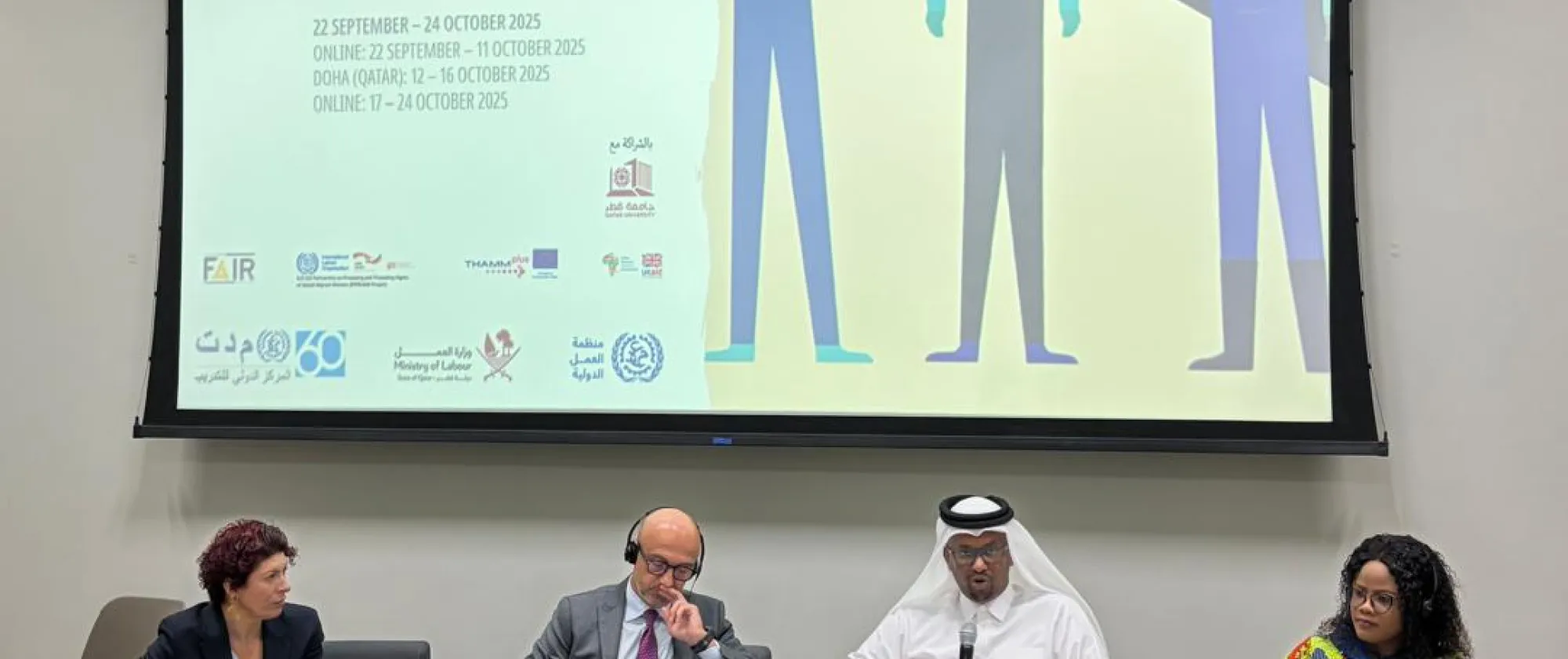
Global training in Doha strengthens action toward fair recruitment and labour rights
The ILO, ITCILO and Qatar's Ministry of Labour brought together 60 participants from over 20 countries in Doha for a week-long training on fair recruitment, covering everything from forced labour prevention to gender and data-driven policymaking, with participants leaving with national action plans in hand.
17 October 2025
The International Training Centre of the International Labour Organization (ITCILO) successfully concluded the residential phase of its global training course, “Enhancing Fair Recruitment Processes 2025,” hosted at Qatar University. This training was organized in collaboration with the Ministry of Labour of the State of Qatar and the International Labour Organization (ILO), through the Country Office in Doha. The course brought together 60 participants from over 20 countries, including representatives from governments, employers, workers’ organizations, private employment agencies, academia, and technical experts. Held in Doha, the residential phase provided a dynamic platform for participants to exchange experiences, deepen their knowledge, and strengthen action toward fair recruitment systems grounded in labour rights and social justice.
The opening session set the tone for a week of interactive learning and dialogue, highlighting the human dimension and transformative potential of fair recruitment. Speakers emphasized the importance of ensuring that fair recruitment becomes the global norm rather than the exception. At the outset, partners underscored the strong collaboration underpinning the initiative, particularly between the Ministry of Labour of Qatar and the ILO under the Fair Recruitment Initiative. This partnership reflects a shared commitment to advancing fair recruitment practices globally.
Opening remarks were delivered by distinguished representatives from government, academia, and the ILO. Hamad Faraj Dalmouk, Assistant Undersecretary for Migrant Labour Affairs at Qatar’s Ministry of Labour and Co-Chair of the Fair Recruitment Initiative highlighted Qatar’s commitment to transparent, accountable and equitable labour market. He emphasized ongoing efforts to regulate recruitment and employment processes to ensure they are free from exploitative practices and protect the rights of all workers and employers.
Francesco d’Ovidio, Director of the ILO Country Office for the State of Qatar, noted that fair recruitment is a critical first step towards achieving decent work, enabling workers to make informed migration decisions. He also highlighted the forthcoming Fair Recruitment Initiative Strategy 2026–2030, which aims to move from principles to strengthened implementation and enforcement. Dr. Aiman Erbad, Vice President for Research and Graduate Studies at Qatar University reaffirmed the university’s commitment to supporting knowledge-sharing and capacity-building. He underscored the role of education and collaboration in shaping practical solutions that improve the lives of workers globally. Sarah Opokua Asare, Ghana’s Minister-Counsellor and Head of Chancery and Diaspora Affairs, and Co-Chair of the Fair Recruitment Initiative commended the collaboration between Qatar and Ghana and reaffirmed Ghana’s commitment to advancing fair recruitment in line with international labour standards. She highlighted Ghana’s development of a National Roadmap for Fair Recruitment, as a key step towards strengthening transparent and accountable systems.
The session was moderated by Zeina Mezher, Course Manager at ITCILO, who situated the discussion within the broader framework of international labour standards and fair recruitment principles. Over five days (October 12–16), participants engaged in interactive sessions, case studies, and a field visit covering key dimensions of fair recruitment. Topics included the role of private recruitment agencies and public employment services, human rights due diligence, prevention of forced labour, access to justice, regulatory frameworks, gender and intersectionality, the care economy, data-driven policymaking, and labour inspection and enforcement mechanisms. Participants also worked in groups to develop national action plans, translating the knowledge gained into practical strategies tailored to their respective country contexts. The course reaffirmed that fair recruitment is a shared responsibility among all stakeholders and a critical pathway to promoting decent work and well-functioning labour markets.
Relevant projects

East and Horn of Africa
Better Regional Migration Management