Advancing social justice, promoting decent work
ILO is a specialized agency of the United Nations
English
Forgotten heroes of the ocean
Efforts to get income by women in fishing villages are only limited up to earning enough to support their husbands. None have encouraged them to improve what they do, and to not just stop at getting additional income.
Efforts to get income by women in fishing villages are only limited up to earning enough to support their husbands. None have encouraged them to improve what they do, and to not just stop at getting additional income.
The sun was so hot that the heat was scorching the village of Morodemak in Bonang District, Demak Regency, Central Java Province. Despite the heat, some old women in the village continued to keep themselves busy; back and forth carrying and drying fish under the sun at the Morodemak PPP (Coastal Fishing Port).
Once in a while, the women moved fish earlier dried in the sun, into some huts built along the Morodemak PPP wharf, where the fish would be processed. “We are now drying some large-head hair-tails, Sir. If you want, it’s Rp. 10,000 per kilogram,” Annisa, a woman of the fishing village, told Media Pembaruan.
Here, Media Pembaruan had a chance to see the activities in one of the fish-processing huts. In the hut, there were more than 10 bamboo-plaited baskets full of various types of fish; from hair-tails, anchovies to several kinds of shrimps.
Having been for years
“I have owned this place for 20 years. I have been working in this wharf for a long time. When this place was still a fish pond, muddy and forested, I had been at work. Now, this is my business, dealing with fish caught by fishermen,” she recalled. Blue-spot mullets, shrimps, anchovies and many other kinds of fish were seen. “If the fish is bought, the fishermen will be happy,” Jamah, 60, told Media Pembaruan, who met her at a fish-processing hut.
Jamah’s income is relatively high. “In a day, I can get not only in kilograms, but it can be a ton or five quintals. That’s when the fish is there. But when the moon is full like today, there is only a few fish, about four or five quintals because many fishing boats do not go out to the sea. I’m going to sell these to Semarang, Jakarta, Solo, Yogyakarta, Cirebon, Ciamis, Sragen. I’m only a small entrepreneur, so I only sell fish to those who offer the highest price,” Jamah said in her thick Javanese accent.
Cracker Producer
Besides Jamah, Media Pembaruan also met Kuniah (35), a woman in the fishing village who makes fish crackers every day. According to her, working activities done by women in the village are not more than assisting their husbands.
“The function of the women is to help their husbands at home. The women at this fishing area are traders, buying and reselling fish, or processing the fish to be crackers. What I do is making crackers,” she explained.
Just like Jamah, Kuniah was also involved in a business producing fish crackers made of the fish caught by fishermen in the fishing village. “We use giant feather-back. Some friends use ‘belung’ fish. I processed this fish to assist my husband. Thanks to God that sometimes, five or 10 kg can be sold in a day. But when I’m unlucky, no one buys. If I don’t assist my husband, his income will not be enough to live,” the mother of four said.
She could be proud because her first child is in the fourth semester at one of the country’s universities. The second child is in the second grade at an Islamic junior high school, the third in the first grade, while the youngest one is still in the third grade of elementary school.
Portrait
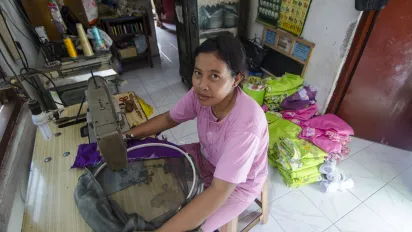
Women activity in the fishing village of Morodemak is one of the general portraits of women’s role in fishing villages in Indonesia. They support their families’ economy amid the mediocre life of fishermen.
“About 70 percent of protein produced at the national level is the result of our traditional fishermen’s hard works. And of the 70 percent, 48 percent is contributed by women in fishing villages,” Mida Saragih, coordinator for management and knowledge at the People’s Coalition for Justice in Fisheries (KIARA), told Media Pembaruan (26/3) in Jakarta.
The phenomenon can also be found in fishing villages from Batang Regency, Gresik Regency, Semarang to West Java. The women in those villages support their families’ economy by separating fish caught by fishermen for sale either in markets or fish auctions. “They also sometimes process the fish to be dried, salted fish and other kinds of processing food,” Mida added.
Regretting
In a separate occasion, Taufik Budi Pramono, a lecturer on aquatic cultivation of the Fisheries and Marine Department at the Jenderal Soedirman University in Purwokerto, Central Java, said Sunday (31/3) that he regretted the lack of attention from the government to empower efforts by women in fishing villages. According to him, if their businesses are empowered, it can contribute to efforts in alleviating poverty among coastal communities in Indonesia.
“Most government programs focus only on the works of fishermen, which are usually done by the husbands or sons. The government concentrates too much on production; how much fish can be caught and so on, while the women, who are mostly the wives of the fishermen, play big roles in further processing the caught fish, such as making crackers, shrimp paste and fish flour, which have high economic values,” the man, who graduated from the Bogor Institute of Agriculture, said.
Mida added that women’s suffering increases due to extreme weather problems. The conditions reduce the fishing days to between 160 and 180 days a year compared to the previous decade, which were between 240 and 300 days a year. “The minimum role of the government in dealing with conflicts, working on adaption for fishermen, as well as the lack of sea accident insurance and the unavailability of information on climate make the life pressure in coastal areas harder. In such difficult situation, women in fishing villages always become the backbone of their families.
This article is the first article on women in fishing industry from a series of two in-depth articles written by Adhitya Himawan of Media Pembaruan and published on 16 May 2013. The article is part of the ILO’s media fellowship programme on gender and employment, jointly conducted in collaboration with the Alliance of Independent Journalists (AJI) Jakarta and six selected leading, national mass media. The media fellowship programme was part of the campaign conducted by the ILO through its Access to Employment and Decent Work for Women Project, funded by the Australian Government.