Advancing social justice, promoting decent work
ILO is a specialized agency of the United Nations
English
Ethiopia Showcases Job Centres as Cornerstone of Skills-Led Economic Revolution
On 21 April 2026, high-level EU and Swedish officials visited Ethiopia's Bole Woreda 12 Job Centre to witness the country's employment and labour migration reforms. The visit demonstrated how Ethiopia's coordinated approach to labour market intermediation strengthens migration governance and supports inclusive economic development.
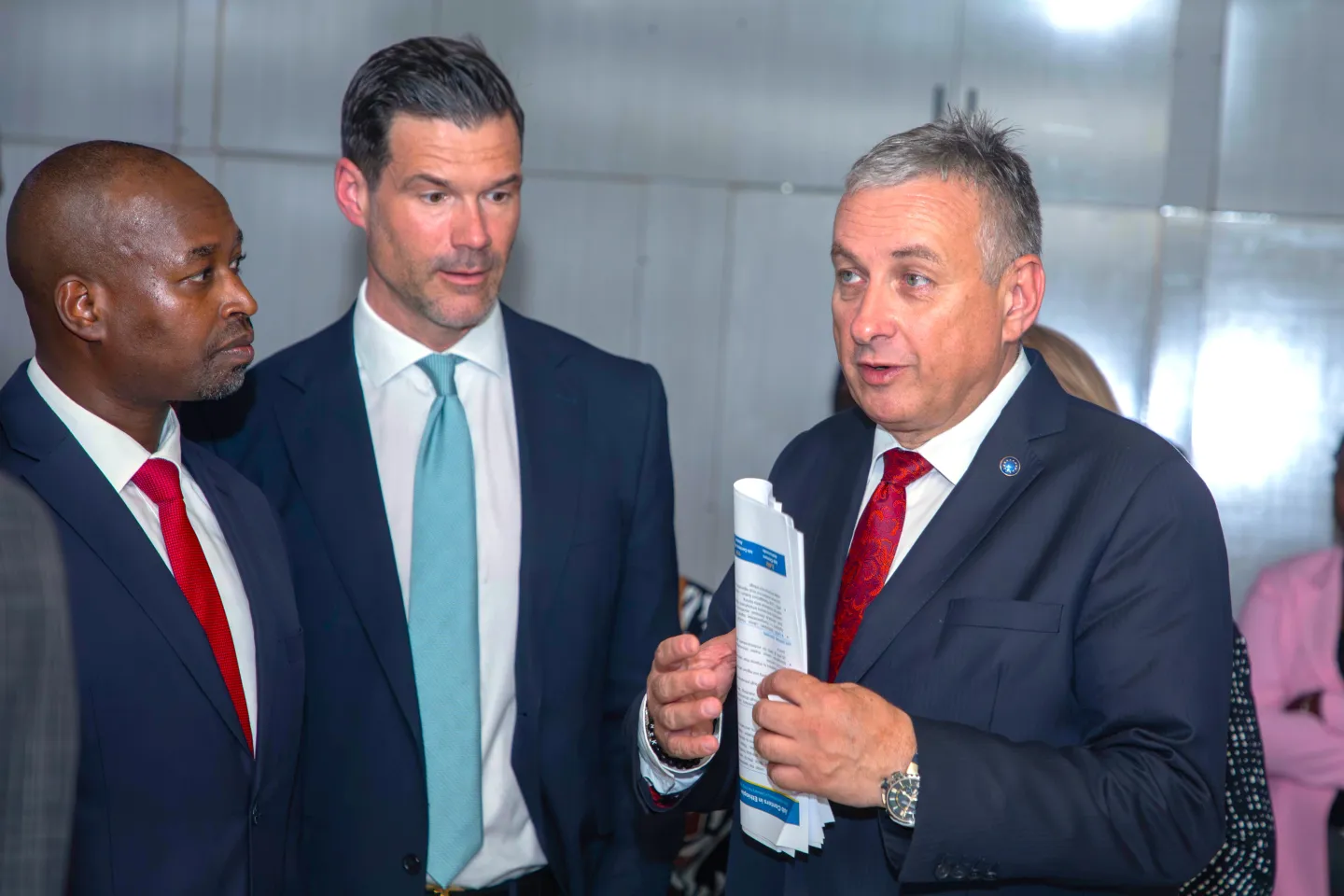
ADDIS ABEBA (ILO News) - The Ethiopian Ministry of Labour and Skills (MoLS), in partnership with the International Labour Organization and the International Organization for Migration, hosted a high-level visit on 21 April 2026 to the Bole Woreda 12 Job Centre in Addis Ababa. Led by H.E. Jozef Síkela, EU Commissioner for International Partnerships, H.E. Johan Forssell, Swedish Minister of Migration, H.E. Sofie From-Emmesberger, EU Ambassador to Ethiopia, and H.E. Magnus Lennartsson, Ambassador of Sweden to Ethiopia, the visit showcased Ethiopia's employment and labour migration reforms.
Accompanied by their delegations, the high-level visitors witnessed how the country’s 2,452 Job Centres deliver integrated services to job seekers, workers, returned migrant workers, and MSMEs through coordinated employment pathways supported by the Ethiopian Labour Market Information System (E-LMIS) digital platform and the EU-ILO programming.
Ethiopia's Job Centres function as one-stop service hubs linking citizens to employment opportunities, TVET training, entrepreneurship support, and safe labour migration pathways. Under the leadership of MoLS and regional bureaus, these centres serve the working-age population across three employment categories: domestic wage employment, self-employment and overseas employment.
The integrated system is further strengthened by the E-LMIS, which reduces information gaps between skills supply and labour demand, enabling more efficient matching and evidence-based planning.
“This centre is more than just a service point; it is a vital bridge connecting the potential of our citizens to the dignity of decent work. It stands as a cornerstone of our national strategy, grounded in the firm belief that our people, our human capital, are Ethiopia's greatest asset."
H.E. Solomon Soka, State Minister of Labour, Employment and Market Sector, Ministry of Labour and Skills
During the high-level EU and Swedish visit to Bole Woreda 12 Job Centre, delegates learned how Ethiopia’s Job Centres are strengthening employment and labour migration services for job seekers, workers, returned migrant workers and MSMEs.
The delegation observed the Job Centre's operational workflow and client-centred service delivery model, gaining insights into how services are delivered in practice. Hilina Demisse, E-LMIS Operation Director, presented the digital architecture linking job centres to E-LMIS, while Abraham Ayalew, Head of the Secretariat of the National Partnership Coalition on Migration (NPC), outlined the country’s migration coordination framework and governance structures. Practical demonstration by Job Centre staff and TVET partners illustrated how employment services align skills training to meet labour market demand.
Job Centres in Addis Ababa operate three integrated employment pathways, anchored by E-LMIS as the primary gateway for service access. The self-employment and wage employment pathways are further supported by Job Management System (JMS), which links potential MSMEs with business planning and government support, while also skills matching, employer linkage and formal job placement.
Complementing this, the overseas employment pathway spans the full migration cycle, with Job Centres using the E-LMIS to support registration, TVET training and certification, job matching, pre-departure preparation, deployment, and post-deployment monitoring. These pertinent reforms are further reinforced by EU-ILO and EU-IOM partnerships, which continues to strengthen the country’s migration governance.



 © ILO© ILO