


Emerging Insight: What is the impact of inclusive insurance on farmers’ production decisions?
Findings from a new systematic review of research studies on inclusive insurance.
11 November 2025
A new systematic review of academic research on inclusive insurance finds that inclusive insurance schemes have demonstrated significant potential in enhancing financial security, promoting health and well-being, fostering economic growth and building resilience against climate-related and other risks among underserved populations.
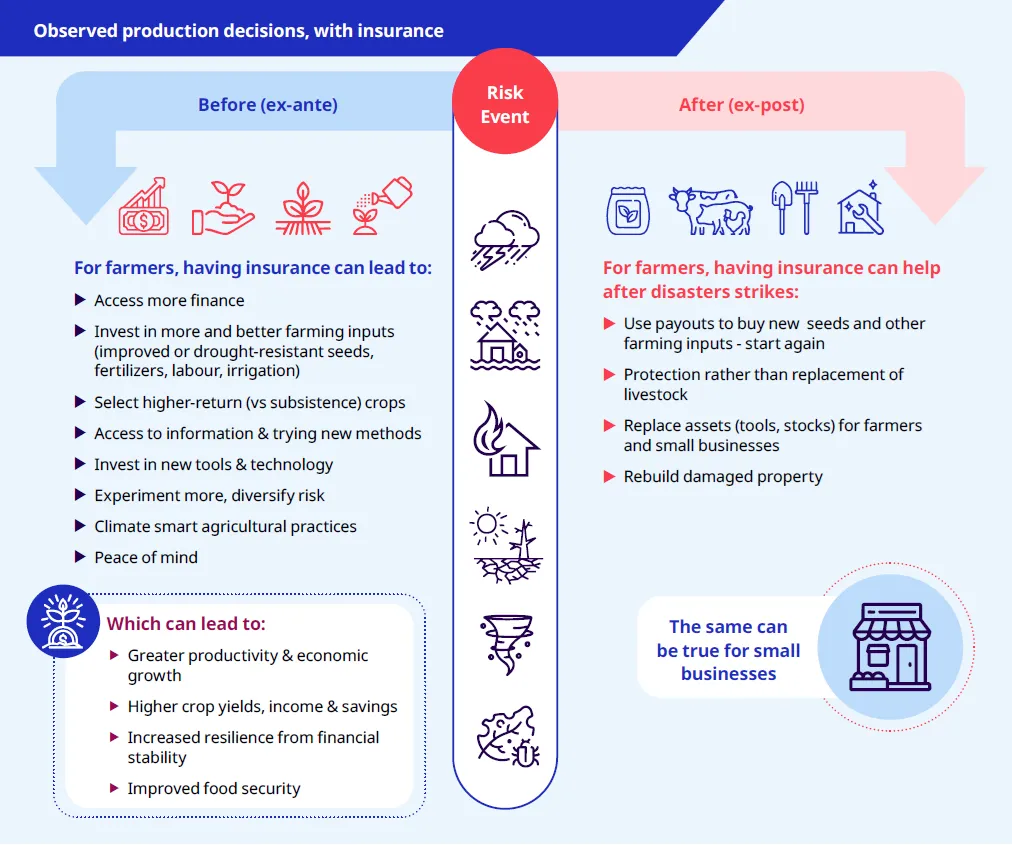
A number of the research studies reviewed investigate the impact of agricultural insurance on production. One key finding is that inclusive insurance can shape agricultural production by ensuring input access, fostering innovation and driving economic growth, thereby boosting productivity and sustainability. Index-based insurance and credit-linked insurance bundles significantly impact the use of agricultural inputs such as fertilizer, seeds, land and livestock, leading to an increase in production. When smallholders lose access to credit-linked insurance bundles, they experience a substantial reduction in their agricultural input use. Specifically, studies reveal that these farmers purchase 36% less fertilizer, resulting in a 27% decrease in harvests and a 31% decrease in the quantity sold.
See the figure below for other observed production decisions with insurance.
To learn more about impacts of inclusive insurance related to health and well-being, coping mechanisms, financial protection, and women and insurance, see The impact of inclusive insurance: A systematic review of the literature (2013 to 2024). In addition to the research findings, the paper also includes recommendations for policy makers, practitioners and researchers to advance the broader development objectives related to inclusive insurance.
Related content

Impact insurance
The impact of inclusive insurance: A systematic review of the literature (2013 to 2024)

Improving the viability and value of inclusive insurance