

Care economy
Childcare allows an informal, working mother to care and support her family
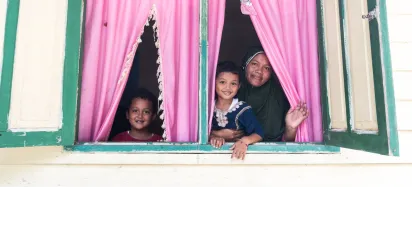
This is the life journey of Siti Riyanti, a working mother of two who has been able to support her family and take care of her sons with the support of a quality, affordable childcare service.
20 November 2023
Her mother-in-law was only able to care for her first 10-year-old son after school. It meant that Siti needed to find a childcare for her youngest son and it was hard to find a childcare nearby her factory so that she could come to work on time.
“It is important for me to keep my job. I must maintain my working performance at the glue section as I cannot afford to lose my job,” she said.
She felt blessed when she found a nearby house that offered an affordable childcare service. She was only required to prepare her son’s own meals and snacks. “My routine every morning, after preparing meals, was to drop my first son to school and pick him up together with my youngest son from their grandmother’s house after work.”Childcare allows me to work and support my family, while also helps my son to learn and grow."
Siti Riyanti
However, it only lasted less than a week. She felt suspicious when her son always cried on the way to the childcare. On the sixth day, she decided to come by to the childcare at lunch break to check on her youngest son.
“I just arrived on the porch when I heard my son being scolded harshly. I went inside and I saw my son slept on the floor without a mat or matrass. I was so shocked,” she told, emotionally holding her tears. “Even after six years, I cannot help feeling emotional remembering how my son being treated badly. I do not have much money, but I cannot let anyone harm my son.”
She then requested for two days leave from work to hunt for a good, decent childcare service. But the reality hit her hard: The good childcare was unaffordable. The one she could afford was a childcare with poor service.
Running out of time and feeling desperate, one of her fellow workers recommended her a recently opened childcare named Rumah Bahagia or Happy Home located in their neighbourhood. Rumah Bahagia childcare is a community-based childcare organized by the Surabaya Institute of Labour Solidarity (ISBS), targeting female factory workers and labourers with small children under the aged of 7 years old.
“I went through the interview process, and I told my condition as it was that I really need a childcare service so that I can work to support my family,” recalled Siti who is now 44 years old.
Siti was relieved when her youngest son was accepted by Rumah Bahagia childcare, and he would be part of Rumah Bahagia’s educational programme. After a few months, Siti was informed that her son had difficulties following orders and instructions.
With the assistance of Rumah Bahagia, her son was tested and diagnosed as a slow learner. “My son’s IQ was 76, under 100. I did not really understand what it really meant. Yet, the staff of Rumah Bahagia childcare assured me that they would help my son’s improving his learning difficulties,” said Siti.
With her son being cared of by the childcare, Siti could focus on her work and even obtained a new job in 2017 with a higher income as a cleaning service at a food court. She could even pay the childcare fee of IDR 300.000 (US$20).
However, when the pandemic COVID-19 occurred in early 2020, Siti lost her job and no longer could pay the fee. “I asked for a waiver, and I was told that I can pay as much as I can,” she said. She tried to pay as much as she could until she was being released from any payment.
When her son was seven years old and was graduated from Rumah Bahagia to enter the elementary school, Siti was grateful that her son was able to follow the public educational system.The ILO has been supporting the Ministry of Women Empowerment and Child Protection in the development of Indonesia’s Road Map and Action Plan on Care Economy and the first priority identified is the childcare service. The investment in universal childcare and long-term care services in Indonesia will generate almost 10.4 million jobs by 2035."
Early Dewi Nuriana, ILO’s Programme Officer for Care Economy
Today, her youngest son is at the 4th grade and has received a good report from his teachers. The teachers also appraise him for his willingness to learn, good manner and etiquette. Siti was told that her son even provides a good example for his friends, such as encouraging them to apologize when doing mistakes, asking permission, maintaining cleanliness and lending hands.
“Childcare allows me to work and support my family, while also helps my son to learn and grow. Rumah Bahagia has taught him to be discipline, independent and has a good manner. His teachers also appraise him for being able to follow most of the lessons and his difficulty is only in handwriting,” Siti, who is now working as an online motorcycle driver, proudly shared.
Early Dewi Nuriana, ILO’s Programme Officer for Care Economy, said for parents who work for income or would like to work, childcare is a concern that is almost universal. Childcare not only increases women’s access to employment, but also increases employment opportunities in childcare.
“The ILO has been supporting the Ministry of Women Empowerment and Child Protection in the development of Indonesia’s Road Map and Action Plan on Care Economy and the first priority identified is the childcare service. The investment in universal childcare and long-term care services in Indonesia will generate almost 10.4 million jobs by 2035,” stated Early.
Related content
Project
The Care Economy in Indonesia

Care economy
A company-based childcare service improves workers’ loyalty and productivity
Relevant projects
Project
The Care Economy in Indonesia