


Technical and vocational education and training
Certified, confident, ready: Timor-Leste’s TVET trainers step forward
Seventy-five trainers graduated from competency-based training in Dili. For two of them, the experience changed not only how they teach, but also how they see themselves as trainers.
20 October 2026
DILI, Timor-Leste (ILO News) – Behind every skilled worker is someone who helped them learn: a trainer who explained the first step, watched them try, guided them through mistakes, and stayed with them until they could do it on their own.
On 13 October 2026, 75 of those trainers took the stage in Dili to celebrate their graduation from Competency-Based Education, Training and Assessment (CBETA) Levels 3 and 4.
They were among 99 participants from training centres across Timor-Leste who took part in the programme, including trainers from the Ministry of Agriculture, Fisheries, Livestock and Forestry.
The training was delivered by the Youth Vocational Training Centre (STVJ Comoro) under the Agroforestry Skills Programme, funded by the European Union.
Over several weeks, participants learned how to design practical, learner-centred training and assess learners based on what they can demonstrate in practice, rather than simply what they can recall.
Completing the course, however, was only part of the journey. Participants also underwent assessment and evaluation to demonstrate that they could apply their new knowledge and skills in practice. Those who successfully met the competency requirements earned national recognition of their ability to train and assess others.
For Clara Moreira, the graduation represented a milestone years in the making.
A long-time trainer at the Agricultural Technical School in Natarbora, Clara has taught countless students throughout her career. But until now, she had never received national certification recognising her competence as a trainer.
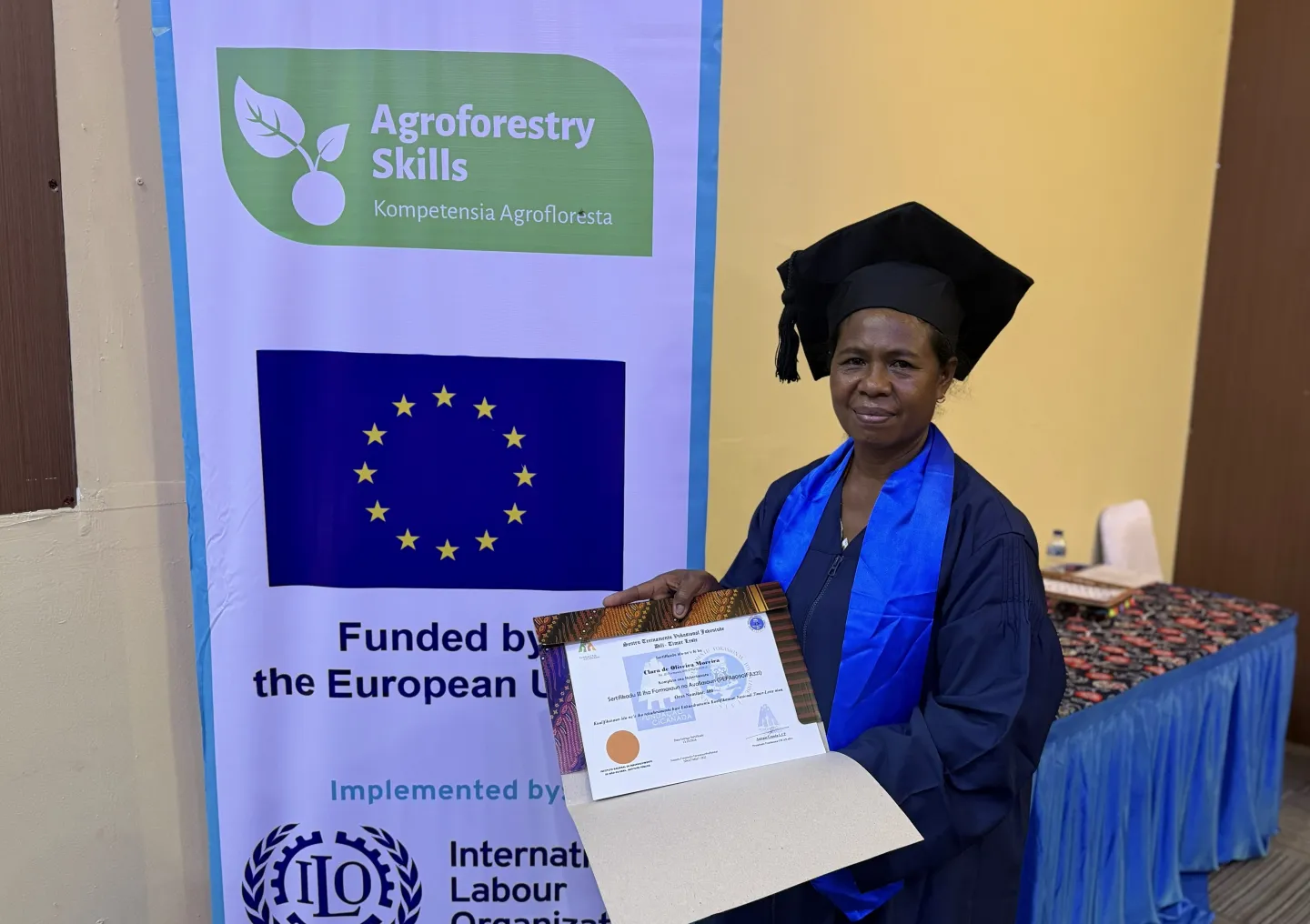
“I have been teaching for a long time, but this is the first time I am certified nationally as a competent trainer,” Clara said. “I am 53, and I learned that age is no barrier. If we keep learning, we keep growing, and I will bring everything I learned back to my students in Natarbora.”
For Tome de Jesus, who has worked as a trainer at the CCDC Manufahi training centre since 2020, the programme reinforced an equally important lesson: knowing a subject is only part of being a good trainer. The other part is knowing how to help someone else learn it.
“Training at STVJ is important for trainers because it increases knowledge, improves skills and introduces new training techniques,” Tome said. “In this way, the trainer can guide trainees well and increase their motivation.”

For Tome, the difference is already visible in his own teaching.
“After the training, my knowledge and skills as a trainer have grown. I have become more confident and motivated, and I can guide participants better and use more effective training techniques,” he said.
The experiences of Clara and Tome reflect the wider ambition behind the programme: to strengthen the quality of technical and vocational education and training (TVET) by investing in the people responsible for preparing Timor-Leste’s future workforce.
Speaking on behalf of the State Secretariat for General and Technical Vocational Secondary Education, Napoleao de Araujo described the graduation as an important step towards strengthening the country’s TVET and education system and supporting the Government’s development goals.
He encouraged the graduates to take what they had learned beyond their own classrooms by sharing their knowledge and skills with trainers and teachers who have not yet had the opportunity to participate in the course. In doing so, he said, the graduates could extend the impact of the training and contribute to preparing the next generation of skilled workers in Timor-Leste.
Antonio Cepeda, President of STVJ Comoro, welcomed the collaboration with the European Union and the ILO to strengthen the capacity of trainers across the country. STVJ Comoro is currently the only institution in Timor-Leste offering the CBETA course.
“We are proud to have partnered with the EU and the ILO on this programme,” Antonio said. “As the only institution in Timor-Leste providing this course, we are confident that these graduates will put their new skills to work and share them with their fellow trainers.”
For the graduates, the certificates they received in Dili represent more than completing a course. They recognise the skills they have built, the confidence they have gained and the responsibility they now carry to pass that knowledge on.
For Clara, that journey leads back to her students in Natarbora. For Tome, it means entering his next training session with new techniques and greater confidence. Across Timor-Leste, each trainer they reach can carry those skills one step further.
Related content
EU Programme
Agroforestry skills for employment and resilience in Timor-Leste
Relevant projects
EU Programme
Agroforestry skills for employment and resilience in Timor-Leste