

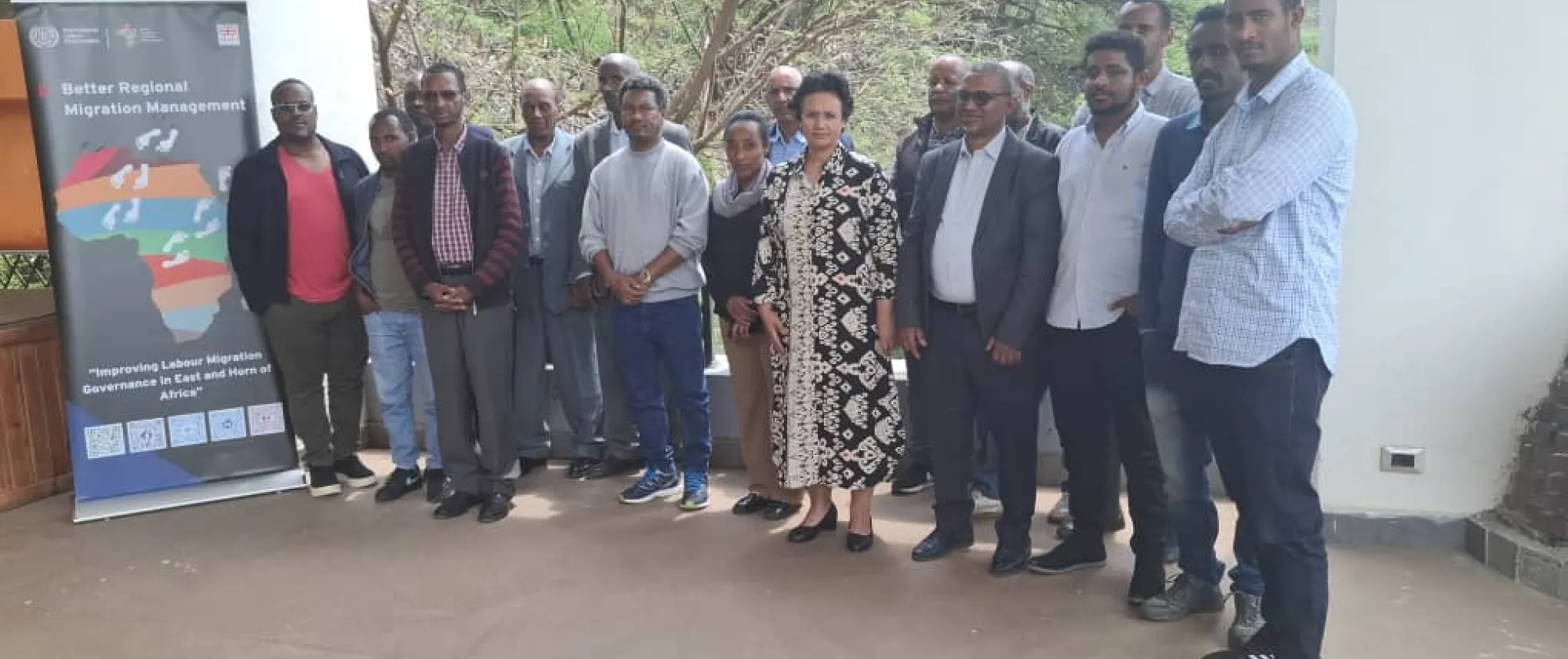
The capacity of the Ethiopian Statistics Service and the E-LMIS team strengthened to apply ICLS Standards in Labour and Migration Statistics
A five-day capacity-building workshop on labour and labour migration statistics was held to deepen participants’ understanding of updated international definitions and measurement approaches in key labour statistics domains, including work, employment, labour force status, informality, status in employment, child labour, working time, and international labour migration.
18 September 2025
A five-day capacity-building workshop on labour and labour migration statistics was held from 14 to 18 September 2025 in Bishoftu. The training was organized by the ILO in collaboration with the Ethiopian Statistics Service (ESS) under the BRMM. Participants included experts from the ESS, four of whom were women, and technical staff from the Ministry of Labour and Skills (MoLS) E-LMIS unit. They took part in technical sessions, group work, and practical exercises focusing on the application of standards from the 19th, 20th and 21st International Conference of Labour Statisticians (ICLS).
The workshop was convened in response to the growing need for strengthened statistical capacity as the ESS undertakes the National Integrated Household Survey (NIHS) and prepares to analyse its labour force and migration components. The training aimed to deepen participants’ understanding of updated international definitions and measurement approaches in key labour statistics domains, including work, employment, labour force status, informality, status in employment, child labour, working time, and international labour migration.
Opening remarks from the ESS and the ILO underscored the relevance of the training for upcoming NIHS data analysis and reporting. Facilitators outlined the structure and expected outcomes of the workshop, emphasizing the importance of applying ICLS standards consistently across survey tools and data sources.
Technical sessions began with the 19th ICLS standards, including the updated definition of work, labour force classification, labour underutilization, and distinction between work and employment. Using NIHS data, participants practised deriving labour force status, applying composite indicators, and identifying differences between previous and updated statistical frameworks
The next set of sessions focused on the 20th ICLS resolution on status in employment, particularly the International Classification of Status in Employment (ICSE-18). Participants examined how the revised classifications affect the measurement of paid and self-employment, employment relationships and vulnerability. Group discussions explored how NIHS questionnaires align with ICSE-18 and where refinements may be required to ensure accurate derivation of employment categories.
The workshop then turned to the 21st ICLS standards on informality, including the definition of the informal sector and informal employment. Participants assessed the NIHS questionnaire to identify information gaps affecting the classification of workers and enterprises across the formal sector, informal sector, and household own-use production. Discussion highlighted persistent challenges in measuring informality and the need for a detailed questionnaire design to support robust estimates.
Final sessions addressed the measurement of international labour migration through household surveys. Facilitators presented revised definitions of migrant workers, essential variables for identification, and recommended approaches for generating labour mobility indicators. Participants reviewed NIHS migration modules to assess whether existing questions support the derivation of core migration indicators, such as country of birth, citizenship, duration of stay abroad, reasons for migration, and labour attachment. Additional topics included child labour measurement, gender-responsive labour statistics, and own-use production work.
The workshop strengthened collaboration between the ESS, MoLS, and the ILO and contributed to building the technical foundation needed to improve the quality of labour and migration statistics in Ethiopia. The ILO reaffirmed its continued support as the ESS moves forward with NIHS data processing, analysis, and dissemination.
Relevant projects

East and Horn of Africa
Better Regional Migration Management