


Entrepreneurship and AI
An AI business adviser in your pocket: What we are learning from the ILO’s SABY pilot
The ILO is piloting SABY, a WhatsApp-based AI business adviser designed to give entrepreneurs practical, continuous support. Early experience across Africa shows how entrepreneurs are using AI to solve everyday business challenges, from improving record keeping and staffing to preparing for export markets.
15 September 2026
-
 Nadja NutzTechnical Specialist for Inclusive Market Systems, International Labour Organization
For an entrepreneur running a small business, advice is often most useful at the moment a problem arises. How should I price this product? Should I hire another employee? How can I approach a new customer? Entrepreneurship training can equip entrepreneurs with the knowledge to answer such questions. But months or years after a training course, entrepreneurs may no longer remember everything they learned, while their businesses and the challenges they face continue to evolve.
This is the problem that SABY – the ‘SIYB AI Buddy for You’ – is designed to address. Developed by the ILO’s MSME Branch in collaboration with ITC-ILO, SABY is an AI-powered business assistant that entrepreneurs can access through WhatsApp. It draws on the ILO’s complete Start and Improve Your Business (SIYB) entrepreneurship training materials[1], alongside other relevant resources, to provide practical guidance as entrepreneurs start, develop and grow their businesses.
Importantly, SABY is intended to complement rather than replace entrepreneurship training and human business-development services. Its purpose is to make continued support easier to access after training and between interactions with trainers or advisers. Moreover, it's explicitly designed to use each interaction as an opportunity to reinforce SIYB concepts and methodologies rather than just give quick answers.
Why an AI advisor on WhatsApp?
The choice of WhatsApp is deliberate. Many AI tools require users to find a new platform, create an account and learn an unfamiliar interface. These seemingly small barriers matter, particularly for entrepreneurs with lower digital literacy, without regular access to computers, or those living in rural or underserved areas.
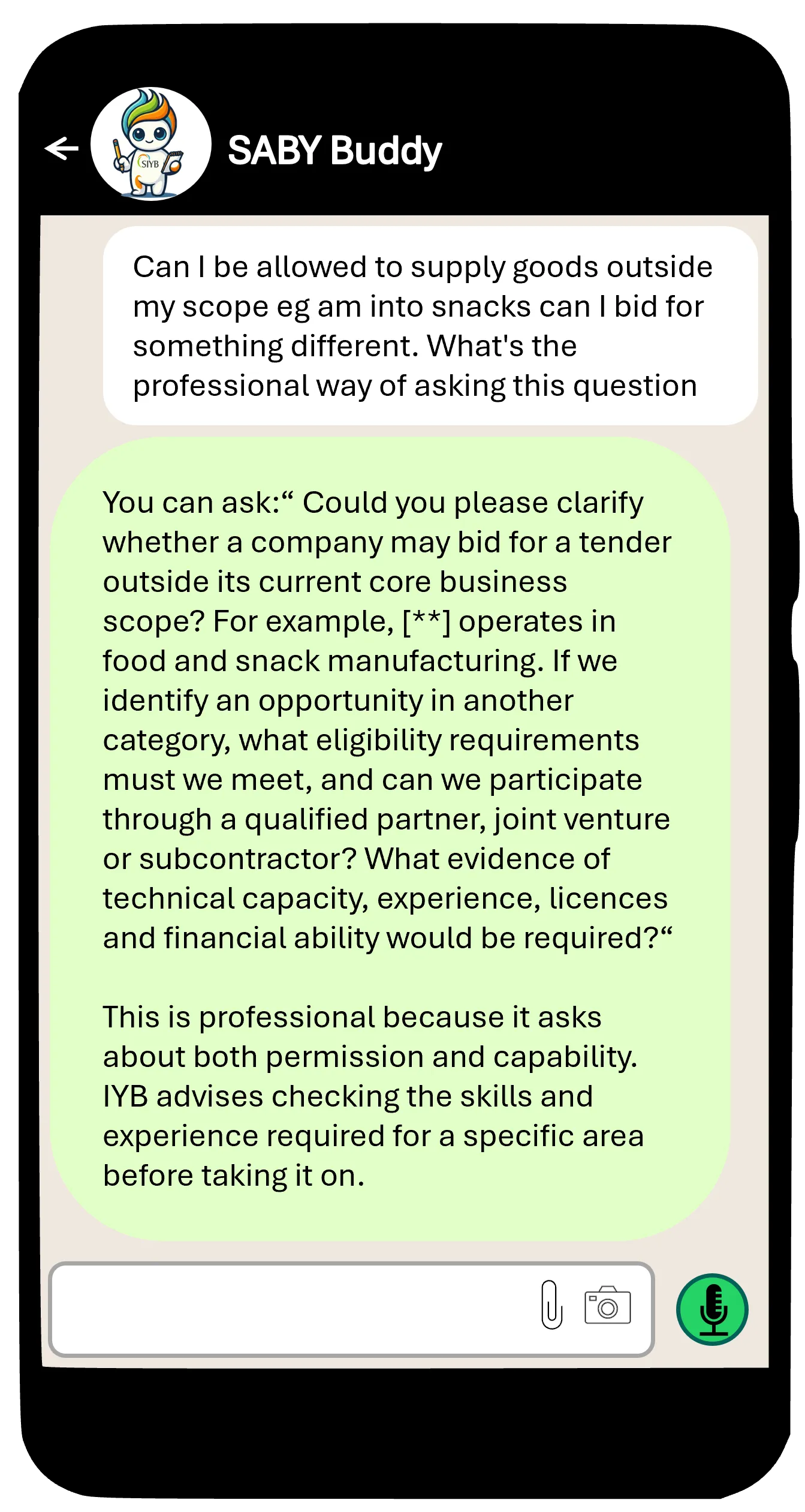
SABY instead meets entrepreneurs in a digital space many already use. Users can simply add a WhatsApp contact and start a conversation. SABY can understand informal language, including slang and typos, and users can communicate through text, voice notes and photographs. That opens up practical possibilities: users can photograph a product display and ask how to improve it, send a voice note asking for help with social media, or return to an earlier conversation when a new challenge emerges. The ambition is straightforward: make AI-enabled business support useful without requiring entrepreneurs to become AI experts first.
| Example of an entrepreneur using SABY via WhatsApp to seek advice on a business opportunity. |
|
SABY in action: a growing spectrum of business conversations
SABY was initially introduced through SIYB trainers for a pilot focused primarily on Kenya. But because access was not geographically restricted, usage has organically spread across Africa without targeted outreach or promotion, an encouraging early signal of demand for accessible, on-demand business support.
By July 2026, a mere 4 months after the launch, 838 entrepreneurs had used SABY, generating more than 64,000 messages. In July alone, 175 entrepreneurs were active and exchanged 6,283 messages with the tool.
However, numbers alone do not tell the most interesting part of the story. Monthly reports show many entrepreneurs returning to SABY repeatedly, sometimes exchanging dozens or even hundreds of messages, and moving across different business problems as their circumstances change.
Strengthening records and expanding growth strategy in Kenya
Consider for example the administrator of two petrol stations near Kakuma refugee settlement in northern Kenya. In May, she used SABY to move from informal WhatsApp reporting towards a structured daily accountability system. Together they developed an Excel ledger to record and reconcile pump sales with cash, M-Pesa, credit and expenses. She repeatedly sent SABY versions of her work for feedback while troubleshooting discrepancies in the records.
Two months later, the conversation had moved on. She was now working to attract institutional customers through prepaid fuel accounts. SABY helped her structure a proposal, think through staffing responsibilities and develop a marketing budget. For a customer promotion, she even used SABY to draft prompts for an AI-generated poster, correcting the AI herself when its representation of local Turkana clothing was inaccurate.
The example illustrates something important: the entrepreneur was not simply receiving an answer from AI. She was using it iteratively, questioning it, adapting its suggestions and applying her own knowledge of her market and context.
From a sales target to an export negotiation in Ghana
A second example comes from northern Ghana, where a woman-led enterprise sources shea butter from women processors for cosmetics businesses. Working towards a monthly sales target of 100 kilograms, the entrepreneur used SABY to track sales and think through test marketing and quality assurance.
Then came her first export negotiation with a UK buyer. SABY helped her work systematically through the quotation: the goods, price, payment and delivery terms all needed to be clear and in writing. When the buyer requested a food-grade certification she did not yet have, SABY advised her not to overpromise, but instead to offer the cosmetic-grade product she could currently supply while maintaining the relationship for the future.
This is where connecting AI advice to established entrepreneurship methodologies becomes particularly valuable. SABY can draw on SIYB principles around costing, marketing, record keeping, people management and other aspects of running a business, and translate them into guidance for the problem an entrepreneur is facing at that particular moment.
Early feedback suggests that users value this support. One Kenyan entrepreneur told SABY: “Thank you for leaving me a better businesswoman.” Another Nigerian entrepreneur described its assistance as “a game changer.”
The next challenge: making AI advice more local and conducive to decent work
These experiences are promising, but SABY remains firmly in the pilot phase, and further testing and evaluation will be important to understand when AI-enabled business advice is most useful, for whom and under what conditions. One important next step is localization: moving from the current global version towards country-specific versions that combine SIYB guidance with information relevant to entrepreneurs' local environments.
Work underway in Jordan, for example, is adapting SABY so that entrepreneurs can receive guidance on locally available financial and business development services as well as relevant policy and regulatory requirements and pathways towards business formalization. This also means ensuring that locally specific advice is reliable and up to date, and recognizing where questions, for example on regulation, finance or workers’ rights, are better referred to a qualified institution or human adviser.
For the ILO, however, the opportunity goes beyond providing more locally relevant business advice. The decisions entrepreneurs make about staffing, workplace practices and formalization also shape the quality of the jobs their businesses provide. As SABY evolves, the ambition is therefore not only to support more productive and sustainable enterprises, but to explore how AI-enabled business advice can also contribute to better working conditions and decent work.
The pilot is still generating evidence. But the conversations already taking place suggest an intriguing possibility: for entrepreneurs who cannot have a business adviser beside them every day, the next best thing may increasingly fit in their pocket.
[1] SIYB is the ILO’s entrepreneurship training programme with different training modules to support entrepreneurs through the different stages of starting, developing and growing a small business.
Related content

Portal
Observatory on AI and Work in the Digital Economy

ILO Department of Sustainable Enterprises, Productivity and Just Transition (ENTERPRISES)

Start and Improve Your Business (SIYB)