

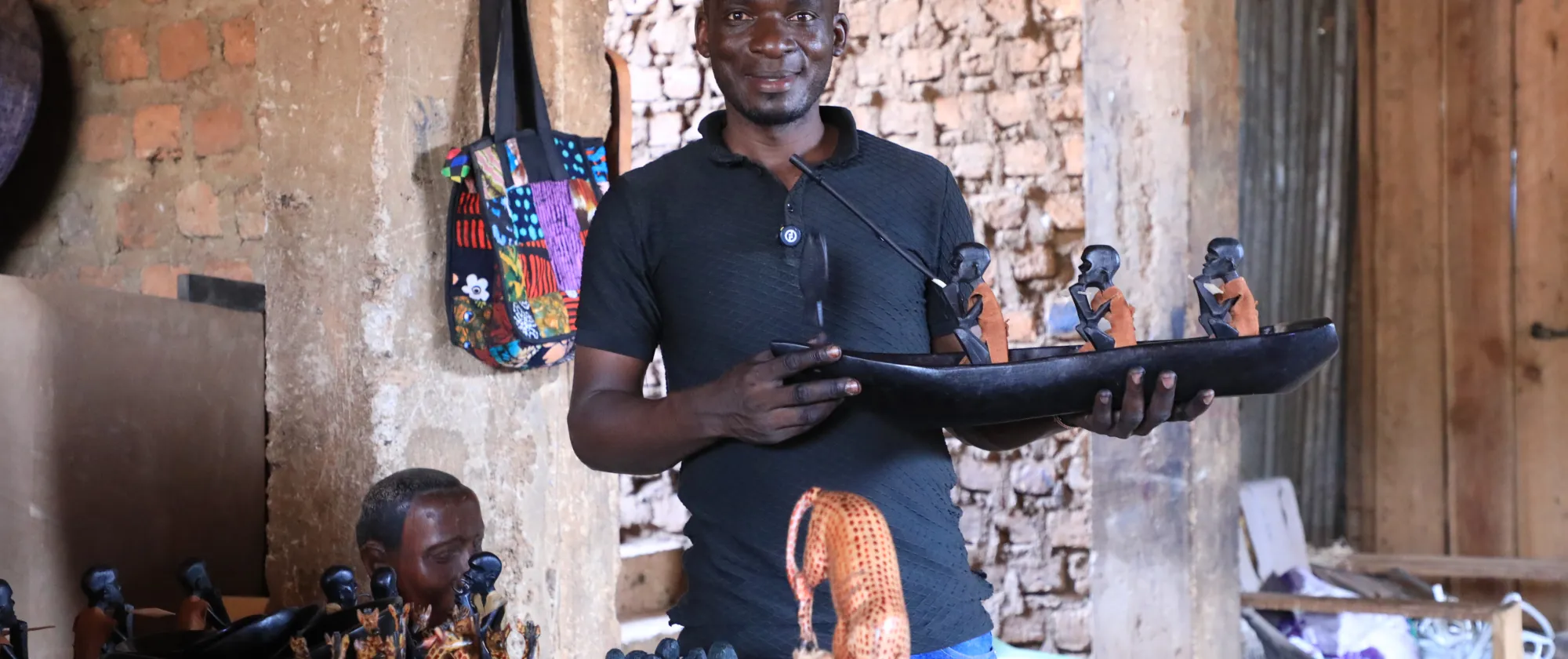
Adapting Traditional Craft to Modern Market Demand
"My biggest problem was not skills or materials, but the market. I could make products, but I did not know how to reach buyers or get fair prices,” said Nathan Mugote.
14 January 2026
Nathan Mugote is a 40-year-old Ugandan artisan from Kampala, married with four children aged between nine months and fourteen years. His livelihood is rooted in traditional wood carving, a skill he learned during his school years while assisting his elder brother in a workshop. During school holidays, Nathan helped with sanding, carving, painting, and finishing wooden products, gradually mastering the craft through hands-on experience.
“When I was still in school, I used to help my brother during holidays. That is where I learned how to carve, paint, and finish the products,” Nathan explained.
In 2008, after the passing of his brother, Nathan left school and took full responsibility for continuing the craft. By 2009, he had established his own small business, relying on former customers who had known his brother’s work. While the business allowed him to support his family, the income remained modest and unpredictable, especially as household responsibilities grew.
In search of better opportunities, Nathan migrated to Somalia in 2020 after being promised a well-paying security job in Mogadishu by recruiters. However, upon arrival, the reality differed sharply from expectations.
“They told us we would earn two million shillings per month, but when we got there, the salary wasn’t even half of what we had agreed on,” he recalled.
Unable to return immediately due to financial constraints, Nathan worked under difficult conditions for a year, saving only enough money to cover his transport back to Uganda. When he returned home, he found himself starting again with little to show for his time abroad.
Back in Uganda, Nathan resumed his woodcraft business. While his technical skills were strong, his biggest challenge was accessing reliable markets and fair prices.
“My biggest problem was not skills or materials, but the market. I could make products, but I did not know how to reach buyers or get fair prices,” said Nathan Mugote.
Nathan’s turning point came in November 2024, when a friend informed him about the entrepreneurship training under the ILO BRMM Programme implemented with Wezesha Impact. Motivated to strengthen his business knowledge, he enrolled in the training, which covered Generate Your Business Idea (GYB), Start Your Business (SYB), and financial education.
The International Labour Organization (ILO) Better Regional Migration Management (BRMM) Programme, in partnership with Wezesha Impact, supports returned migrant workers in Uganda to rebuild sustainable livelihoods through entrepreneurship training, financial education, and market-oriented business development. By strengthening practical business skills and confidence, the programme enables returnees to transform existing skills into viable economic opportunities at home.
“The training helped me understand record keeping, marketing, and how to set business goals, which I had never done before,” Nathan explained.
A key lesson for Nathan was the importance of visibility and digital marketing. Previously, he relied on passers-by and middlemen to sell his products. Through the training, he learned how online platforms could expand his customer base.
“I learned that I can sell my work online and reach more customers instead of waiting for people to pass by,” he said.
With renewed confidence and clearer direction, Nathan now plans to use start-up support to rent a larger workspace, purchase materials locally, and train other artisans. His long-term goal is to establish a large workshop that not only grows his business but also creates employment opportunities for young people in his community.
Nathan’s journey highlights how combining practical skills with entrepreneurship training and market access can support returned migrants to rebuild their livelihoods sustainably. Through the BRMM Programme, he has moved from survival-based production toward a future defined by planning, visibility, and growth.
Relevant projects

East and Horn of Africa
Better Regional Migration Management