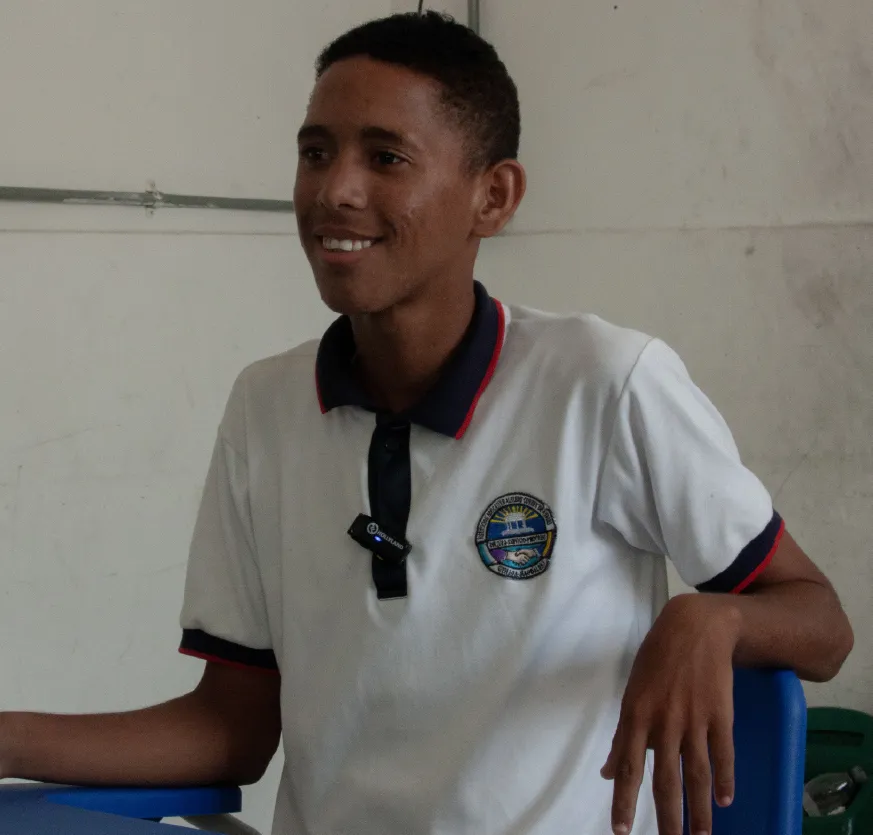
“A very long step” that changed his destiny: the testimony of a young migrant on his learning path with ILO
“Technology makes our lives easier,” says Jean Carlos Mencias Perozo, a 17 year old Venezuelan who, with the support of the SENATIC project, has discovered in the digital world an open door to knowledge, dignity and a future with purpose.
19 May 2025
BOGOTÁ (ILO News) Jean Carlos Mencias Perozo does not need grand speeches to inspire. His life is living proof that even in the most difficult circumstances, one can keep moving forward. Slim, short in stature, with sharp features, dark skin and curly hair, Jean Carlos was born in Maracaibo, Venezuela. There, he spent a childhood without major hardships thanks to his father’s steady work as a blacksmith. But everything changed when he arrived in Colombia.
What began as a holiday quickly turned into a dramatic twist of fate. His mother was dismissed from her job just as he arrived in the municipality of Ciénaga, Magdalena, with the intention of visiting her and suddenly, they found themselves without shelter or food. They slept on the beaches, exposed to the elements, with only uncertainty for company. “We went hungry. Those were very tough days. I call it ‘a very long step’ because we had to go through so much to be okay,” he recalls, his voice tinged with nostalgia, but also with pride in how far he has come.
That long step found a light when an aunt welcomed them into her home, despite resistance from other family members. From there, the slow process of rebuilding began. His mother found new work, and Jean Carlos, then a young teenager, was able to resume his studies at the Alfredo Correa de Andréis public school in Ciénaga, where he is now in 11th grade.
However, the turning point in his story came through the SENATIC project an alliance between the Ministry of ICT, SENA and the ILO which aims to connect young people to the world of technology and digital opportunities. Through SENATIC, Jean Carlos is training as a software programming technician, a skill that is transforming his life.
“Technology has opened many doors for me. Now I can study, do assignments by email and dream of a better future,” he says, with a calm smile. More than just an academic tool, for him, technology has become a bridge to self-respect, social justice and dignity.
“I feel that I’ve gained more than just knowledge — I’ve gained respect and a clear sense of what is right and wrong,” he says, his voice trembling slightly but firm in his conviction. There were times when seeing other young people with more resources stirred feelings of sadness, and even envy — emotions that forced him to confront himself. Today, however, he understands that his path has given him a unique perspective: one shaped by effort, resilience, and a deep commitment to equality.
Jean Carlos dreams of a just world, where everyone has the same opportunities. “Social justice is very important to me. It means equality, and equality fosters respect among all people,” he explains, with the conviction of someone who has experienced both discrimination and solidarity.
He is grateful to SENATIC and to Colombia for offering him a helping hand. “I love it as if it were my own country,” he says. And although his roots are in Venezuela, he knows that his future is being forged with every class he completes and every goal he sets for himself. Jean Carlos doesn’t give up because he has learned that sometimes the longest steps are the ones that take us the furthest. Now, he is focused on setting goals and achieving them with the same determination that helped him overcome hardship and scarcity. At his young age, he already understands what it means to have little and what it means to have nothing. And yet, Jean Carlos always wears a smile.