

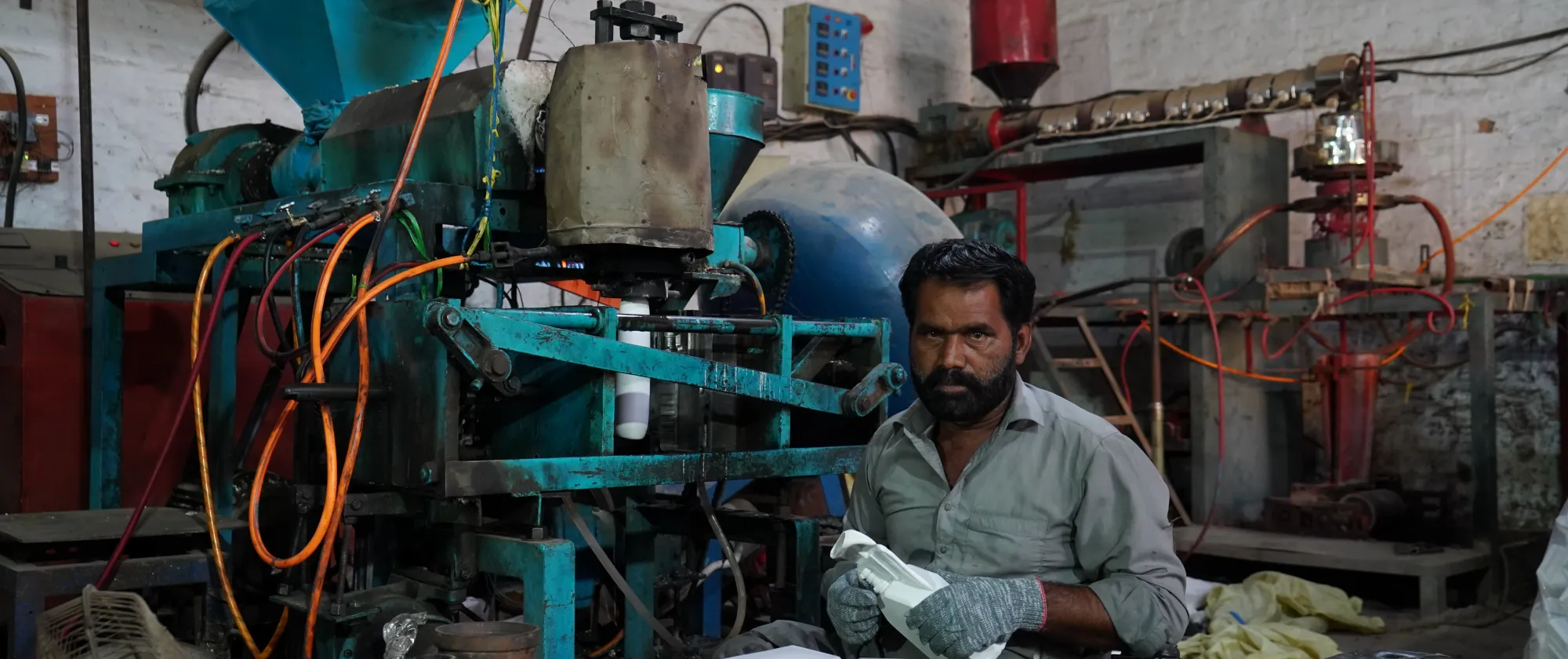
Informal economy
W2W: WASTE TO WORTH – Transforming Informal Waste Work into Decent Livelihoods
The project aims to enhance PET recycling in Islamabad while improving the working conditions, livelihoods, and social inclusion of informal waste workers, contributing to environmentally sustainable and socially responsible plastic waste management.
Duration
1 October 2025 - 31 January 2027
Development partner(s)
The Coca Cola Foundation
Reference
PAK/25/04/UNO
Contact
Hasnat Ul Hasnain Sheikh, [email protected]
Background
Pakistan’s solid waste management and recycling systems rely heavily on informal waste workers, who play a critical role in collecting, sorting, and supplying recyclable materials, particularly Polyethylene Terephthalate (PET) plastics, into the recycling value chain. Despite their contribution to environmental sustainability and circularity, these workers often operate under unsafe conditions, with limited access to occupational safety and health (OSH), social protection, stable incomes, and labour rights.
In Islamabad, informal waste workers remain largely unrecognized within municipal waste systems and excluded from formal employment frameworks. This results in precarious livelihoods, exposure to health risks, and weak bargaining power within the recycling value chain. At the same time, Pakistan is witnessing growing momentum around plastic waste reduction, recycling, and Extended Producer Responsibility (EPR), creating an opportunity to embed decent work principles into emerging circular economy models.
The Waste to Worth (W2W) project responds to this gap by strengthening the PET recycling value chain in Islamabad while placing informal waste workers at the centre of the transition, ensuring that environmental gains are matched with improved working conditions, dignity, and livelihoods. Within this framework, the ILO leads efforts to advance decent work outcomes, aligned with international labour standards.
Objective
The project aims to enhance:
- Strengthen PET recycling systems in Islamabad by improving coordination, data, and engagement across the recycling value chain, including municipal authorities and private-sector actors.
- Improve occupational safety and health (OSH) practices for informal waste workers involved in PET collection, sorting, and aggregation, reducing exposure to health and safety risks.
- Enhance access of informal waste workers to relevant social protection and health services, contributing to greater income security and resilience.
- Support the organization, representation, and collective voice of informal waste workers, enabling more equitable participation in decision-making within the recycling value chain.
- Promote the integration of decent work principles and responsible business practices into emerging circular economy and plastic recycling initiatives.
Project Outcomes
The project is expected to produce the following results:
Outcome 1: Strengthened PET recycling systems
- Improved coordination among municipal authorities, recyclers, and other value-chain actors, supporting more efficient PET collection and recycling.
- Better understanding of PET material flows and operational gaps, informing improved planning and decision-making.
Outcome 2: Enhanced working conditions and livelihoods
- Improved occupational safety and health practices for informal waste workers, reducing exposure to workplace risks.
- Increased access to social protection, health services, and support mechanisms for informal waste workers.
- Stronger organization and collective voice of waste workers, enabling more effective engagement with authorities and value-chain actors.
Partners
Ministry of Climate Change & Environmental Coordination (MoCC&EC) and Capital Development Authority (CDA), the United Nations Office for Project Services (UNOPS)
Target Beneficiaries
Informal Waste Workers in Islamabad, Social Protection Departments
Geographical Focus
Pakistan
For further information please contact
Hasnat Ul Hasnain Sheikh
National Project Coordinator
Email: [email protected]