


Labour migration
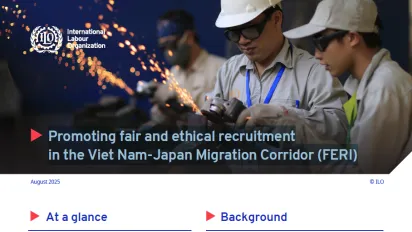
Promoting fair and ethical recruitment in the Viet Nam-Japan Migration Corridor (FERI)
The project promotes fair and ethical recruitment in the Viet Nam–Japan migration corridor by enhancing transparency and toward eliminating recruitment fees for Vietnamese migrant workers.
Duration
1 February 2024 - 30 September 2025
Development partner(s)
Japan International Cooperation Agency (JICA)
Reference
VNM/23/05/JPN
Location
Viet Nam
Key partners and Stakeholders
- Vietnam Association of Manpower Supply (VAMAS)
- Ministry of Home Affairs, Department of Overseas Labour
- Provincial Departments of Home Affairs
- Japan Platform for Migrant Workers towards Responsible and Inclusive Society (JP-MIRAI)
Target beneficiaries
- Potential, current, and returnee trainees participating in the Technical Intern Training Programme (TITP) in Japan
- Recruitment agencies and their association, the Vietnam Association of Manpower Supply (VAMAS)
- Migrant Workers Resource Centers (MRCs) and their provincial labour authorities
Background
As of December 2024, Viet Nam’s Department of Overseas Labour (DOLAB) reported that over 158,000 Vietnamese nationals were deployed overseas for work or training, with women accounting for 34 per cent of this number. Japan is the top destination country. There are around 420 recruitment agencies licensed by the Ministry of Labour, Invalids and Social Affairs (MOLISA) to place trainees and workers in Japan. Approximately 41 per cent of Vietnamese migrant workers/trainees in Japan have obtained employment through the services of private recruitment agencies.
Migrant workers make a significant contribution to the socio-economic development of Viet Nam through remittances. Moreover, up-skilling the labour force is a key priority for the country, and migration can contribute to this goal.
However, it is crucial to ensure that recruitment processes are fair and ethical, jobs offer decent working conditions, effective complaint mechanisms are in place, and that there are robust systems for return and reintegration. A recent study by the General Statistics Office (now National Statistics Office) supported by the ILO, titled "Measuring Sustainable Development Goal Indicator 10.7.1 on Recruitment Costs of Vietnamese Workers Overseas," revealed that Vietnamese migrant workers pay an average of 192 million Viet Nam dong (approximately US$8,000) to secure their first job in Japan. The high recruitment fees increase workers' vulnerability, as they must repay their debts over several months or even years, making it difficult for them to resign prematurely without remaining in debt.
In response to this situation, the ILO, with funding from Japan and in close collaboration with JP-MIRAI, is implementing the FERI project. This initiative aims to establish a responsible and collaborative framework among various stakeholders, including sending organizations, supervising organizations, Japanese employers, DOLAB, VAMAS, and the Japanese non-profit organization JP-MIRAI. The goal is to effectively implement relevant international standards and guidelines on fair and ethical recruitment, with a particular focus on eliminating recruitment fees and related costs for workers as well as promoting transparency.
Project objectives
The primary goal of the project is to harvest the benefits of labour migration by promoting fair and ethical recruitment practices in the Viet Nam migration corridor. This includes working towards eliminating recruitment fees and related costs charged to Vietnamese migrant workers and promoting transparency.
Within the framework of FERI, the ILO focuses on promoting international labour standards and guidance on fair and ethical recruitment, as well as building the capacity of recruitment agencies and regulatory bodies. The ILO leverages its expertise and collaborates closely with its tripartite stakeholders, including social partners. The strategy encompasses:
- Promoting international labour standards among private recruitment agencies through development and implementation of policy and procedures on fair and ethical recruitment and supporting the application of codes of conduct.
- Building the capacity of regulators and social partners for effective oversight.
- Empowering migrant workers through awareness initiatives.
- Strengthening complaints mechanisms and support services.
- Monitoring recruitment costs and collecting data on workers' recruitment experiences.
Key achievements
Policy development
Zero Fee Recruitment Policy and Standard Operating Procedures (SOPs) developed for Vietnamese recruitment agencies based on ILO international labour standards (Conventions and Recommendations), international standards and Guidelines on migration. The Policy and SOPs are under consideration for adoption.
Guidelines on Fair and Ethical Recruitment, Operation Manual and Formats and Standard Operating Procedures (JP-MIRAI Guiding Documents) for relevant stakeholders including Japanese employers developed by JP-MIRAI with technical inputs from ILO and with support to the consultation.
Recruitment agencies’ engagement in fair and ethical recruitment
- 15 recruitment agencies capacitated to implement the Zero Fee Policy and SOPs and sensitized about the above JP-MIRAI Guiding Documents through a series of workshops, training and meetings.
- 6 recruitment agencies officially registered to voluntarily implement the Fair and Ethical Recruitment with JP-MIRAI.
Fair Recruitment Toolkit
The Fair Recruitment Toolkit co-developed and piloted with VAMAS and The Fair Hiring Initiative (TFHI). The Toolkit includes:
- Definitions of forced labour and human trafficking.
- Step-by-step fair and ethical recruitment guidance.
- Tools for due diligence, cost transparency, contract management, and grievance handling.
- Interactive training modules for recruiters and employers.
Enhanced capacity of recruitment agencies through onsite/hands-on coaching
- Enhanced capacity of two Vietnamese recruitment agencies to voluntarily pioneer the fair and ethical recruitment initiative through two training programmes on the use of the Fair Recruitment Toolkit.
- Through this training, 34 top management and staff from the recruitment agencies were equipped with knowledge, tools, and strategies to implement fair and ethical recruitment practices including removing recruitment fees charged to migrant workers.
- Following the July 2025 training workshops on the Fair Recruitment Toolkit, the ILO, in collaboration with TFHI and VAMAS, initiated onsite assessments to provide tailored coaching and support to recruitment agencies. These assessments are designed to:
(a) Verify the implementation of fair recruitment tools and processes.
(b) Identify good practices and innovative approaches already in use.
(c) Detect gaps in current systems and recommend improvements.
Strengthened Multi-Stakeholder Engagement for Fair Recruitment
- The initiative fostered meaningful engagement among government agencies, recruitment agencies, and social organizations through the Open Forum, Stakeholder Meeting, and Training on Fair Recruitment.
The initiative helped to enhance multi-stakeholder coordination, reinforced shared responsibility, and improved operational readiness for implementing fair recruitment practices and the strengthening of oversight mechanisms.
For further information please contact:
Ms Nguyen Thi Mai Thuy
National Project Coordinator
Email: [email protected]
Project factsheet
Promoting fair and ethical recruitment in the Viet Nam-Japan Migration Corridor (FERI)
Related content

Country portal
Viet Nam
Factsheet
Promoting fair and ethical recruitment in the Viet Nam-Japan Migration Corridor (FERI)

Labour migration
Rights and Access to Remedies for migrant workers from Viet Nam to Japan

Brief on labour migration statistics
Making women migrant workers count: Sex disaggregation of labour migration statistics in ASEAN
Fair and ethical recruitment
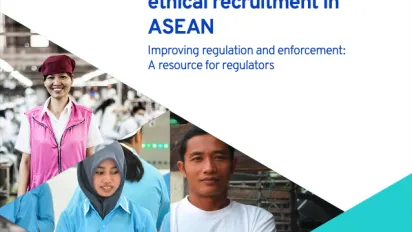
Regional operational guidelines on fair and ethical recruitment in ASEAN. Improving regulation and enforcement: A resource for regulators

Labour migration
Decent work and fair recruitment key to climate-resilient labour migration in ASEAN

Analysis
How will ASEAN regional integration affect labour migration in Viet Nam?