

Indonesia - LSGSC project
Labour Standards in Global Supply Chains: A Programme of Action for Asia and the Garment Sector in Indonesia
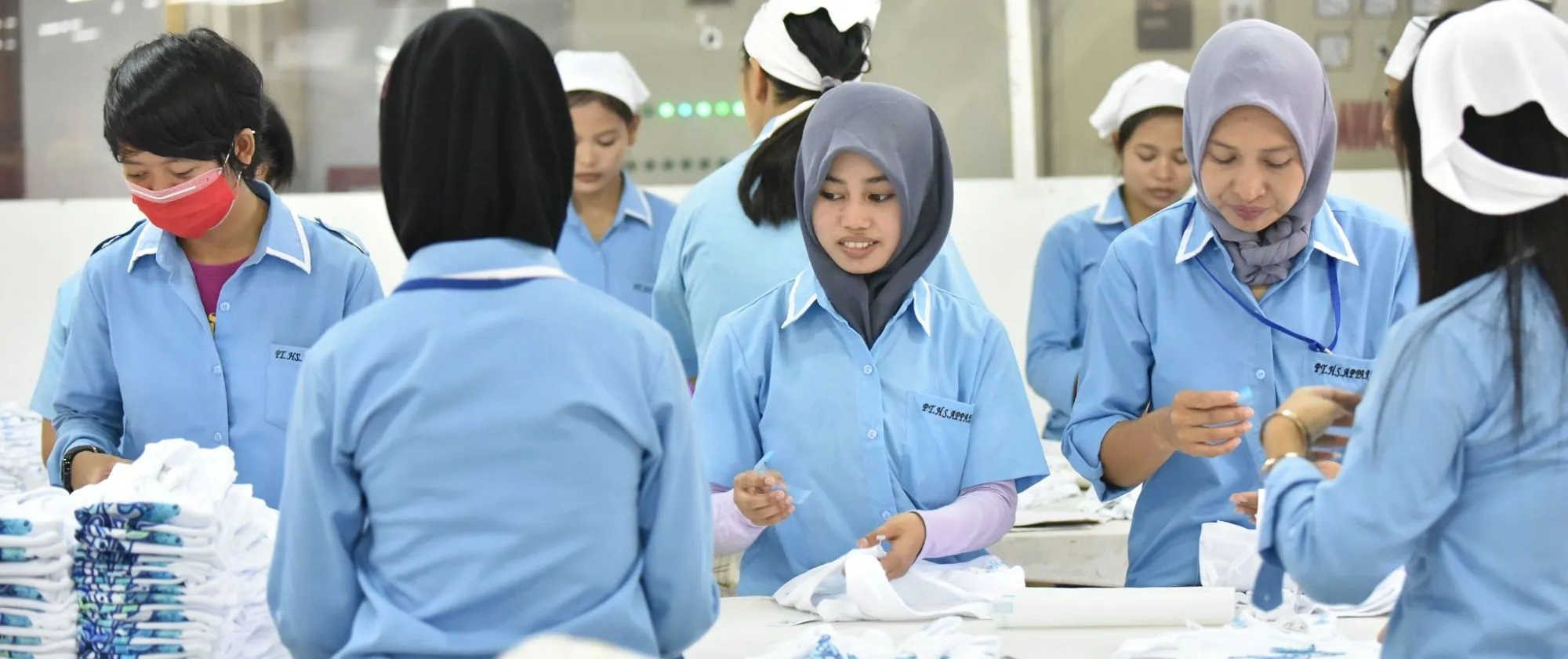
The development objective of the Labour Standards in Global Supply Chains (LSGSC) project was to improve the lives of workers and increase decent work opportunities in global supply chains (GSCs) in the garment sector, starting with the project’s beneficiary countries: Cambodia, Indonesia and Pakistan. The project’s programme of action included interventions at factory-level and country-level as well as global and Asia regional components.
Duration
1 May 2015 - 31 March 2019
Development partner(s)
Federal Ministry of Economic Cooperation and Development (BMZ) and Deutsche Gesellschaft für Internationale Zusammenarbeit (GIZ) on behalf of the Government of the Federal Republic of Germany
Reference
RAS/17/50/DEU
Location
National (Indonesia), Pakistan and Cambodia
Context
In Indonesia, the garment sector accounts for around 1.4 per cent of total Gross Domestic Product (GDP) and 6.6 per cent of total merchandise exports, corresponding to an export value of around US$ 11.6 billion. More than 4 million people are employed in the garment sector in Indonesia, around 58 per cent of whom are women. There are more than 2,000 medium and large size garment manufacturers in Indonesia.
Wages in the garment sector in Indonesia were around US$ 154 per month in 2016, and have grown in nominal terms by around 8.8 per cent per annum since 2012. The raw gender pay gap in Indonesia’ garment sector is approximately 6.8 per cent. Nearly 60 per cent of workers in the garment sector in Indonesia work excessive hours.
Geographically, employment in the garment sector in Indonesia tends to be concentrated in provinces with the lowest minimum-wage levels. Minimum wages are set at the provincial, district and industry level. In 2017, these ranged from around US$ 266 per month in DKI Jakarta to around US$ 100 in DI Yogyakarta. Dispersion between the highest and lowest provincial minimum has been widening over the past decade.
Objectives
In Indonesia, the two principal objectives of LSGSC project during its third and final phase were to strengthen the capacity of the ILO's tripartite constituents to develop and implement:
- Policies on wages through social dialogue
- Collective bargaining agreements at enterprise and multi-enterprise levels
Highlights
In pursuit of these objectives, amongst other interventions, LSGSC:
- Contributed to strengthening and expanding social dialogue on wage issues. In particular, LSGSC provided technical assistance to Indonesia’s National Wage Council, with a focus on minimum wage monitoring based on a participatory and evidence based approach that tracks the evolution of various indicators at different levels of analysis, such as changes in the wages and its distribution, economic growth, productivity, employment and enterprise creation, amongst other factors.
- Assisted the ILO’s social partners to develop and implement 11 new Collective Bargaining Agreements (CBAs), benefitting an estimated total of more than 50,000 garment factory workers, and their respective employers This was the direct outcome of implementation by LSGSC of an enterprise-level pilot programme on effective collective bargaining. Participants reported positive outcomes including smoother negotiations, and greater clarity on the laws that govern worker-employer relationships in the garment sector in Indonesia.
- Scaled-up and supported institutionalization of a culture of sound industrial relations in Indonesia by supporting the Ministry of Manpower (MoM) to provide training on negotiation skills to more than 150 trainers representing trade unions, APINDO, and government officials.
- Collaborated with Better Work Indonesia (BWI) to develop new research on decent work outcomes of collective bargaining in garment factories in Indonesia, based on preliminary analysis conducted with WageIndicator Foundation.
Related content

Asia - LSGSC project
Labour Standards in Global Supply Chains project: A Programme of Action for Asia and the Garment Sector
ILO Asia-Pacific Garment and Footwear Sector Research Note Issue 1
Strong export and job growth in Asia's garment and footwear sector
Project Brief (2017): Labour Standards in Global Supply Chains: A Programme of Action for Asia and the Garment Sector (LSGSC)
International Women’s Day 2018: Mainstreaming gender equality at work through collective bargaining agreement
Time for women to be equal at work through collective agreements
Events held by the Programme of Action for Asia and the Garment Sector in Indonesia (Labour Standards in Global Supply Chains project)
Collective bargaining agreements benefited both workers and employers
Project Brief (2018): Labour Standards in Global Supply Chains: A Programme of Action for Asia and the Garment Sector (LSGSC) - Phase III
Mixed picture for Indonesia’s garment sector
Building an effective national wage system in Indonesia
Making a perfect triangle: minimum wages, collective bargaining and economic growth
Towards a more effective industrial relations dispute settlement mechanism
Sharing lessons learnt in promoting evidence-based wages fixing and collective bargaining in the garment sector