

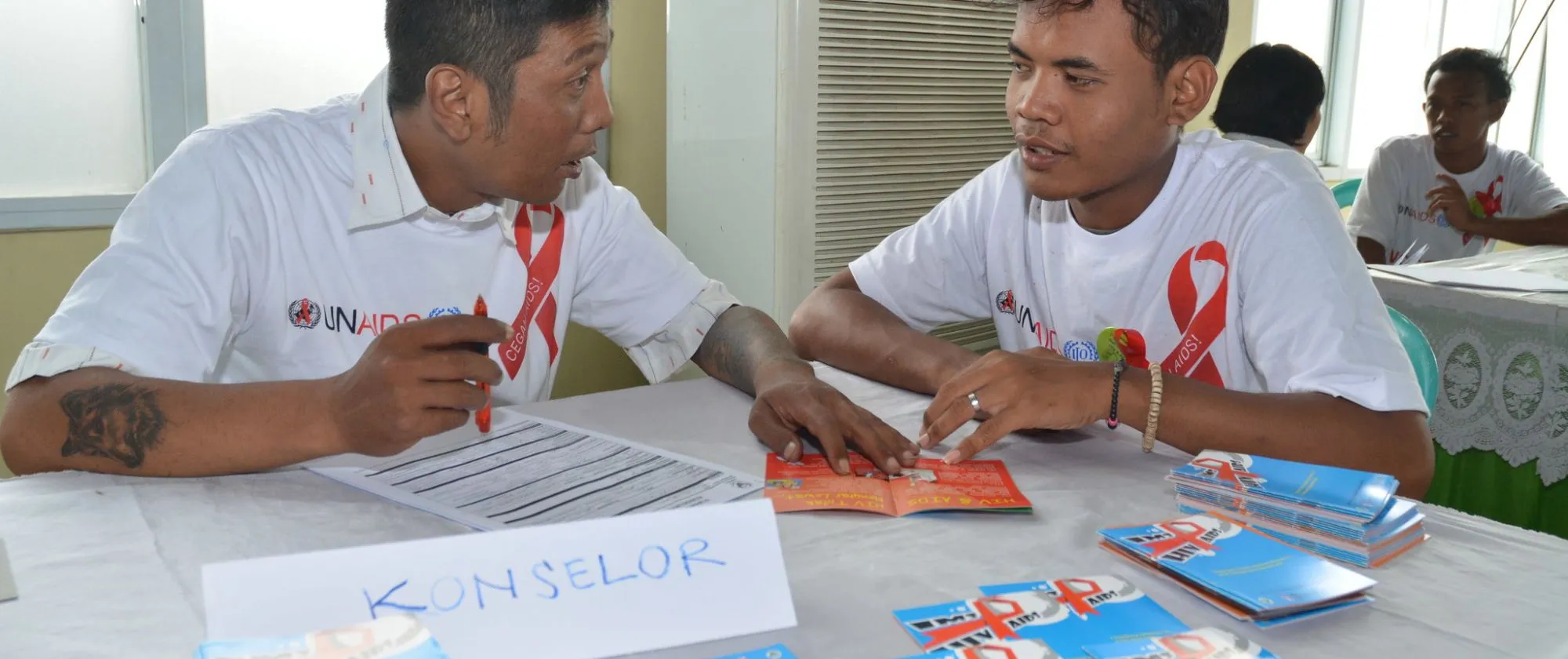
HIV and AIDS Workplace Education Project
The main objective of the project is to contribute to the reduction of employment-related discrimination against people living with or Affected by HIV and AIDS and the reduction of HIV and AIDS risk behaviours among targeted workers.
Duration
1 January 2005 - 31 December 2008
Development partner(s)
United States Department of Labour (USDOL)
Additional details
Project background
- Since the first HIV and AIDS case was reported in 1987, the number of people living with HIV and AIDS in Indonesia has increased dramatically. The Ministry of Health estimated in 2006 that between 169,000 and 216,000 people were living with HIV in Indonesia, and it is estimated that another 4 to 8 million people are at high risk of being infected with HIV.
- Eighty percent of the people living with HIV and AIDS are in their productive years. The HIV and AIDS epidemic affects all levels of society, but especially vulnerable groups such as women, children and poor people.
- HIV and AIDS also affect the world of work in many ways:
- It reduces the labour supply, leading to economic losses and reduced incomes;
- It reduces the number of skilled and trained workers;
- It contributes to a reduction in the productivity of workers, including those in the agriculture sector;
- It raises business costs because of the need to continuously recruit, train, and re-train staff;
- Stigma and discrimination against people with HIV and AIDS directly violates fundamental human, and labour, rights principles, and undermines efforts for prevention and care.
Project rationale and description
The workplace is one of the most important and effective points for tackling the epidemic, because it is where working people come together. It is also an efficient and cost-effective focal point for intervention to limit the spread of infection and mitigate its impacts.
The HIV and AIDS Workplace Programme includes:
- Prevention, especially through awareness-raising and behaviour change interventions (BCI);
- A written workplace policy with a pledge on non-discrimination; and
- Elements of care and support.
The targeted beneficiaries are workers and workplaces in some of the provinces that have shown the highest rates of infection to date.
Project strategies
To achieve these objectives, the ILO HIV and AIDS Workplace Education Project is assisting the Ministry of Manpower, the Indonesian Employers’ Association (Apindo), trade unions, pilot enterprises and PLWHA networks to:
- Improve policies and standards on HIV AND AIDS in the workplace;
- Implement behaviour change communication (BCC) in the workplace;
- Monitor and evaluate progress; and
- Coordinate.
Key partners
- Ministry of Manpower and Transmigration
- National Agency for Placement and Protection of Indonesian Overseas Workers (BNP2TKI)
- Ministry of Health
- AIDS Commission at the national, provincial and district level
- Indonesian Employers’ Association (Apindo)
- Migrant Workers’ Employment Agencies Association (APJATI)
- Trade unions
- Association of Medical Clinics for Indonesian Overseas Migrant Workers (Hiptek)
- Indonesian Migrant Workers Union (SBMI)
- Enterprises
- Network of People Living with HIV and AIDS
- NGOs
Achievements to date
- Operational guidelines issued for the implementation of Ministerial Decree 68/2004 on HIV Prevention in the Workplace.
- Workplace interventions placed as a priority within the National AIDS Strategy 2007 – 2010.
- Advocacy tools developed and implemented by Apindo to mobilize commitments from enterprises through cost-benefit analysis for the implementation of HIV workplace programmes.
- Tools developed and implemented by Apindo to implement HIV workplace programme through human resource and occupational safety and health systems.
- 103 Apindo member companies in six provinces implementing HIV workplace education for 55,804 workers.
- Tools developed by three trade union confederations on social dialogue for HIV workplace programmes.
- 27 trade union trainers providing HIV prevention education to 4,050 members.
- 20 PLWHA trained as facilitators for dialogues on eliminating stigma and discrimination in the workplace.
- Apindo participating as a member of the Indonesia Country Coordinating Mechanism (CCM) for the Global Fund for AIDS, TB and Malaria.
- Working groups on HIV and AIDS in the workplace established in five provincial and eight district AIDS Commissions; each working group has tripartite membership.
- Performance Monitoring Plan (PMP) indicators adapted as the national indicators for HIV and AIDS workplace education.
- Research done on knowledge, attitudes and practices (KAP) of workers in Batam and East Java, and on the progress of the implementation of the Ministerial Decree 68/2004.
Related content

Project Brief: HIV and AIDS in the World of Work