

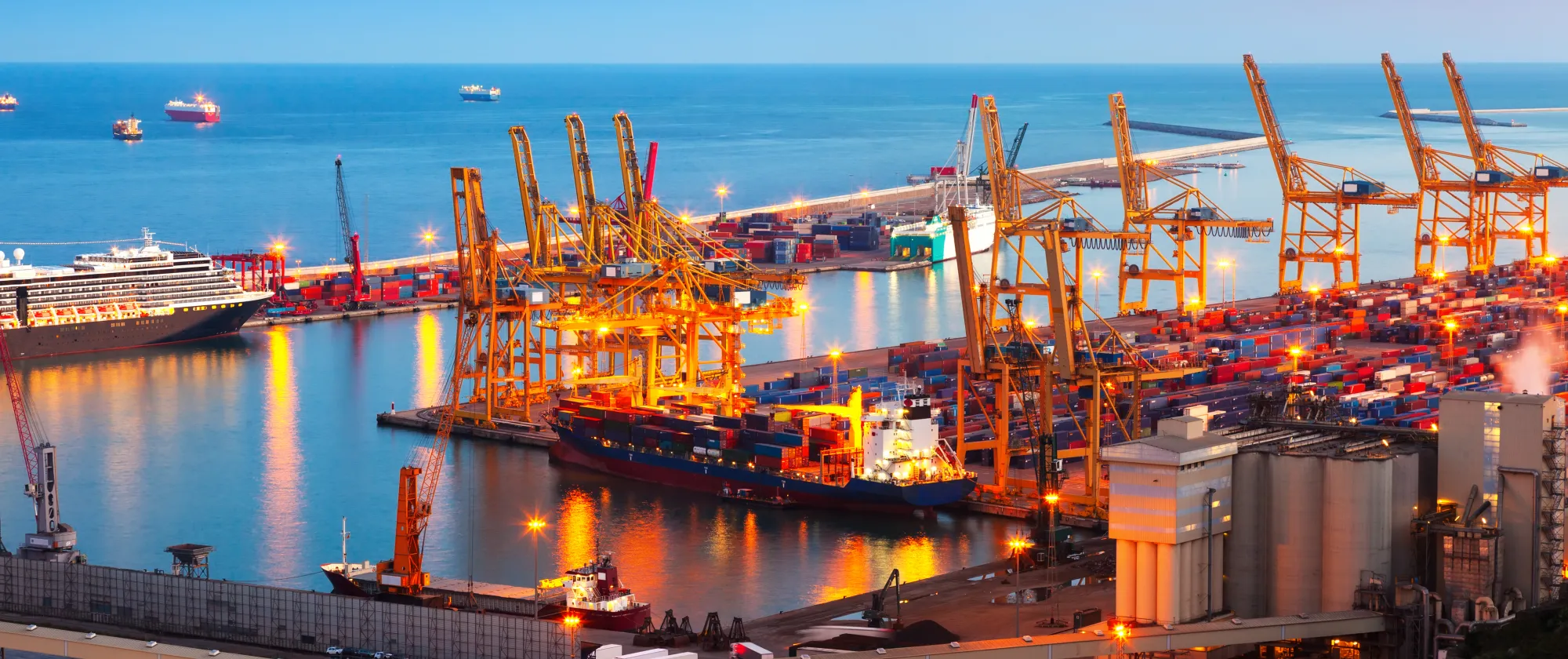
Portworker Development Programme
25 March 2026
Why Training Matters
The international port industry dates from the earliest days of civilization. While technical developments since the 1960s—such as containers and roll-on roll-off ("ro-ro") systems—have improved safety, port work is still regarded as an occupation with very high accident rates. As privatization increases the use of non-permanent workers, the need for investment in the training and skills of portworkers has been increasingly recognized to manage risks and improve performance. In response to these critical needs, the ILO devised and implemented a global training programme which became known as the Portworker Development Programme (PDP).
International Standards & Global Benchmarks
The ILO's technical co-operation is guided by established international instruments and essential benchmarks that define global best practices:
Convention No. 137 & Recommendation No. 145: Provisions for vocational training and retraining of portworkers in response to cargo handling technology.
Convention No. 152 & Recommendation No. 160: Requirements for the provision of information, training, and supervision to protect portworkers against risks.
Evolution of Global Training Standards
Since its inception, the PDP has established effective and systematic portworker training schemes worldwide.
- PDP I (Container Terminals): Launched in the 1989 as a pilot project financed by the Government of the Kingdom of the Netherlands, it involved the preparation and testing of 30 units pertaining to container operations. After revisions in 2004, 2005, and 2011, it has been adopted over 70 organizations in more than 50 countries worldwide.
- PDP II (Bulk Terminals): Leveraging the success of PDP I, the ILO initiated this programme for bulk cargo with the support of the Government of the Republic of Korea starting in 2014. By 2019, it developed 10 units for 5 major dry bulks, focusing on occupational safety, health, and environmental issues where a lack of training poses high risks. The ILO has been intensifying efforts to disseminate the programme globally through a sustained partnership with the Korean Government.
Contact information
- Contact: [email protected]
Application form
Interested governments, port authorities, terminal operators, or academic institutions in the port sector can contact the ILO to request PDP materials.
Materials available: PDP I (English or Spanish) / PDP II (English)
Related content
Sector portal
Ports and logistics
Portworker Development Programme I (Container terminal)

Portworker Development Programme II (Bulk terminal)