Webinar
Youth NEETs on the Rise: Understanding the Trends, What Drives Them and Effective Solutions
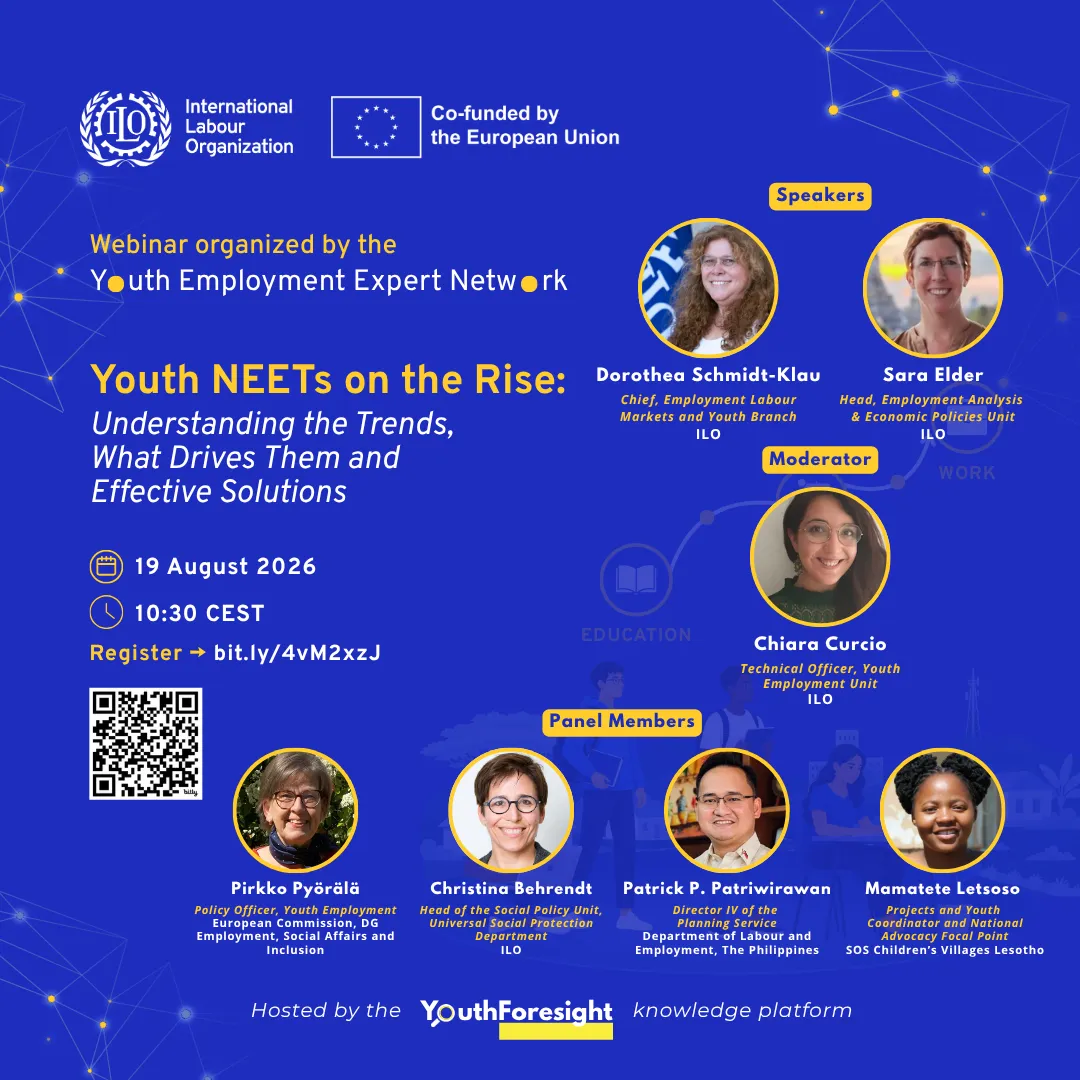
The EU–ILO Network of Youth Employment Experts organized an online learning webinar exploring the latest global and regional trends affecting young people who are not in employment, education or training (NEET), and the policy and practical responses that can support their transitions into education, training and decent work. Drawing on findings from the ILO’s Global Employment Trends for Youth 2026, the webinar connected the latest evidence with country realities and perspectives from policy, social protection, employment services and grassroots practice.
Event Summary
The EU–ILO Network of Youth Employment Experts organized an online learning webinar exploring the latest global and regional trends affecting young people who are not in employment, education or training (NEET), as well as policy and practical responses to support their transitions into education, training and decent work.
Drawing on findings from the ILO’s Global Employment Trends for Youth 2026, the webinar connected the latest evidence with country realities and brought together perspectives from policy, social protection, employment services, and grassroots practice.
Opening the discussion, Dorothea Schmidt-Klau, Chief of the Employment, Labour Markets and Youth (EMPLAB) Branch at the ILO, framed the webinar as an opportunity to translate evidence into action: “I really hope today gives us a chance to move from diagnostics to responses.”
Presenting findings from the ILO’s Global Employment Trends for Youth 2026, Sara Elder, Head of the Employment Analysis and Economic Policies Unit at the ILO, highlighted that progress in youth labour markets has stalled, with youth unemployment and NEET rates rising again. The scale of the challenge extends well beyond unemployment: around 67 million young people are unemployed, compared with 257 million young people in NEET status. She stressed the need to “do more to bolster the shaky foundations of labor market transitions so that young people can have a better chance.”
The presentation also highlighted important differences across regions and countries, persistent gender inequalities, the effects of weak job creation and changing labour market demands, and the need to recognise that young NEETs are a diverse group requiring different forms of support.
Participants then exchanged experiences through breakout room discussions and an interactive reflection session, bringing country perspectives into the conversation before moving from trends to solutions.
In the panel discussion, Pirkko Pyörälä, Policy Officer for Youth Employment at the European Commission’s DG Employment, Social Affairs and Inclusion, shared lessons from the EU Youth Guarantee, emphasizing that effective support starts with understanding whom policies need to reach: “We have to know who the young people are.” She highlighted an approach combining mapping, outreach, guidance, individual action plans and tailored opportunities, supported by partnerships across employment, education, health and social services.
From the Philippines, Patrick P. Patriwirawan, Jr., Director IV of the Planning Service at the Department of Labor and Employment, highlighted the challenges of reaching young people disconnected from both school and formal employment services. As he explained, “A lower participation rate is not inherently negative if more young people remain in education. However, it becomes a critical policy challenge when they drop out of both education and the labor market entirely.” He shared how public employment services are moving towards proactive community-based outreach, digital service delivery and recognised skills certification to connect young people with opportunities.
Bringing a grassroots perspective, Mamatete Bridget Letsoso, Projects and Youth Coordinator and National Advocacy Focal Person at SOS Children’s Villages Lesotho, stressed the importance of designing responses around the realities of young people themselves: “Policies should be community based. They should respond to realities of the vulnerable young people and the caregivers.” Her intervention highlighted youth participation, vocational skills, entrepreneurship, mentorship and partnerships as important elements in supporting vulnerable young people.
Finally, Christina Behrendt, Head of the Social Policy Unit in the ILO’s Universal Social Protection Department, challenged the idea that social protection should only become available once a young person secures employment. Instead, she argued that support should accompany young people throughout their transition into work: “It’s really something that needs to be there from the first day.” She highlighted the importance of universal social protection and integrated approaches linking employment, social protection, care and other relevant policies.
Across the discussion, a common message emerged: reducing youth NEET rates requires integrated, targeted and locally adapted approaches that combine outreach, skills development, employment services, social protection, youth participation and strong partnerships.
Watch the recording here: Youth NEETs on the Rise - Webinar 19 August 2026
Key Takeaways
🔹 The NEET challenge extends far beyond unemployment. Many young people are outside both the labour market and education or training systems, requiring responses that go beyond traditional employment services.
🔹 Young NEETs are a diverse group. Their circumstances and barriers vary considerably, requiring tailored approaches to outreach, engagement and support.
🔹 Gender remains a critical dimension. Young women account for more than two-thirds of young NEETs globally, with inactivity and unpaid care responsibilities continuing to play an important role.
🔹 Reaching young people is often the first challenge. Young people disconnected from education and formal employment channels may also be invisible to conventional administrative and recruitment systems.
🔹 Integrated approaches matter. Employment services, skills development, social protection, community-based outreach and partnerships need to work together to support sustainable transitions into decent work.
Stay Connected
Interested in staying engaged beyond the webinar?
Join the EU–ILO Network of Youth Employment Experts to connect with peers, share knowledge and participate in future learning and collaboration opportunities.
In the Network space, we will keep up the engagement on youth NEETs, follow up on questions raised during the webinar, and share further insights, resources and opportunities around this and other youth employment topics.
Become a Network Member: Apply here