

Formalization of the Informal Economy Project
Workshop for Trade Union Federations staff and self-employed workers
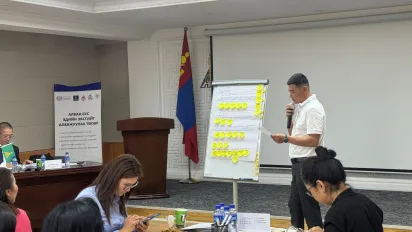
ILO- Formalization of the Informal Economy Project in Mongolia organized workshop in Orkhon province on 5 June 2024. The workshop was organized in collaboration with the Confederation of Mongolian Trade Union (CMTU).

For the first half of the workshop, 22 participants from provincial trade union federations of the five northern provinces took part. The main topics of the workshop were “Relevant laws and regulations for informal economy workers” presented by the General Secretary of CMTU, Kh.Buyanjargal, and “Benefits and services offered to members of the Trade Union Federations” presented by the Head of the Department of Human Rights and Law, M. Sarantsatsral, CMTU.
M. Sarantsatsral also presented “Organizing informal economy workers in the trade unions” and the directors of five provincial trade union federations also shared their views on protecting informal workers’ interests in the provincial tripartite agreements. National Project Coordinator, D. Munkhtogtokh presented "Integrated approaches to formalization" and "The benefits of formalization and practical guidance on expanding membership coverage".

For the second half of the workshop, 48 participants, including the trade unions staff and the self- employed workers of Orkhon province, participated.
Kh.Buyanjargal noted that In Mongolia, there are around 1.2 million employees, and 215.4 thousand people work in the informal sector, excluding the agriculture sector. These people in the informal sector are not covered by the social protection. They also have limited opportunities to get loans from banks and other financial institutions. Therefore, extending social insurance coverage, sharing knowledge, and raising awareness regarding the formalization of the informal economy will have a positive effect on solving these issues.
Participants and self-employed workers were divided into groups and shared their opinions and the obstacles they faced while running their business activities. These include legal knowledge, business planning, right of freedom of association, occupational safety and health issues, public and private partnership, and lease agreement.
During the workshop, representatives of self-employed workers also expressed the importance of understanding the legal environment and its regulations.
Target groups:
- Provincial Trade Union Federations staff of Selenge, Bulgan, Khuvsgul, Darkhan-Uul, and Orkhon provinces.
- Informal workers in the retail trade and service sectors of Orkhon province.
Language: Mongolian
Resource material: A Trade Union Guide-Organising Informal Economy Workers into Trade Unions, ACTRAV, Bureau for Workers’ Activities, 2019 (version: English and Mongolian)
Related content

Formalization of the Informal Economy Project
Fostering the Transition to Formality of Informal Workers and Economic Units in Mongolia
Formalization of the Informal Economy Project
Training on extending social insurance coverage for workers in the informal economy
Relevant projects
Formalization of the Informal Economy Project
Fostering the Transition to Formality of Informal Workers and Economic Units in Mongolia