

Workshop on Role of Trade Unions on Job Creation Issues in Indonesia
Based on Presidential Instruction No. 9/2016 on the revitalization of vocational education to improve the competitiveness and quality of workforce, five ministers signed a MoU on 29 November 2016. The MoU outlined a commitment to better align industries to competency-based vocational education and training.
Background
Based on Presidential Instruction No. 9/2016 on the revitalization of vocational education to improve the competitiveness and quality of workforce, five ministers signed a MoU on 29 November 2016. The MoU outlined a commitment to better align industries to competency-based vocational education and training. The five emplministries involved are the Ministry of Industry, Ministry of Education and Culture, Ministry of Research, Technology and Higher Education, Ministry of Labour, and Ministry of State-owned Enterprises.Recently ILO Jakarta has facilitated the trade union confederations to develop a joint action on decent work priorities, in which Trade Union has divided into three working groups based on the topics in Decent Work Country Program and one of the working group focus on Job Creation. The Job Creation group was developed in the context that traditionally trade union more concern with industrial relation and social protection issues. On other hand, as a matter of fact the current megatrends such as labour market flexibility, digitalization, technology, etc will lead to the fourth generation of industrial revolution (industry 4.0) which in turn the change the world of work. Considering this rapid change and chalange, the team will be focused on the important of Public Employment Services to provide better information and opportunities for job seekers.
Public Employment services plays very important role to help workers enter the labour market, to facilitate labour market adjustments, and to cushion the impact of economic transitions. Their function is even more relevant in the current dynamics of the labour market with rapid development in technology. The working group has also identified that there are two issues under Public Employment Services that important to be discussed in more detail: a. Vocational Skill Training and b. National apprenticeship program.
Human resource development is the key priority for the Government of Indonesia (GoI) this year. With the rapid changes in the world of work due to technological development and while employment in manufacturing sector stalled, the challenge of ‘leapfrogging’ from low skill agrarian to high skill service sector economies is daunting for Indonesia. The employment challenge is further exacerbated by important gaps in quality education, demonstrated by large out-of-school numbers, low schooling rates and high unemployment rates among the relatively educated. Technical and vocational education and training (TVET) opens up an opportunity to improve poor education and labour market outcomes of youth, particularly those from lower socio-economic backgrounds.
The GoI recognizes this opportunity with the launch in December 2017 of vocational road map, focusing in six sectors: manufacturing, agribusiness, tourism, health, migrant workers and digital economy. Improving TVET and ensuring the acquisition and adoption of the right knowledge and skills to real workplace and industrial issues will support enterprises’ expansion and business growth. It is thus, of high importance, for the GoI to strengthen school-to-work transition and improving the employment outcome of vocational education and training for both women and men.
National Apprenticeship. A renewed attempt was made in December 2016 with the (re-)launch of the national apprenticeship program by the President with a revised government regulation on apprenticeship (No. 36/2016) to provide more opportunities and alternatives for job seekers to improve their competencies and skill transition from education to workforce. However, while the importance and potential of apprenticeship as a means of facilitating youth employment has been recognized, apprenticeship remains a controversial subject in the country as the term for apprenticeship, ‘Pemagangan’, has been opened to interpretation and often been a subject of misuse. The unclear models of national apprenticeship programs remains and is considered to be one of the main reasons holding back an up-scaling of the program and against by Trade Unions.
Together with Job Creation working group, ILO will hold one day workshop to socialise Public Employment Service and challenges relate to it including the importance of vocational training and national apprenticeship program. The workshop will also mainstream two components into the job creation issues: improving access for women and people with disability, which currently being mainstreamed by the ILO through existing projects and programmes.
Objective
The objective of the TOR are as follows:- Conduct socialization to Trade Unions on Public Employment Services and focus on two challenges and opportunities: Vocational Skill Training and National Apprenticeship Program.
- Provide input to the position paper on Job Creation Working Group.
Expected outputs
- Understanding on the Public Employment Service and challenges as well as opportunities.
- Inputs on the position paper on Job Creation.
Related content

Women in STEM Workforce Readiness and Development Programme in Indonesia
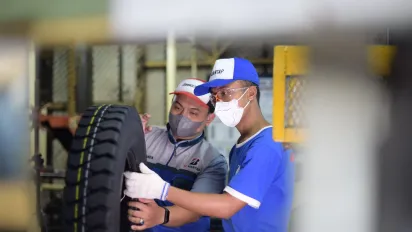
Piloting National Apprenticeship Programme in Indonesia
Relevant projects
Piloting National Apprenticeship Programme in Indonesia
Women in STEM Workforce Readiness and Development Programme in Indonesia

Enterprise development and skills
Women in STEM Workforce Readiness and Development Programme in the Philippines
Enterprise development and skills
Women in STEM Workforce Readiness and Development Programme