

Digitalisation and migrant work
11th ASEAN Forum on Migrant Labour
The 11th ASEAN Forum on Labour Migration (AFML) is convened and hosted by the Government of Singapore with the support of the ASEAN Secretariat, ILO, IOM, UN Women and the Taskforce on ASEAN Migrant Workers.
In line with Singapore’s 2018 ASEAN Chairmanship theme of “Resilience and Innovation,” the 11th AFML focused on “Digitalisation to Promote Decent Work for Migrant Workers in ASEAN”. To ensure that discussions were targeted, the 11th AFML was scoped into two sub-themes:
- Theme 1: Digitalization of migrant labour management
- Theme 2: Digital services to migrant workers
Digital technology continues to expand and integrate the world in new and innovative ways. It can also play a significant role in advancing decent work and the protection and promotion of the rights of migrant workers. Used properly, technology can enhance migrant workers’ agency to make more informed decisions and better understand their rights. For instance, digital technology can be used to: provide online platforms for reviewing and rating recruitment agencies or employers; connect workers to each other to enable sharing information or advocating collectively; increase information and access to resources and services, including legal redress; as well as improve and increase transparency of data and information for migrants, employers, and other stakeholders. Many governments are also setting up digital platforms for migration management and providing services. Such services may include online pre-departure training to migrant workers, as well as issuance of smart cards that provide social insurance and other services and benefits to migrants upon departure, in country of destination, and upon return. In addition, helpful apps are being developed to allow workers to seek assistance or report workplace safety breaches, and to aid the work of labour inspectors.
While technology can provide many advantages, there are also risks and limitations. Digital technology brings challenges with confidentiality, privacy, and data protection. Additionally, access to digital technology may be limited in some areas, for instance in countries facing low internet connectivity or less-advanced financial systems, or for specific populations, for example based on income-level or gender. Migrant workers may also face unique challenges, such as barriers to keeping mobile phones in work environments or less access to technology and the internet in destination countries.
Leveraging digitalization to protect the rights of migrant workers and promote decent work requires an improved understanding of digital technology as well as an improved understanding of the rapidly changing world of work and the future of work.
Related content

TRIANGLE in ASEAN
The ASEAN Forum on Migrant Labour

Migrant workers
TRIANGLE in ASEAN
TRIANGLE in ASEAN events and meetings
Labour migration
Recommendations of the 11th ASEAN Forum on Migrant Labor
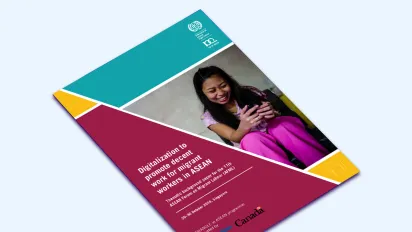
Digitalization to promote decent work for migrant workers in ASEAN

Migrant workers
Implementation of recommendations from the 3rd to 10th ASEAN Forum on Migrant Labour (AFML)
Relevant projects
Migrant workers
TRIANGLE in ASEAN
Migration
TRIANGLE in ASEAN – Thailand
Migration
TRIANGLE in ASEAN – Myanmar
Migration
TRIANGLE in ASEAN – Lao People’s Democratic Republic