

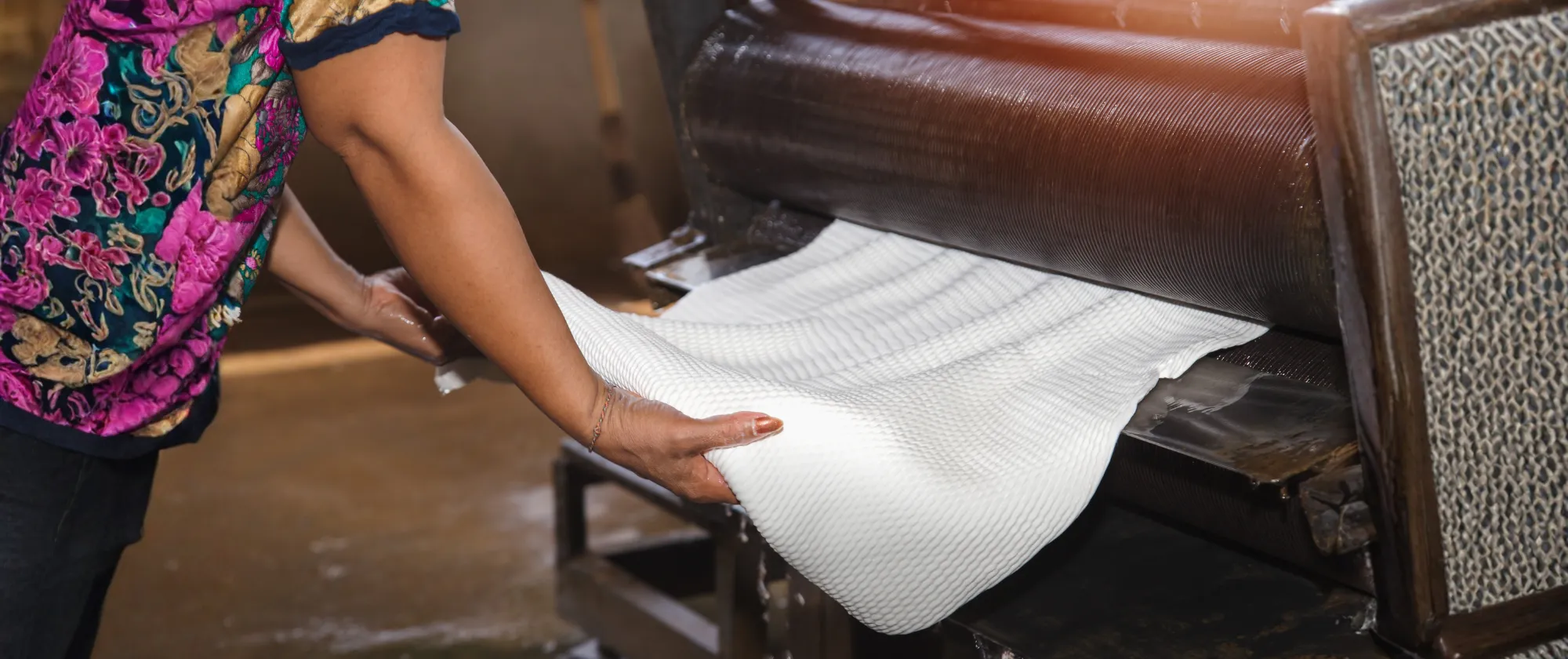
Strengthening Fundamental Principles and Rights at Work (FPRW) and Trade Readiness in Thailand
The three-year initiative aims to bring Thailand’s labour practices in line with international standards and strengthen core labour rights in Thailand’s rubber supply chain, focusing on freedom of association, collective bargaining, the elimination of child labour and occupational safety and health.
Duration
26 February 2025 - 25 February 2028
Budget
CAD$ 2 million (approx. US$ 1.453 million)
Development partner(s)
Employment and Social Development Canada (ESDC), Government of Canada
Reference
THA/24/01/CAN
Location
Thailand
Project overview
While Thailand has seen rapid economic growth and integration into global supply chains, challenges in protecting workers' rights persist, especially within the agricultural and informal sectors. The Government of Canada’s Employment and Social Development Canada (ESDC)-funded Fundamental Principles and Rights at Work (FPRW) and Trade Readiness project seeks to strengthen the application of FPRW in Thailand. The project aims to align national labour practices with international labour standards, which is crucial in the context of Free Trade Agreements (FTAs) and evolving supply chain expectations.
The project will specifically address key areas of FPRW for trade readiness such as freedom of association, collective bargaining, the elimination of child labour, and occupational safety and health (OSH) within Thailand’s rubber supply chain. To achieve its objectives, the project will support the ratification and implementation of the ILO fundamental conventions, improve institutional and legal frameworks, and enhance the capacity of government, employers, and workers through focused technical assistance and trainings. It also aims to foster meaningful social dialogue and collaboration across sectors. By sharing knowledge and best practices in the rubber supply chain, the project will help promote decent work and boost Thailand’s competitiveness and trade readiness in global markets.
Project approaches
- Tripartite engagement: Promoting ratification and application of ILO Conventions No. 87, 98 and 155 through legal reviews, technical consultations, trainings and engagement with government, employers and workers’ organizations.
- Capacity building and institutional strengthening: Enhancing the skills and knowledge of labour inspectors, government officials and social partners on FPRW, OSH and child labour through targeted trainings, mentoring and technical support.
- Sectoral interventions in the rubber supply chain: Addressing labour rights and formalization by supporting and enhancing union capacity, strengthening employers and EBMO’s positions, facilitating collective bargaining and promoting decent work practices across the supply chain.
- Development of tools and public awareness: Developing practical tools and conduct public outreach to support FPRW compliance at the enterprise level.
Expected project outcomes
- Mechanisms to promote FPRW are strengthened and applied in law and practice, including through the promotion of ratification of fundamental conventions on freedom of association (FOA), collective bargaining (CB) and occupational safety and health (OSH).
- The National Plan of Action (NPA) on the Elimination of Child Labour is implemented more inclusively and effectively, particularly in the trade sector, through strengthened ILO constituent capacity and improved data collection via the National Child Labour Survey.
- Enterprises increase their awareness of FPRW compliance obligations and adopt tools that support application.
- Social dialogue and institutional capacity are strengthened to improve labour relations, promote FPRW and expand quality employment, focusing on the rubber supply chain.
- Safe and healthy working environments are promoted and realized at both national and workplace levels, addressing traditional and emerging risk factors, in line with ILO Convention No. 155 and 187.
Related content
ILO and Canada launch project to strengthen Thailand’s rubber sector

Occupational safety and health
Trade unions take a significant step forward to realise a safe and healthy working environment in Thailand
Occupational safety and health
Workers in Thailand’s rubber sector strengthen their role in workplace safety and health