

All publications: informal employment + informal enterprises + informal economy
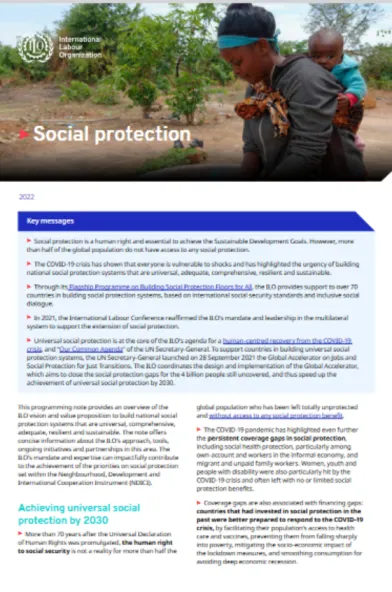
Factsheet
Social protection

What is the Formalize Your Business training and how does it contribute to decent work?
Report
Youth employment in Turkey: Structural challenges and impact of the pandemic on Turkish and Syrian youth
ILO Working Paper 69
Growth, economic structure and informality
This paper explores the relationship between economic growth and informality and highlights the role of GDP growth and its composition in the level and evolution of informality, using country data from 1991 to 2019.
ILO Monitor on the world of work. 9th edition
The report gives a global overview of how countries are tackling an uneven labour market recovery that has been further undermined by developments such as the Russian aggression against Ukraine, increases in inflation, and continuing strict COVID-19...

Vulnerabilities to child labour
Identifying particularly vulnerable groups of children and their specific needs is essential for the elimination of child labour. This brief brings together the key findings from four studies that each address a key area of vulnerability to child...

YEAP 2020-2030
ILO’s Youth Employment Action Plan (YEAP) 2020-30
Labour Overview series for Latin America and the Caribbean 2021
2021 Labour Overview of Latin America and the Caribbean
Nearly two years after the onset of the COVID-19 pandemic, in the third quarter of 2021, the employment rate and economic participation rate were still lower than the 2019 records, while the unemployment rate was higher than in that year. The 2021...

Enabling Environment for Sustainable Enterprises (EESE) in fragile contexts
In the wake of conflict or disaster, decent work is often considered as a secondary priority, when it can be the key to resolving many of the drivers of conflict and can be instrumental to restoring peace and resilience. Employment and...
Publication
Understanding patterns of structural discrimination of migrant and other workers in some countries of South and West Asia
This background paper reviews the literature that sheds light on the structural patterns of discrimination against migrant workers in some countries of South and West Asia. It also articulates recommendations that would help officials in UN...
A review of country data
Impact of the Covid-19 pandemic on informality: Has informal employment increased or decreased?
Concept Note: Unpacking concepts of freedom and unfreedom in the world of work

The ILO’s LEED+ Approach
Strengthening women's economic empowerment and access to Decent Work in Sri Lanka's Northern province
At the core of women's economic empowerment is access and agency; while access to skills, resources, services, and market opportunities is one aspect of advancement, the other, agency is about the power of decision-making. This document provides a...

ILO Working paper 49
How to strengthen informal apprenticeship systems for a better future of work?: Lessons learned from comparative analysis of country cases
This paper undertakes a meta study on informal apprenticeship in developing countries. It compares the findings of country-level research conducted by the ILO and others in the past 15 years to shed more light on apprenticeship systems in the...
ILO Working paper 50
Crowdwork for young people: Risks and opportunities
This report examines the risks and opportunities of crowdwork for young people, exploring their experiences on digital labour platforms. It considers working conditions, income, skills development and employment prospects, and discusses how...
Concept Note: Consultative meeting with the Small Tea Growers on Promoting Occupational Safety and Health in the Workplace

Brief
When OSH is Good for Business
A Guidance Note on Using Market Systems Development to Advance Occupational Safety and Health among MSMEs
Identifying barriers to formalization
A snapshot of key challenges in South Africa’s informal economy, including in times of Covid-19, and suggested measures on how to get policies and incentive structures right
Report
World Employment and Social Outlook: Trends 2022
This ILO flagship report details the effects of the COVID-19 crisis on the world of work.
EESE Report
A comparative analysis from the EESE programme in Zambia, Honduras, Montenegro, Sierra Leone and Mozambique: key findings and lessons...
The five case studies look back on the EESE process in specific countries to document how the assessment was conducted, which stakeholders were involved, what recommendations and action plans were issued as a result of the assessment, and how these...
10 of 32