

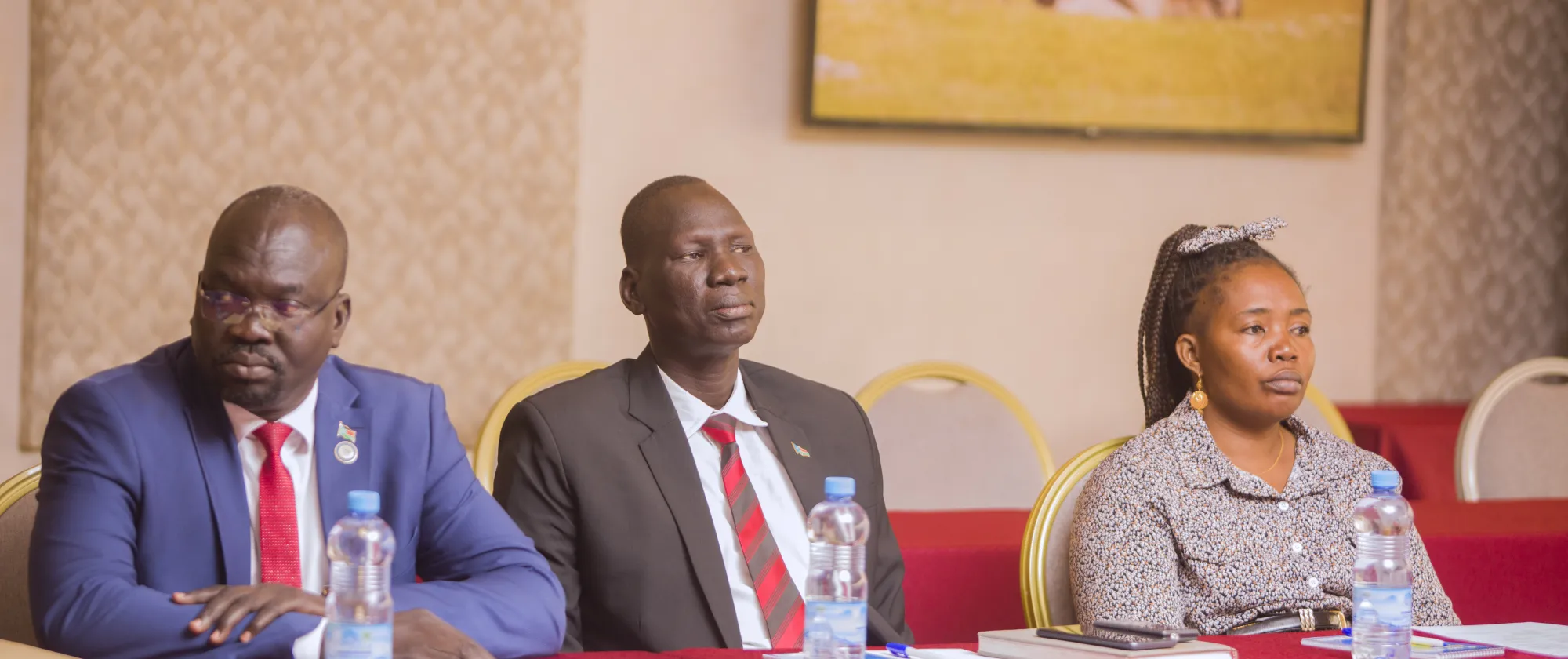
South Sudan Leaders Capacity Strengthened on Labour Migration
A two-day Tripartite Executive Roundtable in Juba. The gathering marked a major step on capacity building on labour migration governance in South Sudan
23 June 2025
On 24–25 March 2025, South Sudan’s Ministry of Labour, in partnership with the International Labour Organization (ILO) under the Better Regional Migration Management (BRMM) programme funded by the UK Foreign, Commonwealth and Development Office (FCDO), convened a two-day Tripartite Executive Roundtable in Juba. The gathering marked a major step on capacity building on labour migration governance in South Sudan by bringing together state and national leaders, employers and workers representatives to align on priorities, share expertise, and chart a way forward for stronger policy and institutional coordination on labour migration.
With 42 participants from 10 states and administrative areas, the event was designed not only to raise awareness of international labour standards and migration frameworks, but also to promote a collective understanding of how labour migration affects South Sudan’s social and economic development. The roundtable’s core outcome was a unified national position on key policy elements of labour migration governance, as well as a shared commitment to protect the rights of both outbound and inbound migrant workers.
The event was officially opened with remarks from the Minister of Labour, Gen. James Hoth Mai, who emphasized the urgent need to shift public perception of migrant workers, especially women, and to ensure that legal protections are extended to all. He reaffirmed the government’s dedication to ratifying ILO Conventions 97, 143, 181, and 189, and called for stronger data systems and fair recruitment process to mitigate irregular migration. The ILO’s Labour Migration and Mobility Specialist, Ms. Aurelia Segatti, highlighted South Sudan’s unique context as both a country of origin and destination and stressed the importance of rights-based governance rooted in international standards and fair recruitment practices.
Throughout the two days, participants worked through a packed agenda that blended technical presentations with participatory dialogue. A key highlight was the in-depth review of labour migration trends at global, continental, and regional levels. Participants gained new insights into how South Sudan’s migration dynamics fit into broader regional labour mobility patterns, particularly in East Africa, where migration is largely intraregional. These discussions helped situate the country’s challenges including irregular migration, weak regulation and limited data, within a global context, reinforcing the urgency for policy coherence and better enforcement mechanisms.
The workshop, further, surfaced critical data gaps and implementation barriers, especially at state-level labour offices. However, it also identified concrete pathways forward. These included expanding the use of bilateral labour migration agreements (BLMAs), improving licensing and oversight of private employment agencies, and investing in vocational training to make South Sudanese workers more competitive in regional and international labour markets.
The panel discussion on the economic and social impact of labour migration served as a turning point in shaping stakeholder commitments. Representatives from the Ministry of Foreign Affairs, the Employers’ Association of South Sudan (EASS), and the South Sudan Workers Trade Union Federation (SSWTUF) reflected on the role of migrant workers in sectors like construction, hospitality, and domestic work, and underscored the potential for remittances and skills transfer to drive inclusive growth.
The roundtable concluded with strong commitments from all stakeholders. Government, employers, and workers’ groups committed to strengthen institutional collaboration, build capacity at sub-national levels, and continue high-level dialogue. A call was also made to formalize this forum and hold regular meetings to ensure that labour migration governance evolves with the country’s needs. The Undersecretary of Labour, Madam Mary Pitia, reiterated the Ministry’s responsibility in leading the implementation of agreed reforms and emphasized the need to institutionalize staff training, better regulate recruitment practices, and build legal frameworks grounded in international conventions.
Relevant projects

East and Horn of Africa
Better Regional Migration Management