

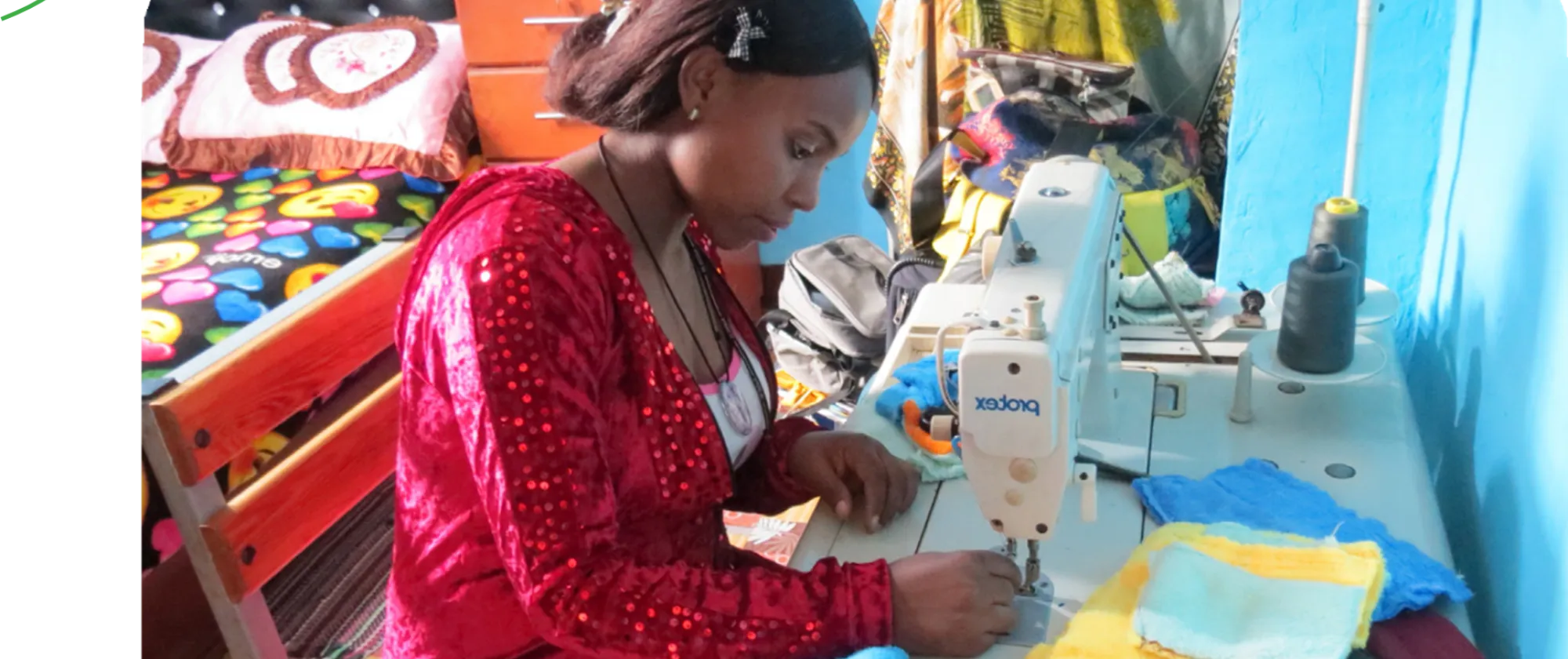
Aster Dosha’s Story of Courage and Entrepreneurship
A 33-year-old woman from Addis Ababa changed adversity into opportunity after years of hardship as a migrant domestic worker in the Gulf and Lebanon.
25 April 2025
Aster Dosha is a 33-year-old married woman who was born and raised in Shiro Meda, a locality in Addis Ababa, Ethiopia. She is the fourth child in her family. Aster attended Amaha Desta Primary School and subsequently enrolled at Etege Menen Secondary School. However, she dropped out in the 10th grade in 2007 due to the pressing need to support her family, who did not have much. Growing up in a household where resources were scarce, Aster witnessed the challenges of poverty and the struggle to secure basic needs firsthand. The decision to leave her home country came at an early age, driven by the reality that finding work as a dropout in Ethiopia would be extremely difficult. Hence, with a desire to improve her financial situation and that of her family, she set her sights on opportunities beyond Ethiopia. Inspired by the few success stories of neighbours who had travelled overseas, she began exploring job prospects in the Arab countries.
Due to her family’s severe economic situation, she was unable to afford a passport or the necessary administrative fee to travel. However, recognising the potential benefits of a better future, Aster’s mother sold her gold necklace for 10,000 Birr to cover her travel expenses. With this support, Aster embarked on her journey and, in 2017, arrived in Dubai, United Arab Emirates.
In Dubai, Aster started working as a caregiver in a household, where her primary responsibility was being a babysitter for two years. The work was demanding, and she faced conditions that were harsh. Despite these hardships, she was able to support her family back in Ethiopia by sending her salary on a monthly basis. As a result, despite working abroad, she was unable to save any money. After two years of hard labour in Dubai, she returned to Ethiopia and spent one year with her family, during which time she got married to her current husband but could not get employment. Still determined to secure a better future for herself and her family, Aster returned back to Dubai and worked for an additional year.
The onset of the COVID-19 pandemic brought about drastic changes in the region, with many Arab countries, including the United Arab Emirates, closing their borders for migrant workers. However, at that time, Lebanon had not yet closed its borders, so Aster travelled to Beirut in 2020. She began working as a domestic worker in a household and continued in this role for about six months. Unfortunately, during her stay, a massive port explosion struck the city, triggering a severe economic collapse. The crisis soon affected her employer, who informed Aster that she could no longer pay her salary or cover her return travel expenses. In a distressing turn of events, Aster was evicted from her employer’s home and left at the door of the Ethiopian Embassy. With the embassy overwhelmed and unable to support all stranded migrants immediately, Aster ended up staying in Lebanon for more than a year following the incident, relying on the temporary shelter arranged by well-wishers and the Ethiopian activist community until her return was eventually facilitated.
Aster recounted the moment with a heavy heart:
I felt abandoned when I was left at the embassy door with no money to return home.
Similar to Aster, many Ethiopian migrants in Beirut were trapped in similar situation due to lack of financial support from their employers and the embassy's inability to cover transportation costs for all migrants. Forced to seek alternative solutions, Aster and others turned to social media to share their situation. A video detailing their situation was circulated among Ethiopian activists, catching the attention of Tamagn Beyene, a well-known Ethiopian activist based in the United States. Mr. Beyene managed to raise money from various sources and secured a rented dormitory for the stranded workers. Through these efforts, transportation expenses were eventually covered, and Aster, along with other Ethiopian migrant domestic workers, were able to return safely to their homeland.
The return to her home country, however, was marked by depression. Aster arrived empty-handed once again. The emotional and psychological scars of her experience abroad were deep, and the feeling of isolation and betrayal lingered. Yet, the challenges she faced did not break her spirit. Rather than succumbing to unemployment and despair, she was determined to rebuild her life and forge a new path.
Having grown up in an environment where weaving and textiles were common, Aster recognised a potential opportunity in the sewing industry. Therefore, she reached out to her older sister, who was working in Dubai, United Arab Emirates, at the time and requested a small loan to help her start anew. After consulting with their mother, her sister sent her a small loan, which served as the seed money for her next venture, namely a clothing sewing business.
Accordingly, with this loan, Aster purchased a sewing machine and enrolled in vocational sewing classes. Over the course of three months, she learned how to make skirts, trousers, shirts, and gowns, she successfully completed the training. Once she finished her training, she rented a small workshop near her home in Addis Ababa and began sewing and repairing old garments. Although the initial venture was not highly profitable and sometimes failed to cover the monthly rent, it signified a big improvement than remaining unemployed.
During her spare time, Aster dedicated herself to further improving her skills by watching sewing tutorials online on platforms like Google and YouTube. One day, while browsing YouTube, she came across a video demonstrating the production of women’s sanitary pads using a sewing machine and other simple raw materials. Inspired by this impactful video, she made her first sanitary pad and tested its functionality. Encouraged by the positive results, she shared her work with her sister and mother, asking for their feedback and recommendations for improvement, and their constructive feedback motivated her to refine the design further.
As word of her new product spread, Aster began promoting her reusable sanitary pads within her community. She approached neighbours, friends, and other women, gradually increasing the acceptability of her product. Customers feedback was essential to her approach; women in her neighbourhood offered valuable suggestions, particularly regarding the quality of the cloth used. By incorporating these suggestions, Aster was able to improve her product, ensuring that it met the market’s needs. In this way, she changed her initial idea into a marketable product that not only provided a source of income but also addressed a local need.
Despite the early success in her sewing venture, she faced a major setback when the workshop she rented was suddenly scheduled for demolition due to the government's Corridor development. The abrupt notice forced her to leave immediately, and she attempted to continue her work from home. Unfortunately, working from home did not yield the same productivity, and her motivation began to wane. The fear of losing her hard-won market and the uncertainty of her future led her to consider the possibility of returning to work abroad, a thought that filled her with dread.
During a period of reflection, Aster encountered a woman from her neighbourhood who was also a returnee. The woman had recommended Aster to join an entrepreneurship training program offered by the Organization for Women in Self Employment (WISE) in partnership with the International Labour Organization (ILO) Better Regional Migration Management (BRMM) Programme funded by the UK Foreign Commonwealth and Development Office (FCDO). Aster was moved by the advice and signed up right away.
During her 15-day SIYB training, one of the first lessons Aster learnt was that everyone possesses unique potential and talents. This realisation changed her perspective on life.
The training showed me the truth in the saying, ‘To those who have, more will be given’
We often think we have nothing, yet we have a lot. Once we acknowledge what we have, even more will come our way,” she said, her voice filled with conviction. The training focused on practical skills in business management, financial literacy, and saving techniques. The training highlights that even small amounts of money when managed effectively, result in tremendous growth over time.
For Aster, the training was much more than just gaining business knowledge, it had a profound impact on her mental well-being and motivation. She felt more confident as she participated in group discussions, shared her experiences, and listened to the insights of others who had faced similar challenges. The supportive environment that the training facilitated allowed her to voice her aspirations and understand that with hard work and proper planning, she could overcome her past setbacks.
After completing the training, Aster applied what she had learnt directly to her business endeavours. She resumed her sanitary pad sewing business with renewed determination, ensuring that her products were of higher quality and more appealing to her customers. In addition, as an additional revenue stream that helped supplement her income, she began to collect fabric scraps from local marketplaces, which she repurposed into pillows.
" no longer dream of moving to Arab countries as before. My heart is set on working hard to change my own country” said Aster with determination in her face. “I have a big dream, and I’m determined to change it into a reality," She proclaimed, signalling a turning point in her mindset.
Encouraged by her sewing accomplishment, Aster decided to expand her business. She plans to invest in a cutting machine and import raw materials for her work in mass. Her long-term vision is to mass-produce female sanitary pads and eventually open a factory that would manufacture a range of products. This expansion would not only secure her own financial future but also create employment opportunities for potential and returned migrant workers in her community.
Despite the progress she had made, she still faces challenges typical of small business owners. The lack of initial savings, the need to rebuild her business network, and the difficulty of securing affordable loans were constant hurdles. However, the mentorship and ongoing support from the ILO, WISE, and related programs provided her with a framework to address these issues. The training introduced her to the concept of savings groups and microfinance, which helped her develop a more disciplined approach to managing her finances. She now participate in savings groups and maintain meticulous records of her income and expenditures, tools that enabled her to plan for future investments and manage risks effectively.
Relevant projects

East and Horn of Africa
Better Regional Migration Management